Six Weird Holidays, Six Quick Card Projects
November Edition: From Pickles to Planets
November is nearly here, and while everyone else is busy preparing for Thanksgiving and Christmas, we’re going to take another little detour through the wonderfully peculiar world of unofficial holidays.
Welcome to the second edition of Six Weird Holidays, Six Quick Card Projects!
If you joined us in October, you already know the idea. We pick six unusual celebrations, turn each into a small creative challenge, and see how many greeting-card possibilities we can squeeze out of them.
No enormous collections required. No weeks of preparation. Just one good idea, a little imagination, and perhaps a character who deserves to appear on more than one card.
This month, we’re playing with folded paper, pickles, buttons, absolute nonsense, mathematics, and Martians.
Ready? Let’s get weird.
🕊️ 1. Origami Day: November 11
Mini Brief: A Little Paper Magic
We’re greeting-card artists. Paper is practically our natural habitat.
Origami Day celebrates the Japanese art of paper folding, and it’s a wonderful excuse to explore designs that look three-dimensional without requiring any actual folding.
Imagine a delicate paper crane floating among clouds, a tiny folded elephant carrying a birthday balloon, or an entire garden of origami flowers.
You could even create an illustration of a paper animal who has apparently come to life and is thoroughly surprised by the experience.
Possible card directions:
- Birthday: “Another year beautifully unfolded.”
- Thinking of You: “Sending a little peace your way.”
- New Baby: “Something wonderful is unfolding.”
- Congratulations: “Look what you’ve made possible!”
- Anniversary: Two origami cranes forming a heart.
Quick-project challenge: Choose one recognizable origami shape and illustrate it in three different ways: elegant, playful, and humorous.
A paper crane might become a sophisticated sympathy design, a whimsical birthday character, or a Christmas ornament.
One shape. Three completely different audiences.
🥒 2. National Pickle Day: November 14
Mini Brief: A Pickle With Personality
Some subjects practically demand to be taken seriously.
The pickle is not one of them.
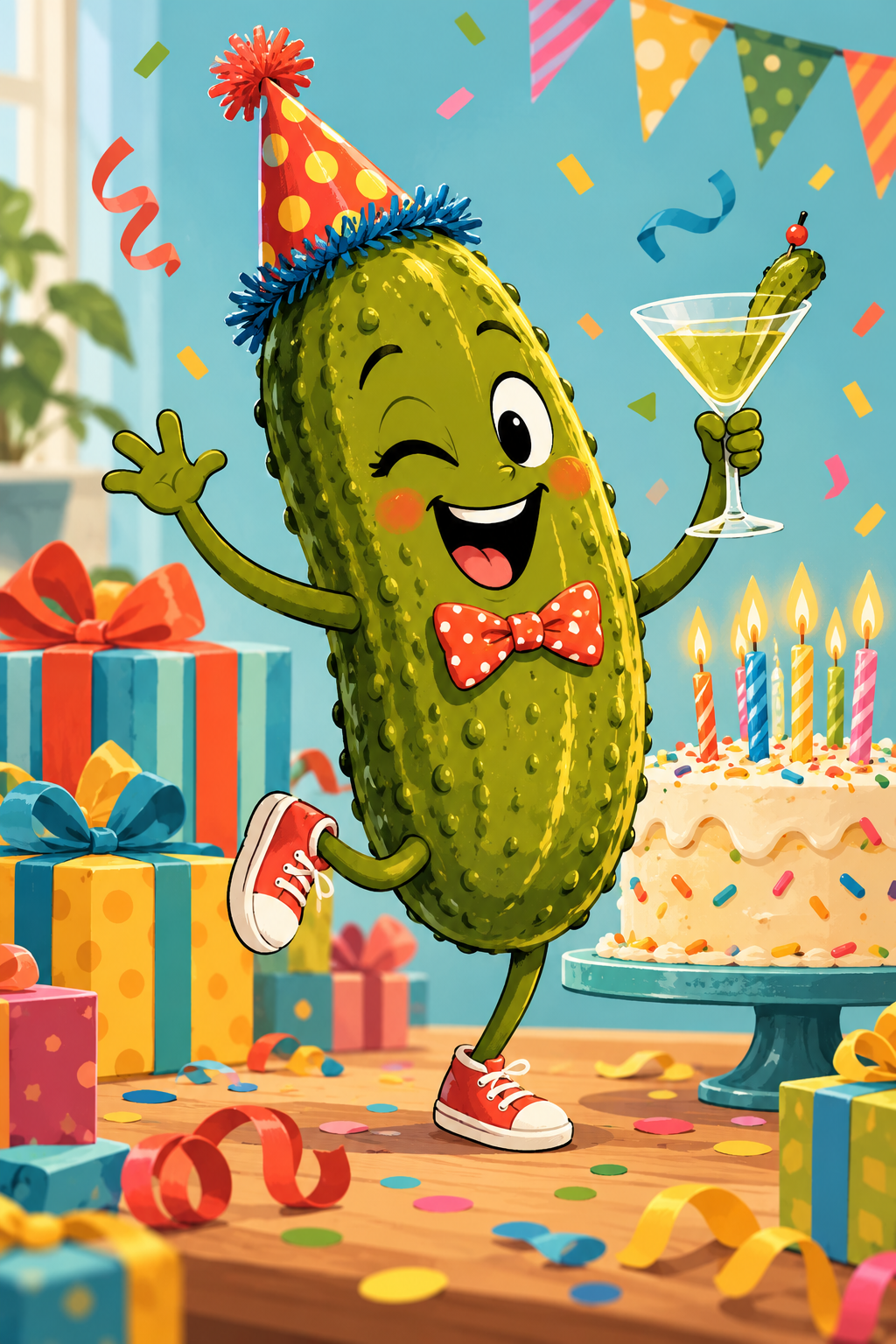
Give your pickle an expression, a personality, and perhaps a tiny pair of shoes. Is it grumpy? Overconfident? Hopelessly romantic? A sophisticated gentleman wearing a monocle?
Maybe it’s a pickle having a very bad day.
Or a cucumber celebrating its transformation into something magnificent.
The possibilities are surprisingly extensive for a vegetable that spends most of its life in a jar.
Possible card directions:
- Birthday: “You’re kind of a big dill.”
- Friendship: “Life would be in a pickle without you.”
- Congratulations: “You’re a really big dill!”
- Love: “I relish every moment with you.”
- Get Well: “Hope you’re feeling less sour soon.”
Quick-project challenge: Create one pickle character with a distinctive personality.
Then put that character into three different situations.
A pickle at a birthday party. A pickle in love. A pickle celebrating Christmas.
The trick is to make the character recognizable enough that the same little green troublemaker can return for future occasions.
🧵 3. National Button Day: November 16
Mini Brief: Cute as a Button
Buttons are wonderfully ordinary objects.
Until you start looking at them as design elements.
Think about old-fashioned button tins, mismatched collections, colorful sewing boxes, vintage clothing, handmade toys, and those beautiful little mother-of-pearl buttons that seem far too pretty to hide on a shirt.
Buttons also lend themselves to clever typography, decorative borders, and illustrations with a handmade appearance.
Or perhaps your button has a face.
And opinions.
Possible card directions:
- New Baby: “Cute as a button!”
- Birthday: “You’re sew special!”
- Friendship: “We just click.”
- Thank You: “Thanks for holding everything together.”
- Mother’s Day: A beautiful arrangement of vintage buttons forming a heart.
Quick-project challenge: Create an illustration using buttons as the main visual element.
Try a button bouquet, a button rainbow, or a little button-eyed character.
Then explore whether the design works better as a nostalgic illustration, a modern graphic composition, or something delightfully whimsical.
Don’t overlook the potential for sewing and crafting enthusiasts. A well-designed button illustration could become a useful addition to several year-round card categories.
🎩 4. National Absurdity Day: November 20
Mini Brief: Absolutely Ridiculous
Finally!
A holiday that gives us permission to abandon common sense entirely.
National Absurdity Day celebrates the ridiculous, the illogical, and the gloriously nonsensical.
For greeting-card artists, this is practically a creative playground.
Imagine a goldfish walking its pet human.
A giraffe attempting to hide behind a lamppost.
A very serious penguin conducting an orchestra of vegetables.
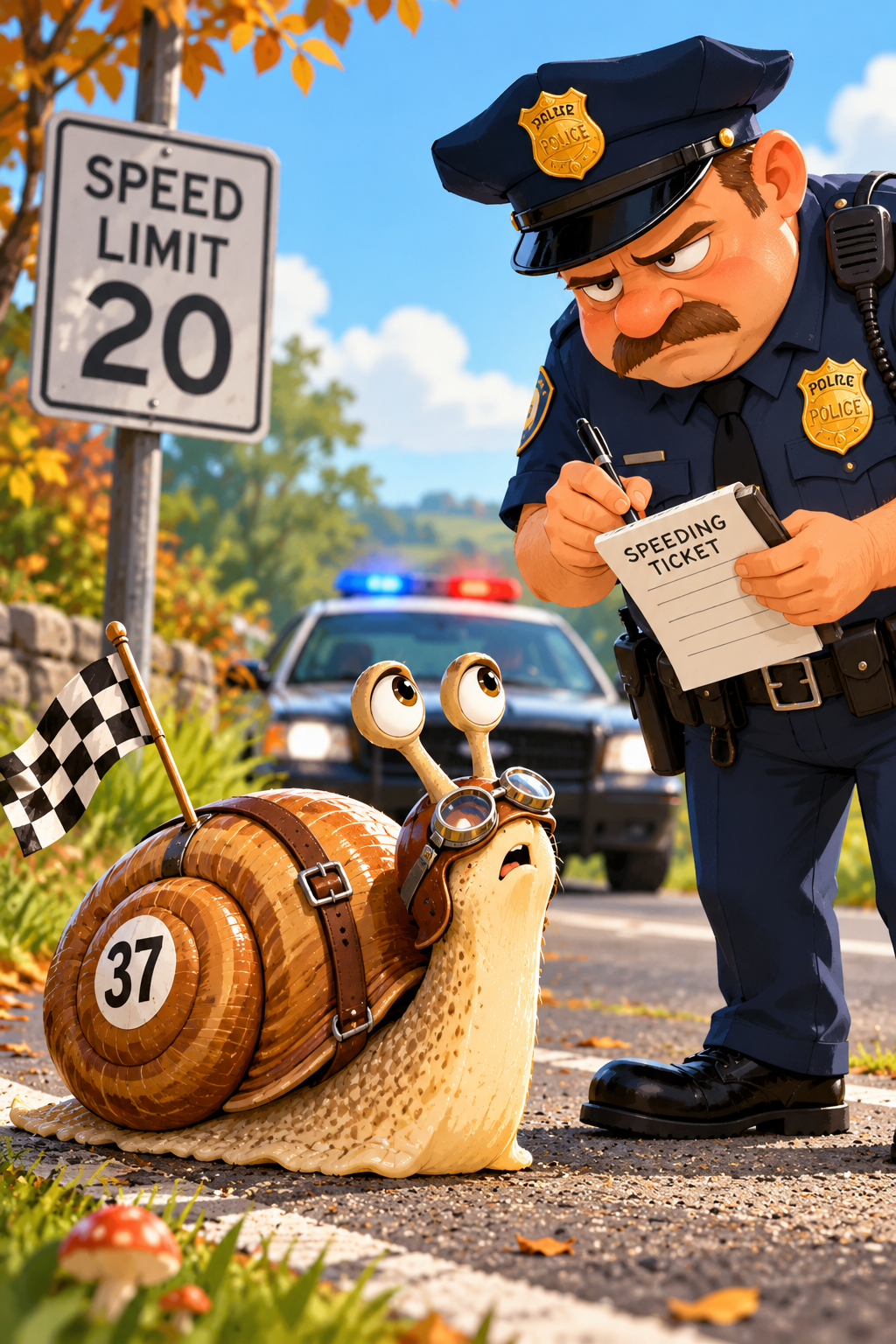
A snail receiving a speeding ticket.
Or a distinguished gentleman attending a business meeting with a large cabbage on his head.
The important thing is to present the absurd situation as though absolutely nothing unusual is happening.
That’s often where the best humor lives.
Possible card directions:
- Birthday: “Another year older. Reality remains optional.”
- Congratulations: “Against all reasonable expectations, you did it!”
- Friendship: “Normal friends are overrated.”
- Retirement: “You can finally stop pretending any of this makes sense.”
- Just Because: “I saw this and thought of you. Make of that what you will.”
Quick-project challenge: Combine two things that have absolutely no business being together.
An animal and an occupation. A household object and an emotion. A vegetable and a historical event.
Create a funny illustration, then challenge yourself to find at least two occasions where it could become a greeting card.
Sometimes the most commercially useful humorous designs begin with the least sensible ideas.
🌀 5. Fibonacci Day: November 23
Mini Brief: Beautifully Mathematical
November 23 is written as 11/23 in the United States, giving us the first four numbers of the Fibonacci sequence: 1, 1, 2, 3.
In this mathematical sequence, each new number is the sum of the previous two.
It continues 5, 8, 13, 21, and so on.
But you don’t need to be a mathematician to find inspiration here.
Fibonacci numbers and related spiral constructions have inspired artists and designers for generations. Think spiraling compositions, botanical illustrations, geometric patterns, and beautiful arrangements of shapes.
Or forget the elegant approach entirely and make a card for someone who genuinely enjoys mathematical jokes.
Yes, those people exist.
Some of them even have birthdays.
Possible card directions:
- Birthday: “You can count on a wonderful birthday.”
- Love: “My love for you keeps growing.”
- Congratulations: “Your possibilities are multiplying.”
- Teacher Appreciation: “Thanks for helping everything add up.”
- Friendship: “Some things just add up perfectly. Like us.”
Quick-project challenge: Create one design inspired by a mathematical pattern.
It could be an elegant spiral composition, a geometric floral arrangement, or a humorous illustration featuring an enthusiastic mathematician.
Then adapt the design for two different audiences: someone who loves mathematics and someone who simply appreciates beautiful artwork.
This is a particularly interesting exercise in creating cards that appeal to niche interests without limiting their wider usefulness.
🚀 6. Red Planet Day: November 28
Mini Brief: Greetings From Mars
On November 28, 1964, NASA launched Mariner 4, the spacecraft that would eventually send back the first close-up images of Mars.
Red Planet Day commemorates that historic mission.
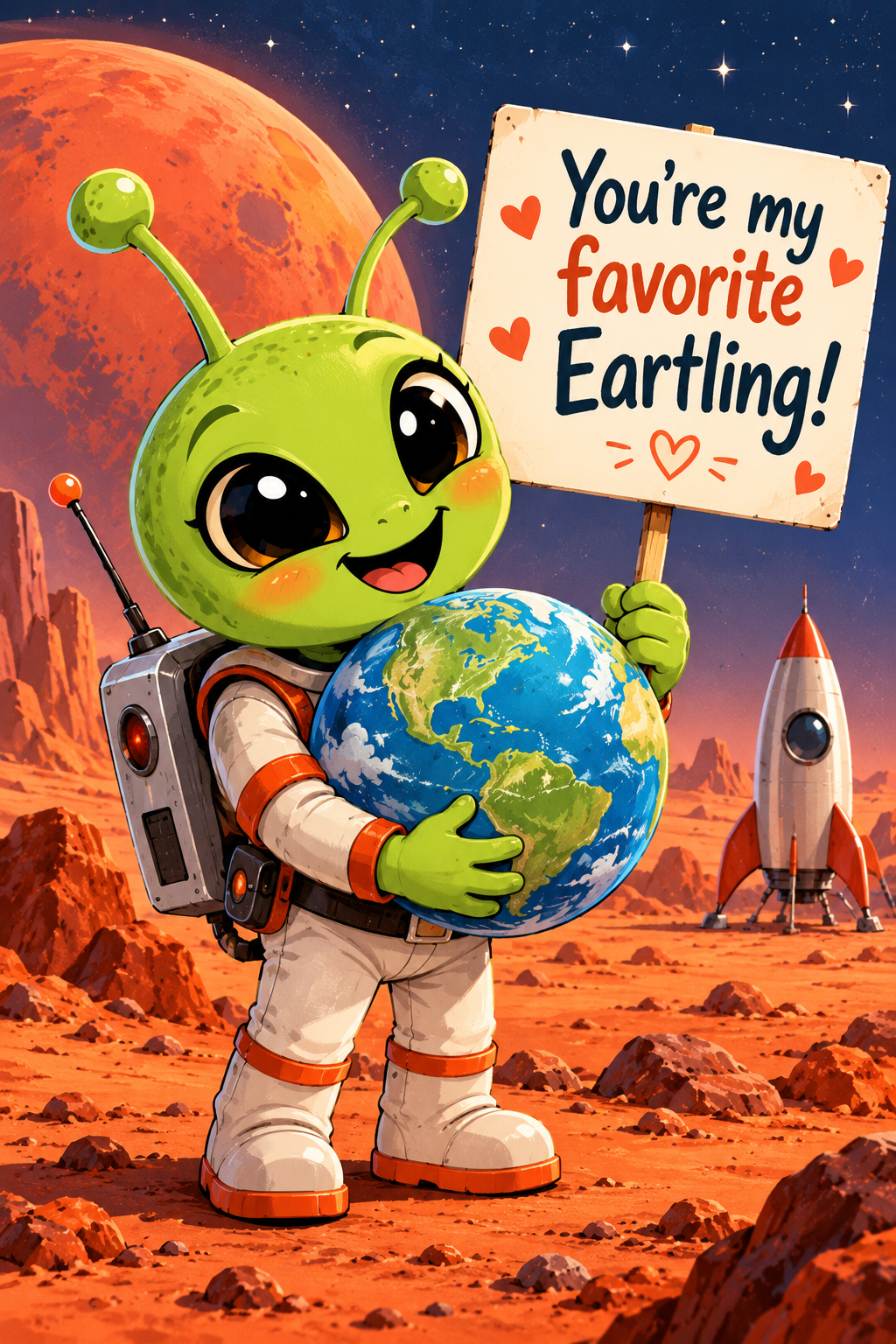
But for our purposes, it also provides a wonderful excuse to populate the greeting-card universe with Martians.
Friendly Martians. Grumpy Martians. Romantic Martians.
Martians attempting to understand birthday candles.
Martians decorating a Christmas tree.
Martians who have traveled millions of miles only to discover that Earthlings still haven’t learned how to fold a fitted sheet.
There’s room here for vintage science-fiction aesthetics, cute modern illustration, retro space-age graphics, and elaborate imaginary alien worlds.
Possible card directions:
- Birthday: “Hope your birthday is out of this world!”
- Love: “I’d cross the universe for you.”
- Friendship: “You’re my favorite Earthling.”
- Congratulations: “Your success is astronomical!”
- Christmas: “Season’s greetings from another planet.”
Quick-project challenge: Design one Martian character who could become the star of an entire miniature card collection.
Give your alien a recognizable appearance and personality.
Then imagine how that character would celebrate an ordinary Earth occasion.
Birthdays, weddings, graduations, Christmas, Valentine’s Day.
The stranger the alien’s interpretation of human customs, the more opportunities for humor.
The Real Challenge: Make Your Weird Idea Work Harder
By now, you may have noticed a pattern.
We’re not really trying to convince everyone to buy a greeting card specifically for Fibonacci Day or National Pickle Day.
Although if there’s a customer out there desperately searching for the perfect pickle-themed celebration card, we’d certainly like to help.
The bigger opportunity is to use these unusual holidays as creative starting points.
A pickle becomes a birthday character.
A button collection becomes a beautiful Mother’s Day design.
An origami crane becomes an elegant Thinking of You card.
A Martian becomes the star of a Christmas greeting.
And that utterly ridiculous snail receiving a speeding ticket?
Well, that might just become a fantastic belated birthday card.
Your November challenge is simple:
Choose one of these six unusual holidays and create one design inspired by it.
Then ask yourself three questions:
- Who else might enjoy this illustration?
- Which everyday occasion could it work for?
- Could a different greeting or small visual change turn it into another useful card?
You don’t need to turn every experiment into a collection.
Sometimes one excellent design is enough.
But sometimes a tiny idea turns out to have eight arms, six legs, or a surprisingly large number of tentacles.
Wait. That was last month’s octopus.
Never mind.
Happy creating, and may your November be wonderfully weird!
Curious About These Holidays?
For more information and inspiration, explore:
- Time and Date: November’s Fun Holidays
- Origami Day: History and Traditions
- The Old Farmer’s Almanac: November Holidays and Fun Facts
These are mostly unofficial, lighthearted observances, but they make excellent excuses to exercise our creative muscles.
Happy Designing!
Corrie
Share this:

Nuts & Bolts – Inside Image for Custom Request
GCU has always allowed shoppers to personalize the inside of the cards: they can add their own image (photo or logo) and customize the inside verse. It is one of the top selling points of fully personalized cards.
With the recent discussion of inside images on The Card that Fights Back, artists do have an interesting way to offer cards with inside graphics yet reserved for custom requests. This is not for offering cards in the GCU public marketplace but for custom design requests. Artists can offer shoppers cards with an inside image via the Share this Card Link.
The image itself can be sized up to the full inside space (for full bleed 10×7 image) and simply uploaded to the inside of the card just like any shopper can do with an image/photo. The two important things to keep in mind regarding the inside image positioning are: 1. the fold line so nothing really important is positioned on the crease and 2. the outside margin allowance so nothing along the edges gets trimmed. The image should be high resolution and a JPG, GIF or PNG format.
Placing the inside image can be a little tricky to align just right, especially if it’s a full bleed design, but the finished results are WOW and quite impressive, particularly when including the shopper’s own photos for a highly personal and colorful design. It could also be used for a small design element on the inside as well as a highly stylized font for the inside verse.
Since designing the inside image takes more time and effort than designing one without an image, artists may want to require the shopper to meet a minimum order size so their earnings are worth the additional effort.
I have used this method for my personal holiday cards. GCU artists completed many of them, and I have done some more recently. See some examples below:
And a peek at the front and inside of last year’s card:
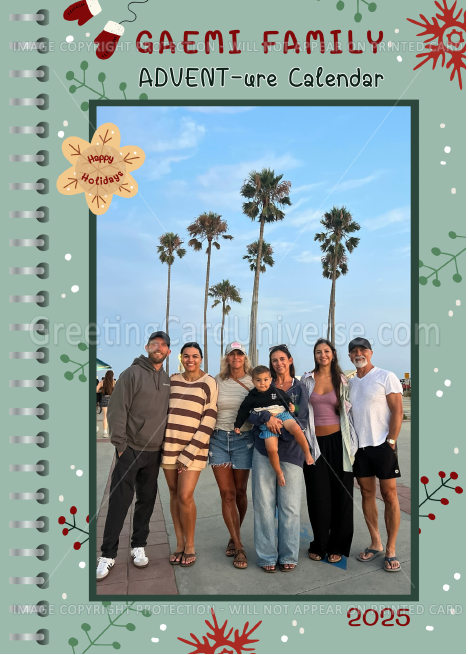
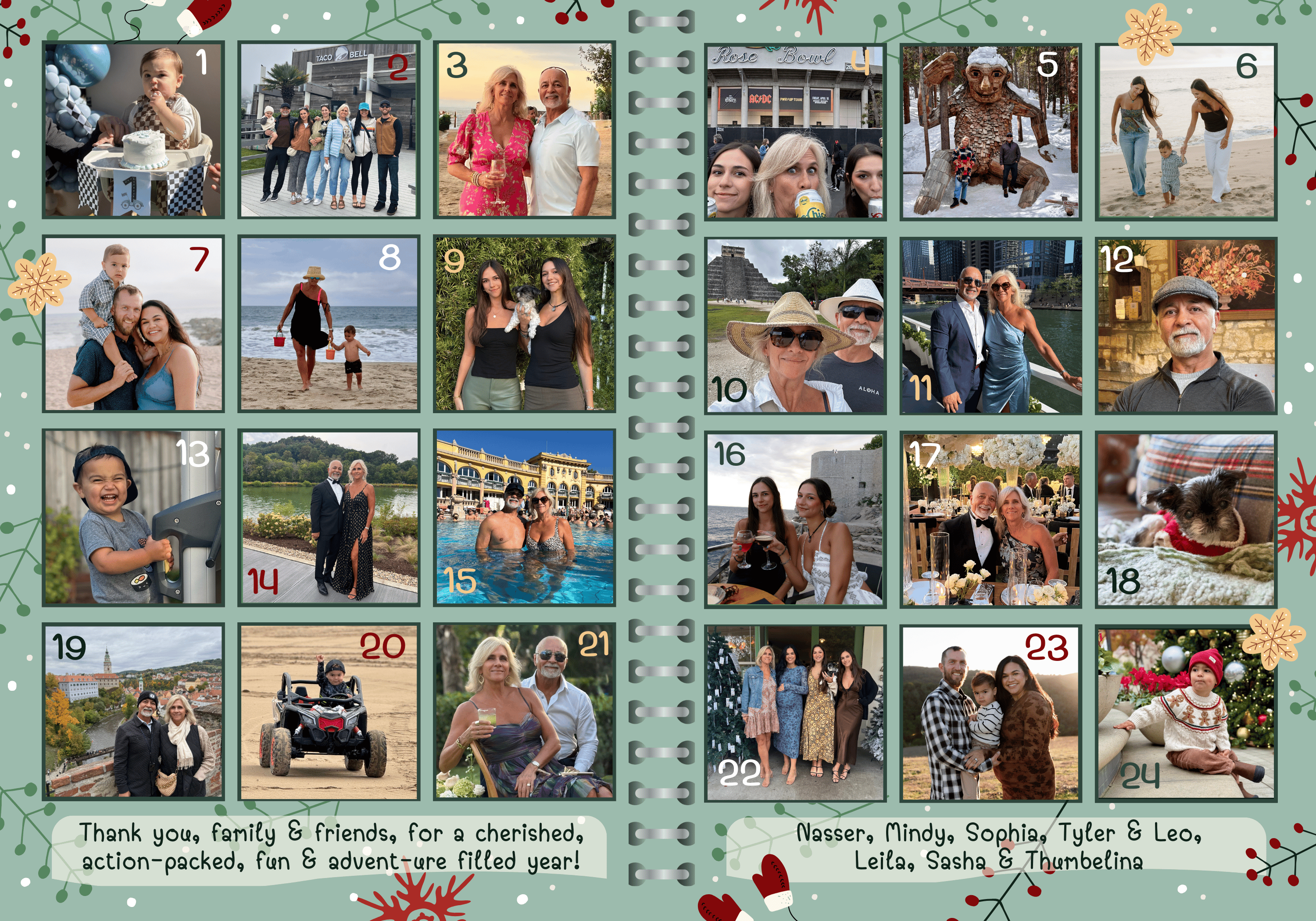
The difference is made in the details!
Mindy
GCU Community Manager
mindy@gcuniverse.com

Share this:

Wanted Cards: Finding the Right Words
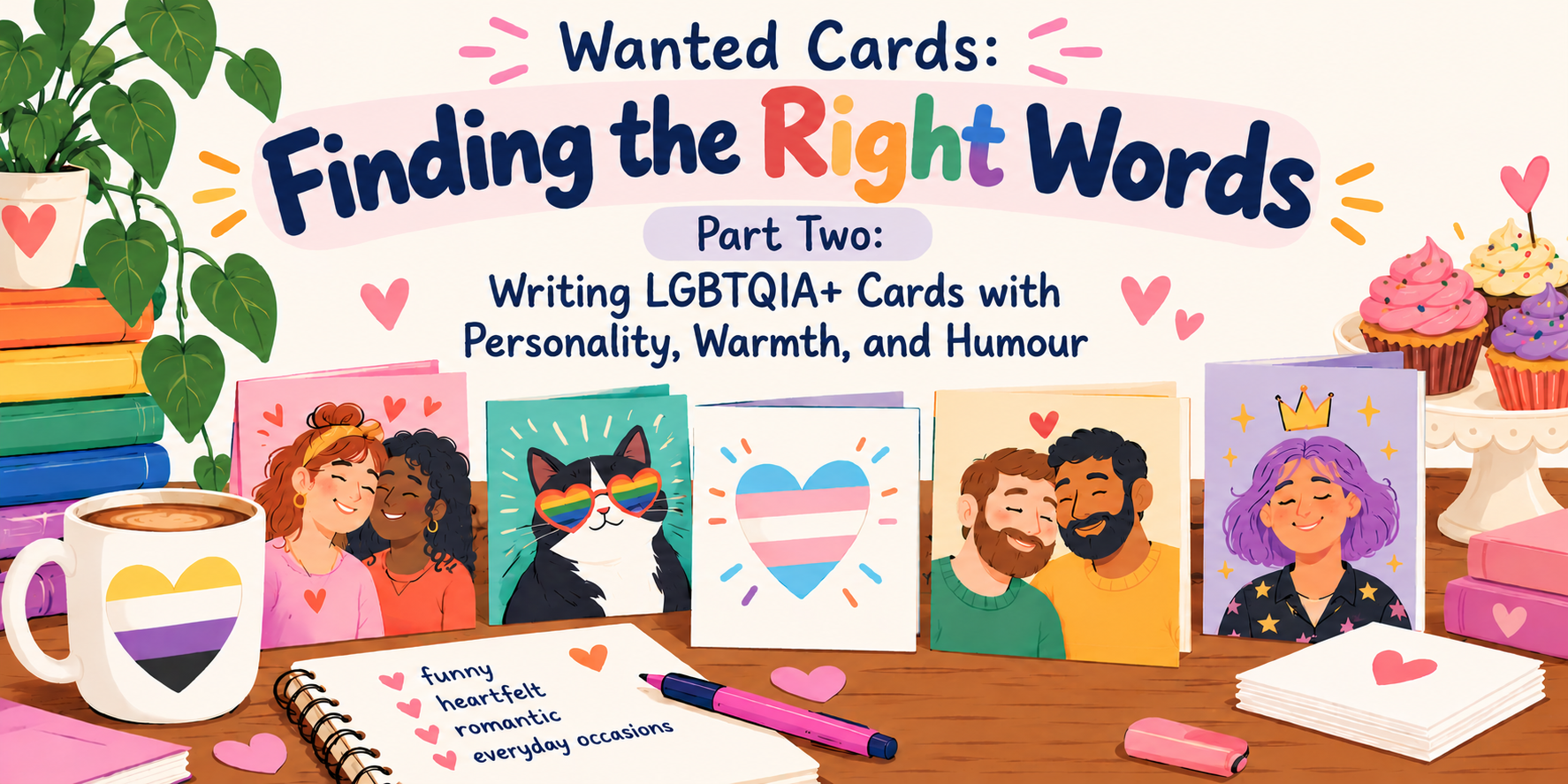
Part Two: Writing LGBTQIA+ Cards with Personality, Warmth, and Humour
In Part One of Beyond the Rainbow, we explored the creative opportunities behind identity-specific LGBTQIA+ greeting cards, from birthdays and anniversaries to Christmas, family occasions, and everyday celebrations.
But even the most beautifully illustrated card needs the right words.
A clever greeting can turn a good design into a memorable one. A thoughtful inside message can make a recipient feel understood. And a well-placed joke can transform a simple birthday card into something they’ll want to show their friends.
So how do we write LGBTQIA+ cards that feel natural, personal, and genuinely enjoyable?
The answer is often surprisingly simple.
Write for the person and the occasion, not just the identity.
1. Let the Occasion Lead
A birthday card should feel like a birthday card.
An anniversary card should celebrate a relationship.
A Christmas card should capture something about the season.
Identity-specific wording can make these messages more personal, but it doesn’t always need to dominate them.
Consider these examples.
Birthday Card for a Transgender Woman
Front: Happy Birthday to One Fabulous Woman!
Inside: Wishing you a day filled with laughter, love, cake, and everything that makes you happy.
Birthday Card for a Non-Binary Friend
Front: Another Year Older. Still Beyond Categorization.
Inside: Some people fit neatly into boxes. You’re far too interesting for that. Happy Birthday!
Anniversary Card for Two Wives
Front: Wife. Best Friend. Favourite Human.
Inside: Every year with you gives me another thousand reasons to fall in love with you. Happy Anniversary, sweetheart.
The identity-specific context is there, but the occasion remains central.
2. Humour Works Best When It’s Affectionate
Humour can be one of the strongest tools in greeting card design.
But there’s an important difference between laughing with someone and making their identity the punchline.
Playful wordplay, everyday relationship humour, affectionate exaggeration, and character-driven comedy can all work wonderfully.
For example:
Bisexual Birthday Card
Front: Bi the Way… You’re Getting Older.
Inside: But you’re also getting more fabulous. Happy Birthday!
Lesbian Anniversary Card
Front: I Still Get Butterflies When I See You.
Inside: Although these days, that might also be the coffee. Love you, wife!
Gay Husband Birthday Card
Front: Happy Birthday to My Husband, Who Has Everything.
Inside: Including excellent taste in men. You’re welcome.
Non-Binary Birthday Card
Front: You’re One of a Kind.
Inside: Which is probably why the universe hasn’t dared make another. Happy Birthday!
Notice that the jokes aren’t about whether someone deserves acceptance or whether their identity is legitimate.
They’re about ageing, relationships, personality, and the delightful absurdities of being human.
That’s fertile ground for greeting card humour.
3. Gender-Neutral Doesn’t Have to Mean Impersonal
Gender-neutral wording is useful for many occasions, especially when the sender wants a card that doesn’t assume a particular gender or relationship.
But neutral doesn’t have to mean bland.
Compare:
Happy Birthday. Have a Nice Day.
With:
Happy Birthday to My Favourite Chaos Coordinator.
Or:
Congratulations on Another Successful Trip Around the Sun. The Planet Has Been Warned.
Both examples avoid gendered language, but they have far more personality.
Other possibilities include:
Romantic
Front: You’re My Favourite Plot Twist.
Inside: Of all the stories life could have written, I’m so glad ours brought us together. Happy Anniversary.
Birthday
Front: Officially Too Fabulous for Your Age.
Inside: Fortunately, nobody has invented a law against that. Happy Birthday!
Christmas
Front: All I Want for Christmas Is You.
Inside: Although I wouldn’t object to some chocolate as well. Love you!
These messages can suit a wide range of recipients and relationships.
And when a card is intended for a specific identity or relationship, artists can make that clear through the front wording, artwork, or both.
4. Sometimes Specific Wording Is Exactly What Matters
While gender-neutral language offers flexibility, it isn’t always the right creative choice.
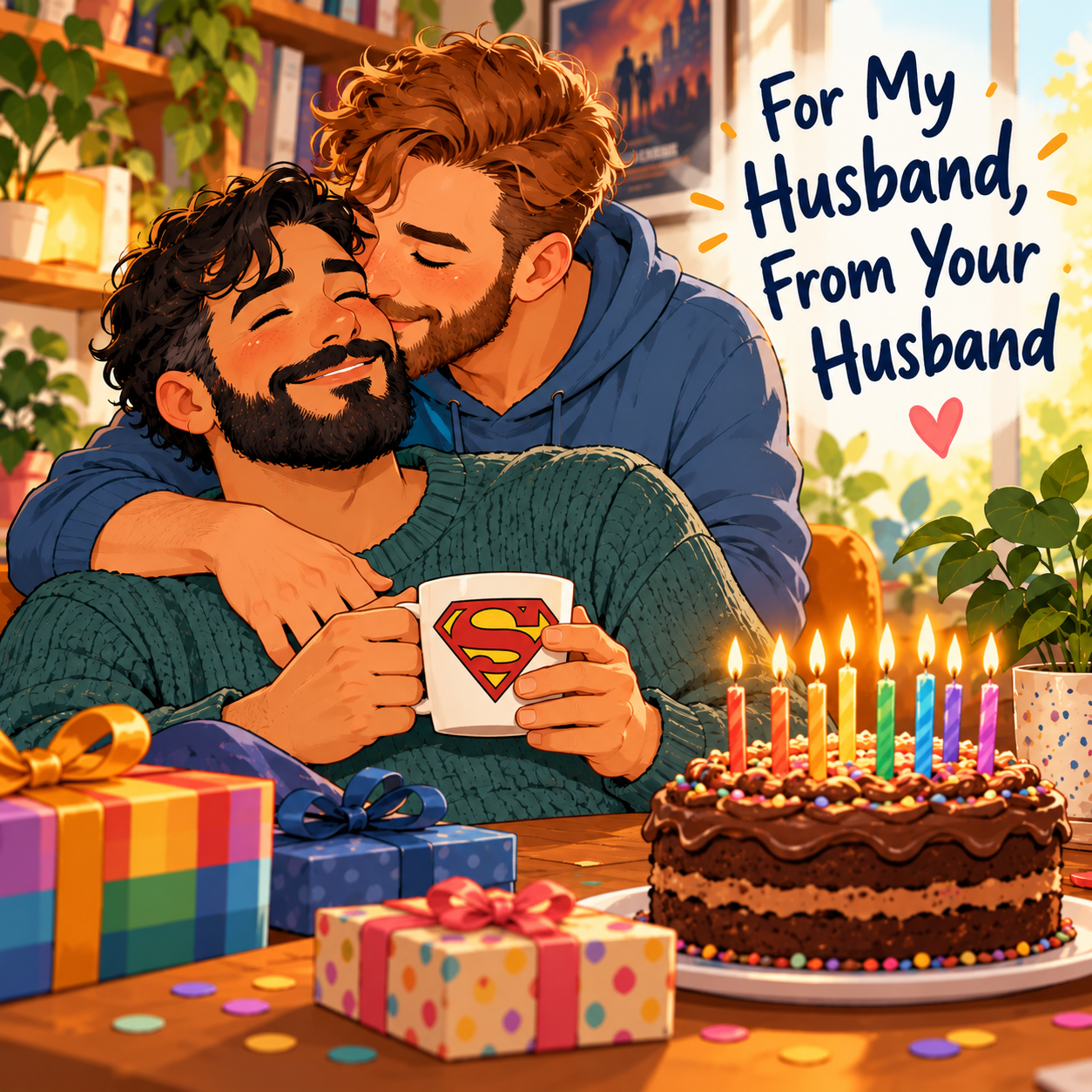
A customer looking for a card that says To My Wife, From Your Wife may want those exact words.
A transgender father might appreciate a Father’s Day card that explicitly celebrates him as a dad.
A non-binary partner might love a romantic card that uses partner rather than assuming husband or wife.
Specificity can be a form of affection.
Here are a few possibilities.
For My Wife, From Your Wife
Front: Two Wives. One Wonderful Life.
Inside: And I wouldn’t trade a single moment of it. Happy Anniversary, my love.
For My Husband, From Your Husband
Front: I Married My Favourite Person.
Inside: And somehow you still put up with me. Happy Anniversary!
For a Transgender Dad
Front: Happy Father’s Day to an Amazing Dad.
Inside: Thank you for all the love, laughter, wisdom, and encouragement you bring into our lives. You’re appreciated more than words can say.
For a Non-Binary Partner
Front: My Partner. My Person. My Everything.
Inside: Life is infinitely better with you beside me. Happy Anniversary, sweetheart.
The important distinction is that artists should choose language intentionally rather than automatically defaulting to generic wording.
5. Avoid Turning Every Card Into a Coming-Out Card
Coming out, transition milestones, and messages of support are meaningful occasions that deserve thoughtful designs.
But not every LGBTQIA+ greeting card needs to reference a personal journey, a struggle, or the courage to be oneself.
Sometimes a recipient simply wants a funny birthday card.
Sometimes two husbands want a ridiculous Christmas card featuring their badly behaved dog.
Sometimes a lesbian wife wants to tell her partner she’s still hopelessly in love after twenty years together.
And sometimes a non-binary friend wants a card about cake, dinosaurs, or the horrifying prospect of turning 40.
There is room for all of these.
Representation becomes more natural when LGBTQIA+ characters and relationships are allowed to be ordinary, extraordinary, romantic, ridiculous, and everything in between.
6. A Little Thought Goes a Long Way
Identity-specific wording benefits from care, particularly when artists are writing for experiences or communities they may not personally know.
A few useful principles:
Use the identity terms you actually mean. Lesbian, gay, bisexual, transgender, non-binary, and other identities aren’t interchangeable.
Don’t assume every recipient likes the same humour. A cheeky pun may be perfect for one person and completely wrong for another.
Avoid unnecessary assumptions about someone’s life. Not every queer couple is married, not every trans person has the same transition experience, and not every LGBTQIA+ person celebrates Pride in the same way.
Be mindful of slang. Some terms are warmly embraced within particular communities but may feel uncomfortable or inappropriate when used casually by someone else.
Let affection sound like affection. A sincere, uncomplicated message can be more powerful than a paragraph trying too hard to demonstrate inclusivity.
When in doubt, ask whether the wording would make sense coming from someone who genuinely knows and cares about the recipient.
If it sounds like a slogan rather than a greeting, it may need another draft.
7. More Front-and-Inside Combinations to Try
Here are a few additional ideas to spark new designs.
Christmas Card for Two Husbands
Front: Two Husbands. One Christmas Tree. Absolutely No Agreement on Decorations.
Inside: Here’s to another Christmas of compromise, laughter, and pretending we don’t know who broke the ornaments. Love you!
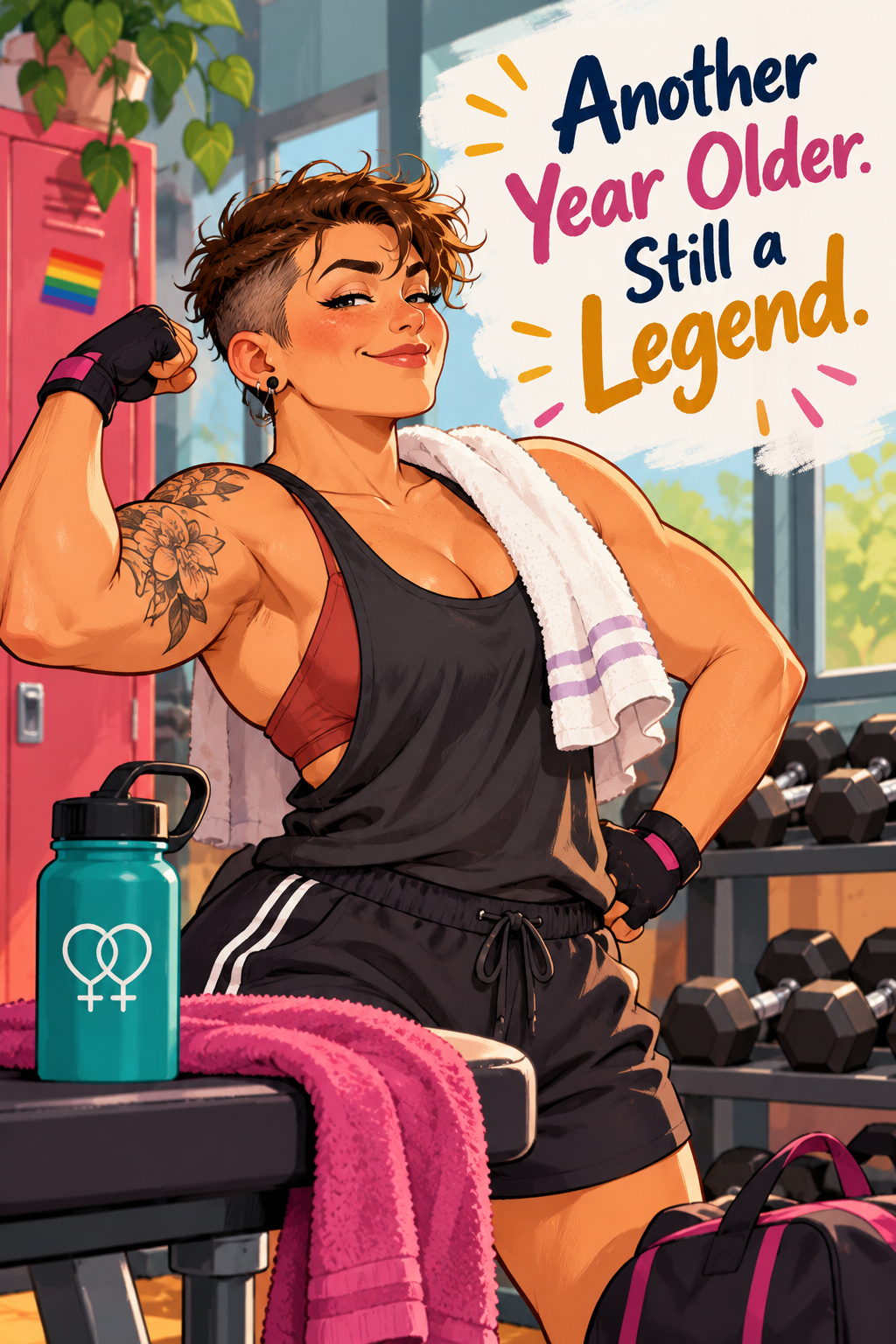
Birthday Card for a Lesbian Friend
Front: Another Year Older. Still a Legend.
Inside: Some things just get better with age. You, for example. And possibly cheese. Happy Birthday!
Anniversary Card for a Queer Couple
Front: Still Each Other’s Favourite Weirdo.
Inside: Here’s to all the wonderful, ridiculous, unforgettable moments we’ve shared. Happy Anniversary!
Birthday Card for a Non-Binary Friend
Front: The Birthday Royalty Has Arrived.
Inside: Your crown is imaginary, but your fabulousness is undeniable. Have a brilliant birthday!
First Christmas Together
Front: Our First Christmas Together.
Inside: Here’s to new traditions, old favourites, and many more Christmases side by side. I love you.
Birthday Card for a Gay Best Friend
Front: Happy Birthday to My Favourite Bad Influence.
Inside: Life would be considerably quieter without you. And nowhere near as much fun.
These examples can be adapted to different artistic styles, from elegant typography and delicate florals to bold comic characters and mischievous animals.
The Creative Challenge: Write the Message First
For this challenge, try reversing your usual design process.
Instead of starting with an illustration, begin with a greeting.
Choose a specific recipient and occasion, then write one sentence that could only belong on that particular kind of card.
Perhaps it’s funny. Perhaps it’s romantic. Perhaps it’s quietly sentimental.
Now imagine the artwork that would make those words shine.
Could a character’s expression deliver half the joke?
Could a familiar domestic scene make the sentiment more personal?
Could a beautifully restrained design give a simple message more emotional weight?
The strongest greeting cards often succeed because the words and artwork feel as though they belong together.
Beyond the Rainbow, Beyond the Occasion
The growing variety of identity-specific greeting cards is an encouraging creative development, but the real opportunity isn’t simply to produce more designs with different labels.
It’s to offer more choice, more personality, and more occasions worth celebrating.
A good greeting card doesn’t need to explain who its recipient is.
It simply needs to make that person feel remembered, appreciated, loved, or wonderfully amused.
And sometimes, the most inclusive thing a greeting card can do is let someone enjoy being the birthday star, the beloved spouse, the proud parent, or the friend who absolutely deserves to be teased about turning fifty.
Because everybody deserves a card that feels like it was made just for them.
A Note About LGBTQIA+ Card Categories at GCU
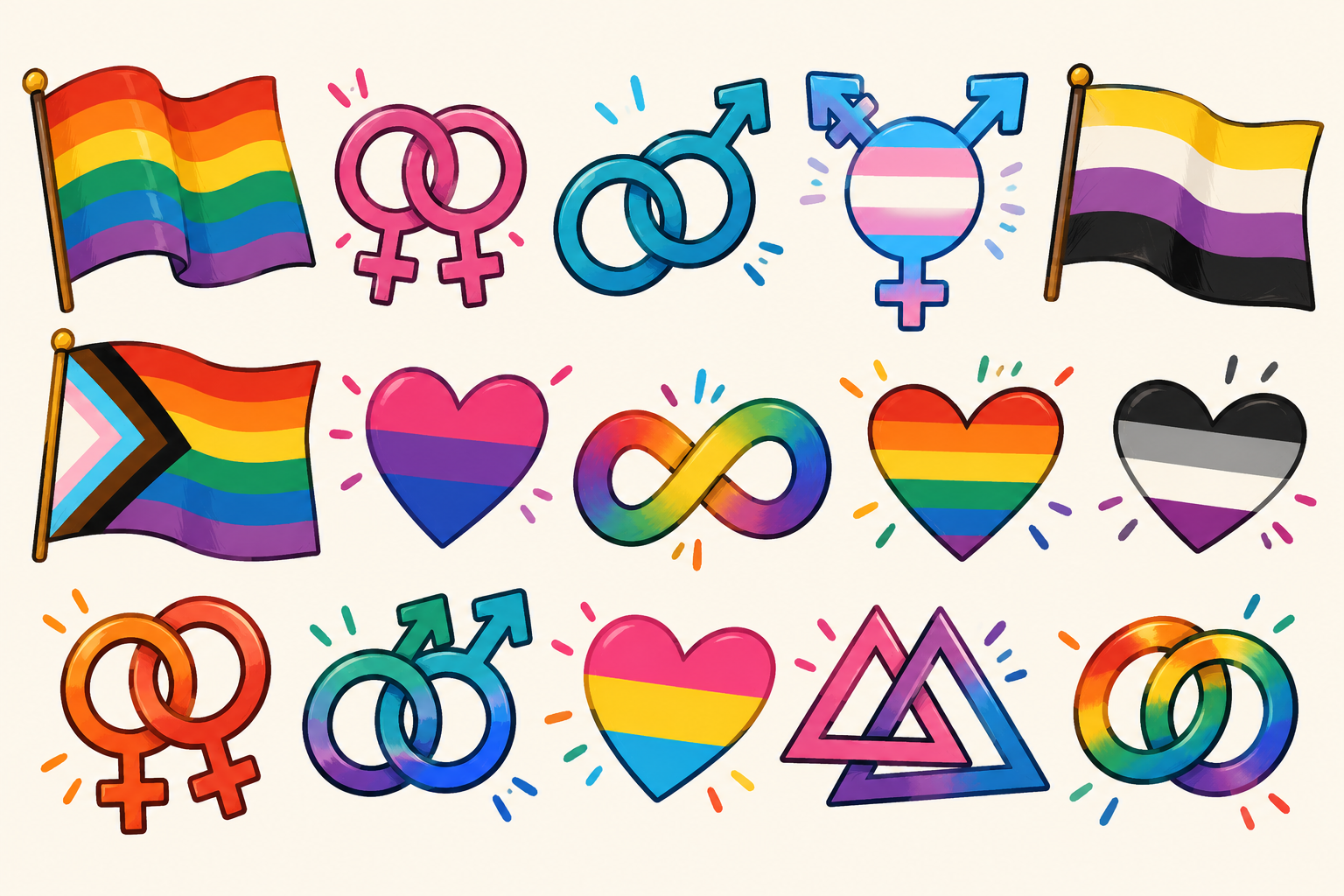
One important thing to remember when designing for LGBTQIA+ categories: a card doesn’t need a rainbow, but it does need a reason to belong in that category.
A general birthday card that says Another Year Older. Still a Legend! is a great birthday card, but the message alone doesn’t make it LGBTQIA+-specific. Simply placing that same design in both the general birthday and LGBTQIA+ birthday categories isn’t what we’re aiming for.
Instead, give the design something that speaks specifically to the LGBTQIA+ community, whether through the illustration, the front greeting, or the inside verse.
For example:
- General: Happy Birthday to My Favourite Person.
- LGBTQIA+-specific: Happy Birthday to My Beautiful Wife, From Your Wife.
- General: Happy Father’s Day to an Amazing Dad.
- LGBTQIA+-specific: Happy Father’s Day to My Two Wonderful Dads.
- General: Another Year Older. Still Fabulous.
- LGBTQIA+-specific: Bi the Way… Another Year Older. Still Fabulous!
The distinction can be subtle, humorous, romantic, or heartfelt. What matters is that it’s intentional.
Where should these designs go?
Most GCU occasions and categories have a Gay / Lesbian / LGBTQ subcategory. Some family occasions also offer specific categories such as Both My Moms and Both My Dads.
There are some gay/lesbian relations under >> For Family Relation Specific and then the general >> Gay / Lesbian / LGBTQ subcategory.
If you can’t find an appropriate category, Other is a good choice. GCU’s reviewers can help find the best placement or request a new subcategory when needed.
The goal isn’t to make one design do double duty. It’s to create cards that genuinely serve recipients and relationships that deserve their own place in the greeting card aisle.
Happy Designing!
Corrie
Share this:

Wanted Cards: Beyond the Rainbow
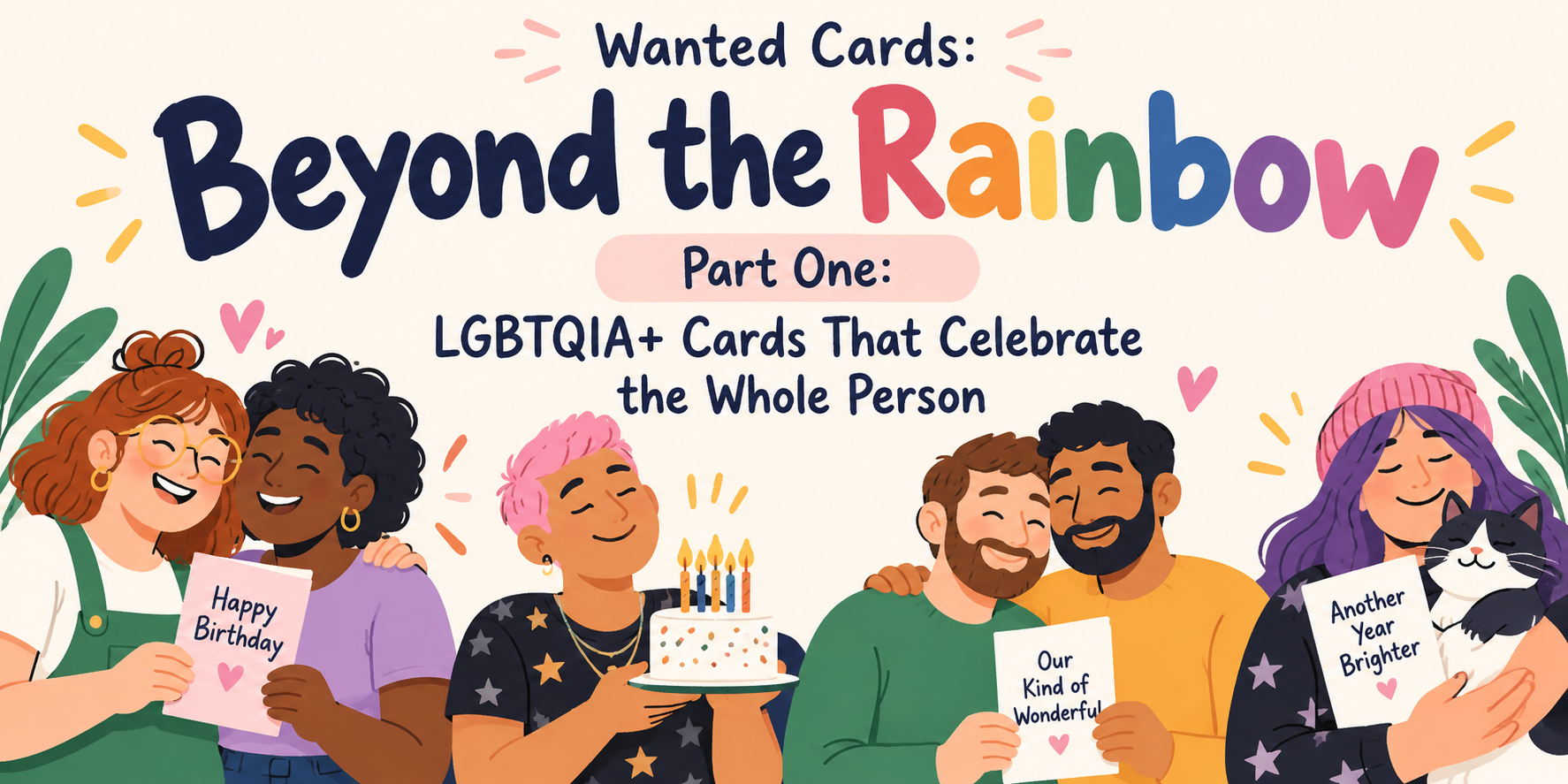
Part One: LGBTQIA+ Cards That Celebrate the Whole Person
For a long time, LGBTQIA+ greeting cards have been closely associated with Pride Month, rainbow flags, coming out, and messages of love and acceptance. All of these have their place, but there is a much bigger world of occasions, relationships, personalities, and celebrations waiting to be explored.
A recent development in the greeting card industry offers a timely reminder of that opportunity.
On October 14, British publisher Bare Cards introduced Loud & Proud, a collection of 12 birthday card designs representing different LGBTQIA+ identities and genders. The launch builds on an existing range that includes transgender, non-binary, anniversary, and Christmas cards.
You can read more about the collection in Greetings Today: Bare Cards Expands LGBTQIA+ Offering with Loud & Proud.
It’s an interesting example of a publisher moving beyond general LGBTQIA+ representation toward cards that speak to more specific recipients.
And that’s where the creative possibilities really begin.
Representation Is Good. Recognition Is Better.
There’s a difference between a card that says Everyone Is Welcome and one that says Happy Birthday to My Wonderful Wife, designed with two women in mind.
Both have value, but they serve different purposes.
One expresses an inclusive sentiment. The other acknowledges a particular relationship and a particular person.
A lesbian celebrating her wife’s birthday, a non-binary friend turning 30, or a transgender man celebrating his first Father’s Day may be looking for something that feels personally relevant.
The challenge for greeting card artists is to create designs that offer that recognition without reducing the recipient to a label.
After all, LGBTQIA+ people aren’t a single audience with a single aesthetic. Some love rainbows, glitter, and exuberant celebrations. Others prefer understated elegance, dry humour, vintage illustration, or something delightfully absurd.
The more variety artists offer, the more opportunities customers have to find a card that feels just right.

1. Birthdays Beyond the Generic Greeting
Birthday cards are an excellent place to begin.
Rather than creating another general Pride-themed design, think about the recipient’s identity, personality, and sense of humour.
Possible design directions:
- A glamorous retro birthday queen with a cheeky expression and the greeting Another Year of Being Fabulous.
- A non-binary birthday character surrounded by balloons, cake, and confetti, with Another Trip Around the Sun, Still Beyond Categorization.
- A beautifully illustrated floral birthday card with Happy Birthday to an Amazing Trans Woman.
- A bold, colourful design celebrating bisexual identity with Bi the Way, It’s Your Birthday!
- A minimalist, sophisticated birthday card for a gay man who would rather have beautiful typography than glitter.
These concepts can be playful, elegant, heartfelt, or wonderfully eccentric.
The important thing is that the design celebrates a birthday first, while making room for the recipient’s identity.
2. Relationships Deserve Their Own Designs
Romantic greeting cards offer enormous possibilities for more specific representation.
Think beyond general anniversary and Valentine’s Day cards.
Consider cards for:
- My Wife, From Your Wife
- My Husband, From Your Husband
- My Wonderful Non-Binary Partner
- Our First Anniversary as Wives
- Our First Christmas as Husbands
- My Girlfriend, My Best Friend, My Favourite Person
These aren’t necessarily new sentiments, but they become more meaningful when the artwork and wording are designed around the relationship.
For example, imagine two elderly women sitting together on a park bench, sharing a thermos of coffee.
Front: Still My Favourite Person to Grow Old With.
Inside: And there’s nobody else I’d rather complain about the weather with. Happy Anniversary, my love.
Or picture two husbands attempting to assemble an enormous Christmas tree while their cat supervises.
Front: Our Christmas. Our Chaos. Our Kind of Wonderful.
Inside: There’s nobody I’d rather make a beautiful mess with. Merry Christmas, sweetheart.
Neither card needs a rainbow to communicate the relationship.
The people, the occasion, and the affection do that beautifully.
3. Not Every Queer Card Needs a Rainbow
Rainbow imagery is joyful, recognizable, and often entirely appropriate. Identity-specific flags and colours can also be meaningful visual choices.
But they aren’t the only design vocabulary available.
Consider exploring:
Character-led illustration: Everyday people, couples, families, and friends in recognizable situations. A funny expression or familiar domestic scene can communicate more personality than a decorative symbol.
Vintage and retro styles: Mid-century advertising, Art Deco elegance, vintage comic illustration, or nostalgic typography can give identity-specific cards a distinctive visual character.
Nature and florals: Botanical illustrations, woodland creatures, flowers, landscapes, and seasonal imagery can work beautifully with LGBTQIA+ birthday and relationship messages.
Typography-led designs: Sometimes a clever phrase, beautifully arranged lettering, and a carefully chosen colour palette are all a card needs.
Humour and absurdity: Animals with attitude, ridiculous situations, unexpected visual puns, and exaggerated characters can make a card memorable.
The aim isn’t to avoid rainbow imagery. It’s to make sure it remains one creative option among many.
4. Everyday Occasions Are Worth Exploring
Pride Month is one month of the year.
Birthdays, anniversaries, Christmas, congratulations, retirement, new homes, and family celebrations happen all year long.
That creates opportunities to combine identity-specific wording with occasions that may receive less attention.
A few possibilities:
First Christmas Together: A romantic design for a same-sex couple celebrating their first holiday season as partners or spouses.
Congratulations on Your New Home: Two girlfriends or two husbands surrounded by moving boxes, a confused pet, and furniture that definitely won’t fit through the doorway.
Happy Father’s Day: A design specifically celebrating a transgender dad, with an affectionate or humorous message.
Happy Mother’s Day: A heartfelt card for a lesbian mother from her wife, or for one of two mums from their children.
Retirement: A funny card celebrating a queer friend who finally has enough free time to become everybody’s favourite troublemaker.
These are just starting points. Artists can take them in many directions, from traditional and sentimental to contemporary and comic.
5. Design for a Person, Not a Demographic
Here’s a useful exercise.
Instead of beginning with the question What would an LGBTQIA+ card look like?, imagine an actual recipient.
Perhaps she’s a 65-year-old lesbian who loves gardening, terrible jokes, and her three cats.
Perhaps he’s a young gay man celebrating his first Christmas with his husband.
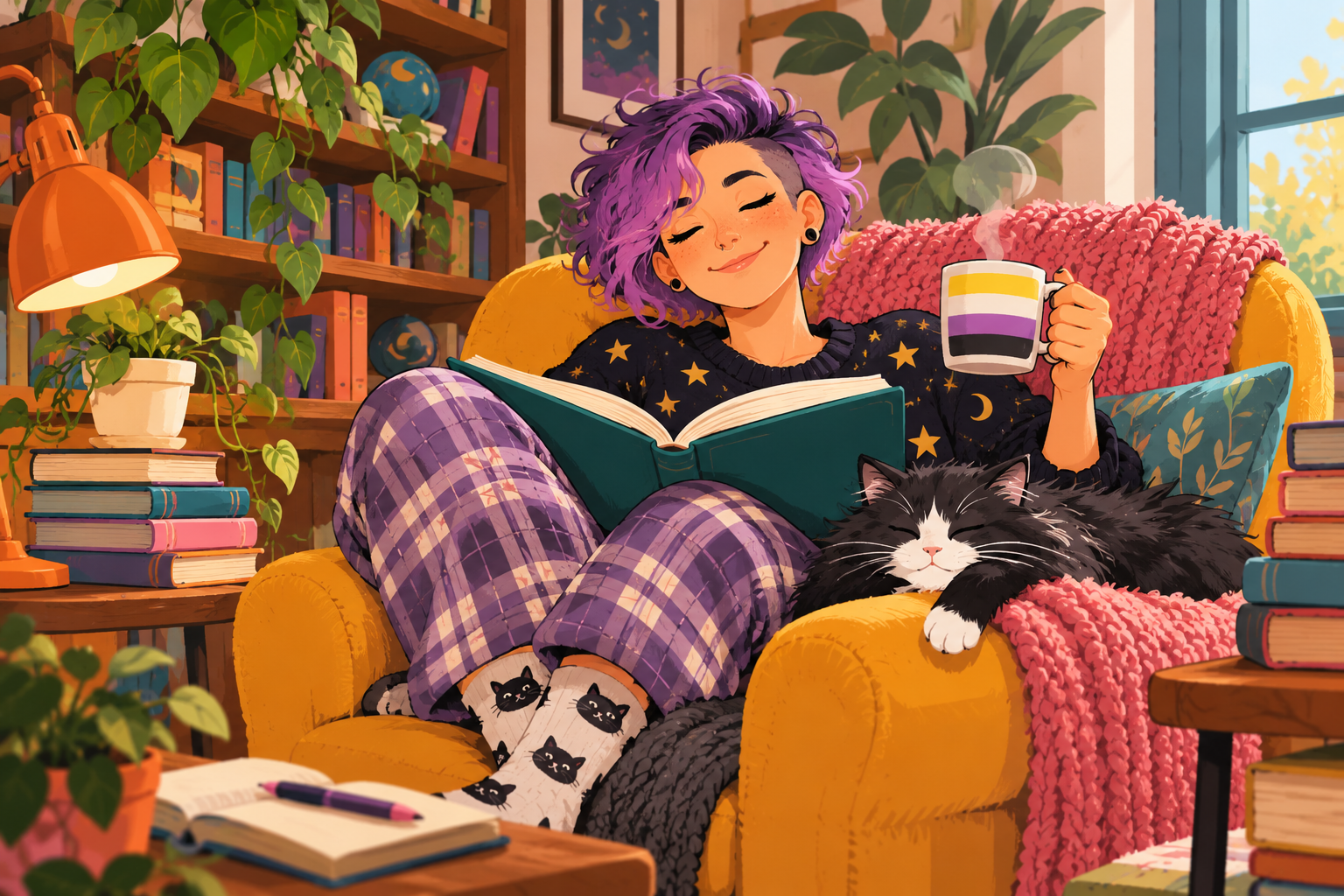
Perhaps they’re a non-binary bookworm who would much rather spend their birthday in a cosy armchair than at a noisy party.
Suddenly, the design possibilities become much more interesting.
The gardener might receive a birthday card featuring a rebellious garden gnome. The newlyweds might appreciate a humorous domestic Christmas scene. The bookworm might love an illustrated stack of novels and a message about another chapter beginning.
Identity helps make the card relevant. Personality makes it memorable.
A Creative Challenge for GCU Artists
For your next design, try combining three ingredients:
One specific recipient + One everyday occasion + One distinctive personality.
For example:
A bisexual friend + Birthday + A terrible weakness for puns.
Or:
Two husbands + Christmas + A cat who destroys decorations.
Or:
A non-binary partner + Anniversary + A shared obsession with science fiction.
Use those ingredients to create something personal, recognizable, and full of character.
Because inclusive greeting card design isn’t simply about adding more labels to existing designs.
It’s about offering more people the pleasure of finding a card that feels as though it was made especially for them.
Coming in Part Two: Finding the Right Words, where we’ll explore how thoughtful, funny, romantic, and natural wording can make identity-specific cards even more meaningful.
Happy Designing!
Corrie
Share this:

A Quick Clarification About “The Card That Fights Back”
It seems our recent two-part blog series, The Card That Fights Back, has caused a little confusion, so let’s clear that up!
GCU artists still cannot add images or illustrations to the inside of their cards. That hasn’t changed.
The idea behind The Card That Fights Back is to use the front illustration to set up the joke and the inside text to deliver the punchline. The humor comes from the unexpected twist in the wording, not from additional artwork inside the card.
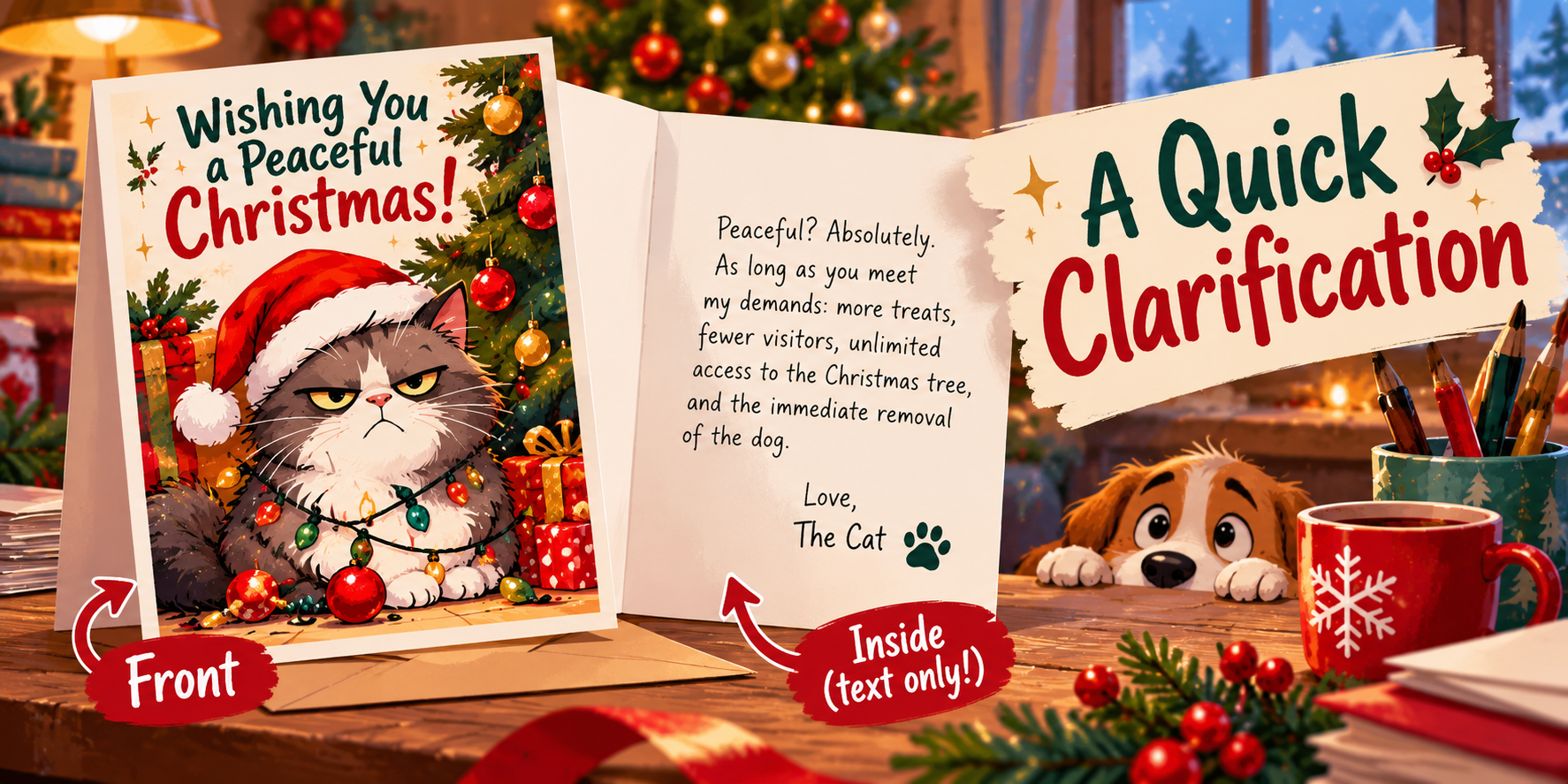
Here’s a simple example:
Card Front: An illustration of a grumpy cat wearing a Santa hat, sitting beside a beautifully decorated Christmas tree.
Front text: “Wishing You a Peaceful Christmas!”
Card Inside (text only):
“Peaceful? Absolutely. As long as you meet my demands: more treats, fewer visitors, unlimited access to the Christmas tree, and the immediate removal of the dog.
Love, The Cat”
The illustration establishes the character and the situation. The inside text delivers the surprise. No additional artwork needed!
The illustrations accompanying our blog posts were created to help visualize the concepts and inspire your creativity. They are not examples of actual GCU card layouts or available design features.
Customers can still add their own personal images inside cards when ordering, but this option is not available to artists creating card designs.
Sorry for any confusion! And please don’t let this discourage you from experimenting with the idea. Sometimes the funniest punchline needs nothing more than a few well-chosen words! 😊
Happy Designing!
Corrie
Share this:

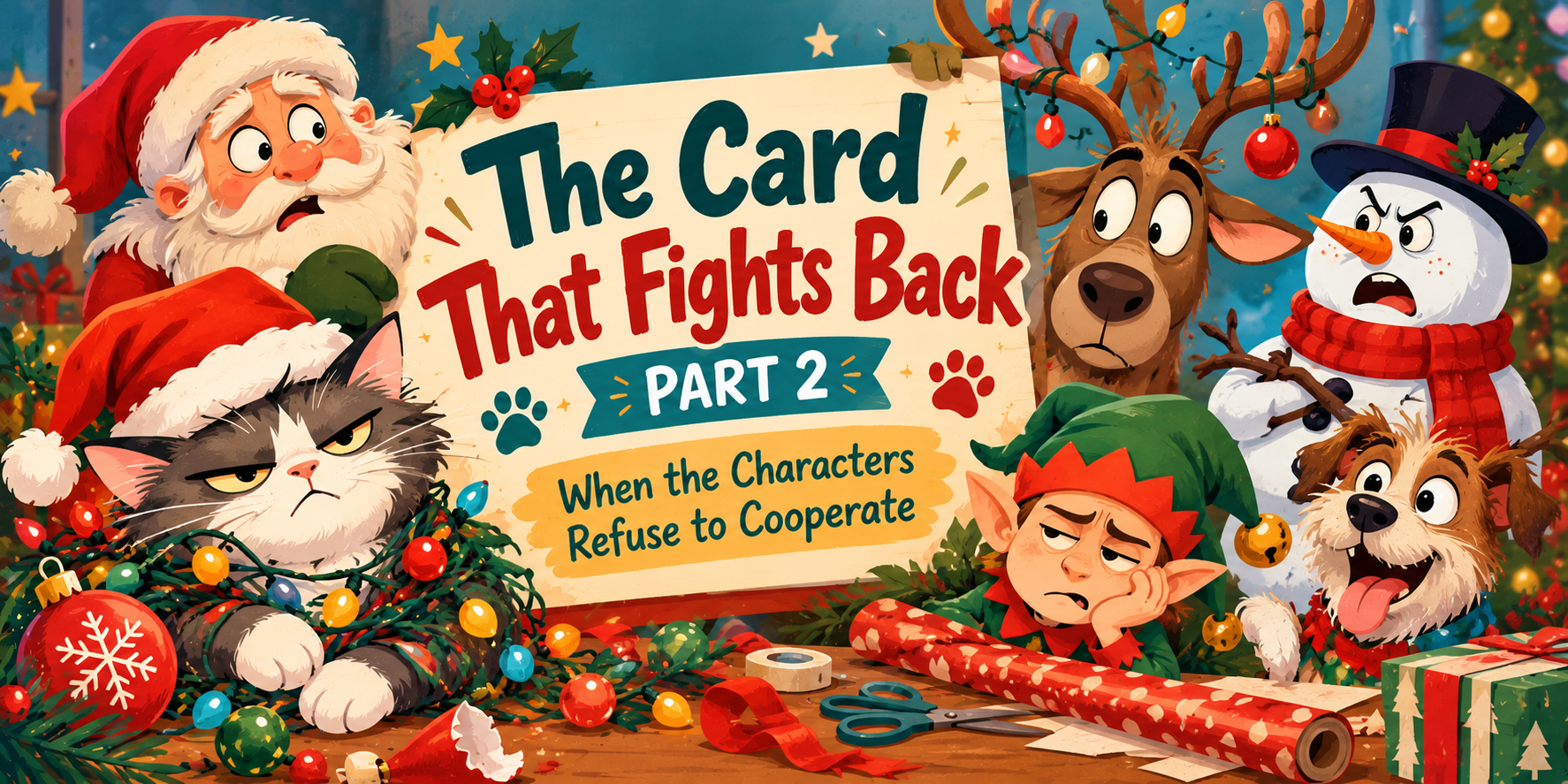
Santa has complaints. The snowman is offended. And the cat would like to speak to management.
In Part One: When the Inside Has Other Ideas, we explored greeting cards that set up a perfectly innocent message on the front, only to deliver an unexpected punchline inside.
But there’s another way to make a greeting card fight back.
What happens when the characters in your illustrations refuse to cooperate?
Imagine a group of adorable woodland animals gathered around a Christmas tree. They’re supposed to be delivering a cheerful holiday greeting. Unfortunately, the rabbit has objections, the fox wasn’t consulted, and the bear is only interested in the refreshments.
Suddenly, the illustration isn’t just decorating the card. It’s participating in the joke.
For Greeting Card Universe artists, character-driven humor opens up a world of possibilities, especially for Christmas, the winter holidays, and New Year.
Let’s give those characters something to say.
1. The Character Who Hijacks the Message
Start with a perfectly normal greeting, then introduce a character who takes exception to it.
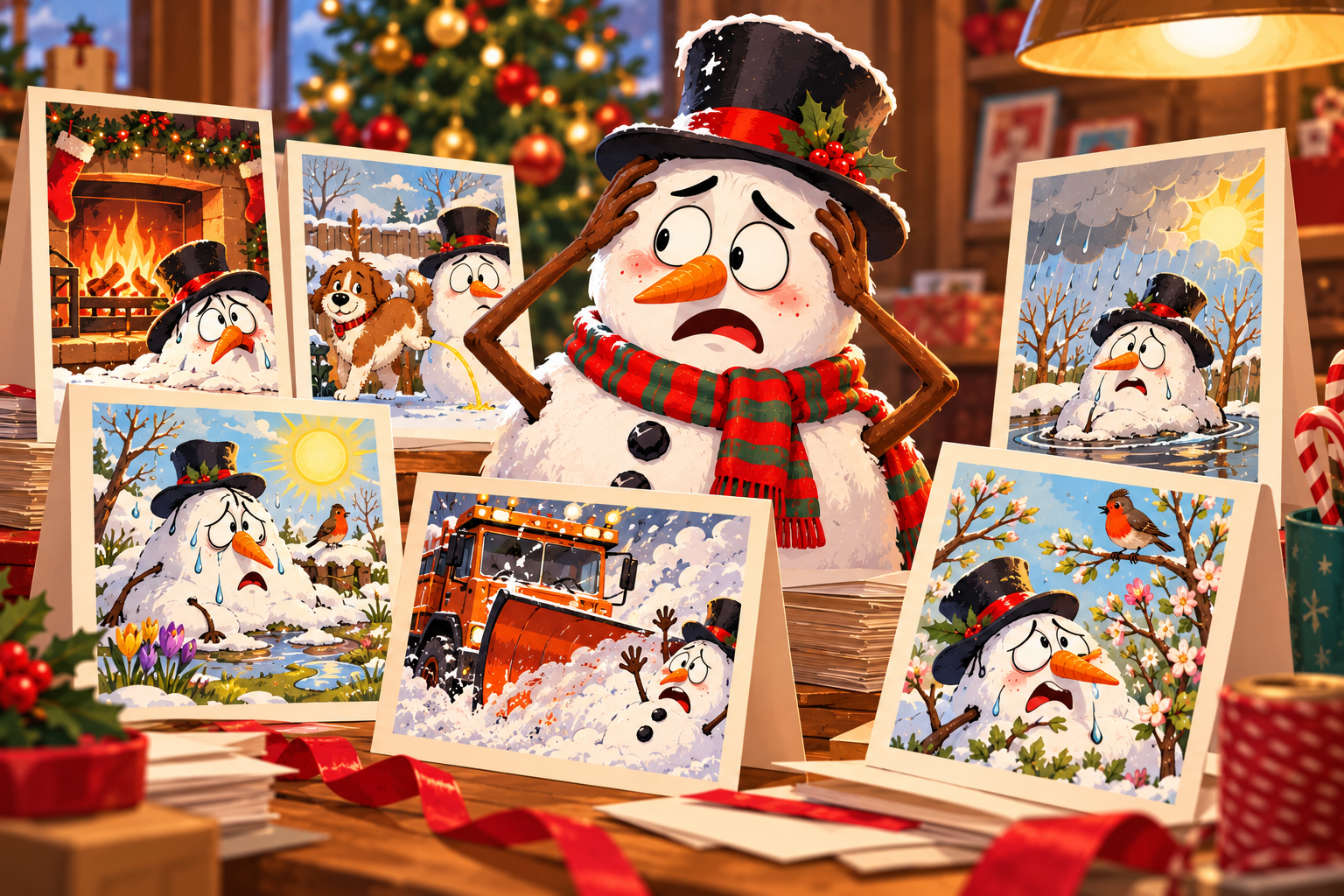
The Offended Snowman
Front: “Wishing You a Warm and Wonderful Christmas!”
Inside:
Snowman: “WARM?!”
Penguin: “Oh dear. You’ve upset him again.”
The Reindeer With Questions
Front: “May All Your Christmas Dreams Take Flight!”
Inside:
Reindeer: “Flight? Nobody mentioned flying.”
Santa: “It’s literally your job.”
Reindeer: “I want to see my contract.”
The New Year’s Party Cat
Front: “Let’s Celebrate the New Year in Style!”
Inside:
Cat: “Define ‘celebrate.'”
Dog: “Music! Dancing! Fireworks!”
Cat: “Absolutely not.”
The beauty of this technique is that the interruption becomes the punchline. One character delivers the traditional sentiment, while another refuses to play along.
A dramatic facial expression on the front can make the reader curious about what happens next.
2. The Card That Argues With Itself
Why stop at one opinionated character when you can have an entire cast?
Multiple characters allow you to create little conversations, misunderstandings, and escalating disagreements.
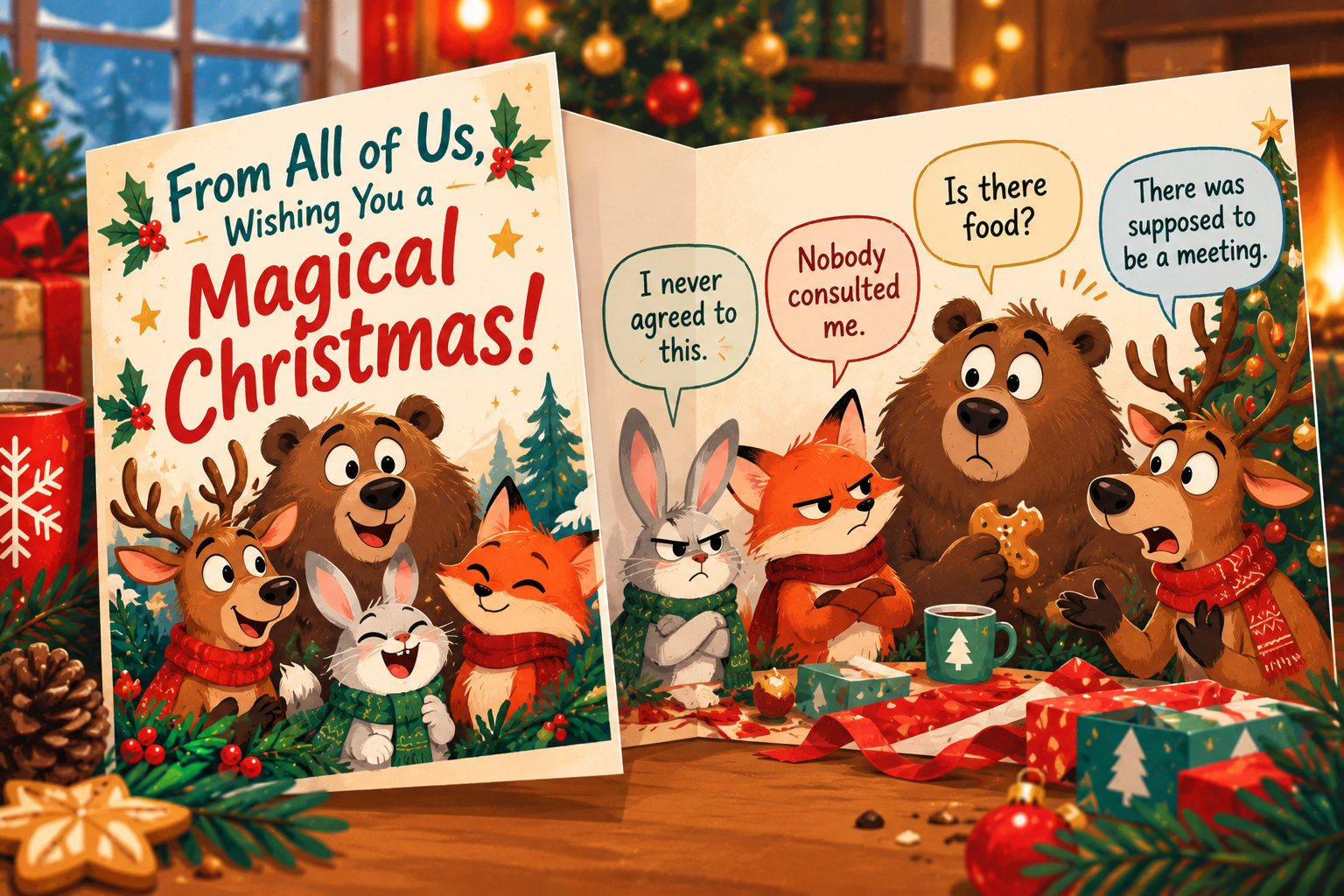
The Christmas Committee
Front: “From All of Us, Wishing You a Magical Christmas!”
Inside:
Rabbit: “I never agreed to this.”
Fox: “Nobody consulted me.”
Bear: “Is there food?”
Rabbit: “There was supposed to be a meeting.”
Santa’s Budget Meeting
Front: “Have Yourself a Merry Little Christmas!”
Inside:
Santa: “Little?”
Elf: “We had budget cuts.”
Santa: “Again?”
Elf: “Don’t ask about the reindeer.”
The New Year’s Resolution Committee
Front: “New Year. New You!”
Inside:
Dog: “We could exercise more!”
Rabbit: “We could eat healthier!”
Cat: “We could mind our own business.”
This approach works particularly well when the characters have contrasting personalities.
One might be enthusiastic, another deeply suspicious, and a third completely uninterested in the conversation.
The comedy comes from their reactions to one another.
3. The Reluctant Holiday Participants
Not everyone loves the holidays. And that includes fictional characters.
A grumpy character surrounded by excessive holiday cheer can be a wonderful starting point for a humorous card.
The Introverted Christmas Dragon
Front: “Let the Christmas Festivities Begin!”
Inside:
Dragon: “I have decorated my cave, prepared snacks, and locked the entrance. Perfect.”
The Exhausted Elf
Front: “Christmas Magic Is in the Air!”
Inside:
Elf: “That’s glitter. The ventilation system exploded.”
The New Year’s Dinosaur
Front: “Ready to Roar into the New Year?”
Inside:
Dinosaur: “I was. Then I remembered how the last one went.”
The Antisocial Holiday Cat
Front: “There’s No Place Like Home for the Holidays!”
Inside:
Cat: “Especially when nobody else is in it.”
These characters are particularly effective because their personalities are instantly recognizable.
A grumpy cat doesn’t need much introduction. Neither does a tired elf, a nervous reindeer, or a dragon who prefers a quiet evening at home.
The illustration establishes the personality, and the inside text lets it speak.
4. Let the Front Illustration Set Up the Punchline
Not every joke needs a long conversation. Sometimes the funniest part is what the reader imagines happening next.
Imagine a Christmas card featuring a beautifully decorated tree, with a suspiciously innocent-looking cat sitting beside it.
Front: “May Your Christmas Be Perfect in Every Way!”
Inside: “The tree was perfect. Briefly. Then the cat got involved. We don’t talk about the tree anymore.”
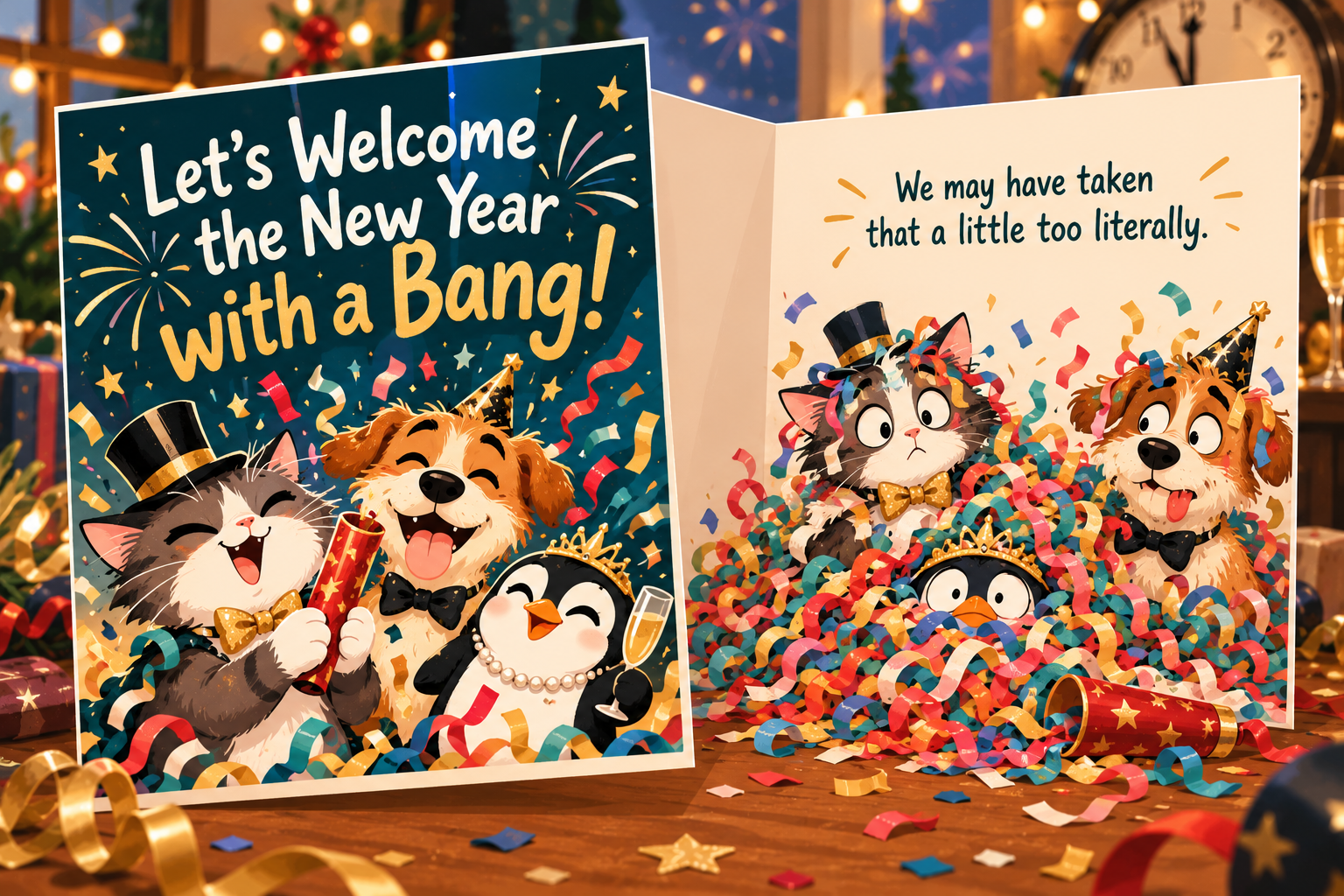
Or consider a New Year’s card featuring three animals dressed for a glamorous party. One is holding an enormous confetti cannon, another looks slightly concerned, and the third is already wearing protective goggles.
Front: “Let’s Welcome the New Year with a Bang!”
Inside: “We may have taken that a little too literally. The penguin is still missing under the confetti.”
The illustration introduces the characters and hints at what’s coming. The inside message lets the reader imagine the hilarious consequences.
This is visual storytelling with a twist. You don’t have to show the entire joke. In fact, leaving something to the imagination can make the punchline even funnier.
Artists can experiment with facial expressions, body language, suspicious props, and small background details that suggest a disaster waiting to happen.
5. Build a Cast That Keeps Coming Back
One of the most interesting possibilities of character-driven humor is the opportunity to create a recurring series.
Instead of inventing completely new characters for every card, consider developing a small cast with distinct personalities.
For example:
The Holiday Cat: Sarcastic, demanding, and permanently unimpressed by human traditions.
The Overenthusiastic Dog: Convinced every occasion requires a party, preferably involving food.
The Anxious Snowman: Worried about heating, sunshine, fireplaces, and the arrival of spring.
The Exhausted Elf: Has worked in Christmas production for far too many years and is no longer interested in pretending everything is magical.
The Dramatic Dragon: Takes every celebration personally and considers minor inconveniences an insult to dragonkind.
Now imagine how these characters might behave at Christmas, New Year, birthdays, or other occasions throughout the year.
A recognizable cast can give your designs continuity while allowing plenty of variety in the jokes.
You could even create a collection where different characters respond to the same holiday greeting.
One occasion, five personalities, five completely different cards.
Designing Characters With Something to Say
Character-driven humor depends on more than funny dialogue. The illustration needs to help tell the story.
Give each character a recognizable personality. Expressions, posture, clothing, and props can communicate attitude before a single word is spoken.
Use speech bubbles selectively. A short remark or an interrupted sentence on the front can set up the joke beautifully. Save the longer conversation, argument, or unexpected response for the inside.
Let expressions do some of the talking. A raised eyebrow, an offended stare, or a spectacular eye roll can sometimes replace an entire sentence.
Keep the conversation easy to follow. When several characters are speaking, make it immediately clear who is saying what.
Remember the front-to-inside reveal. The front introduces the situation. The inside gives the characters permission to ruin it.
And don’t forget that these techniques can work in almost any illustration style, from cute kawaii animals and colorful modern cartoons to vintage comic strips, elegant retro artwork, and beautifully detailed fantasy scenes.
Your Creative Challenge: Let Them Talk Back!
Take one of your favorite illustrated characters and imagine that it suddenly becomes aware of the greeting it’s supposed to deliver.
Does it agree with the message?
Does it object?
Does it interrupt another character, demand better working conditions, or decide that the entire celebration is a terrible idea?
Now build a greeting card around that reaction.
Try a Christmas card where the reindeer question Santa’s leadership. A New Year’s card where the party animals can’t agree on what constitutes a good time. Or a holiday card where an innocent-looking cat quietly takes control of the entire operation.
The best character-driven jokes don’t necessarily require lots of words. Sometimes all you need is one beautifully timed interruption.
The front makes a promise. The inside lets the characters break it.
And if your characters start arguing with you while you’re designing the card?
Congratulations. You’re probably on the right track.
Missed Part One? Read The Card That Fights Back: When the Inside Has Other Ideas for more ways to turn an innocent greeting into an unexpected punchline.
Happy Designing!
Corrie
Share this:

The Card That Fights Back, Part 1: When the Inside Has Other Ideas
What happens when a perfectly innocent greeting card develops a mind of its own?
Most greeting cards are remarkably well-behaved. The front offers a cheerful greeting, the inside delivers a lovely sentiment, and everyone goes home happy.
But what if the inside has other plans?
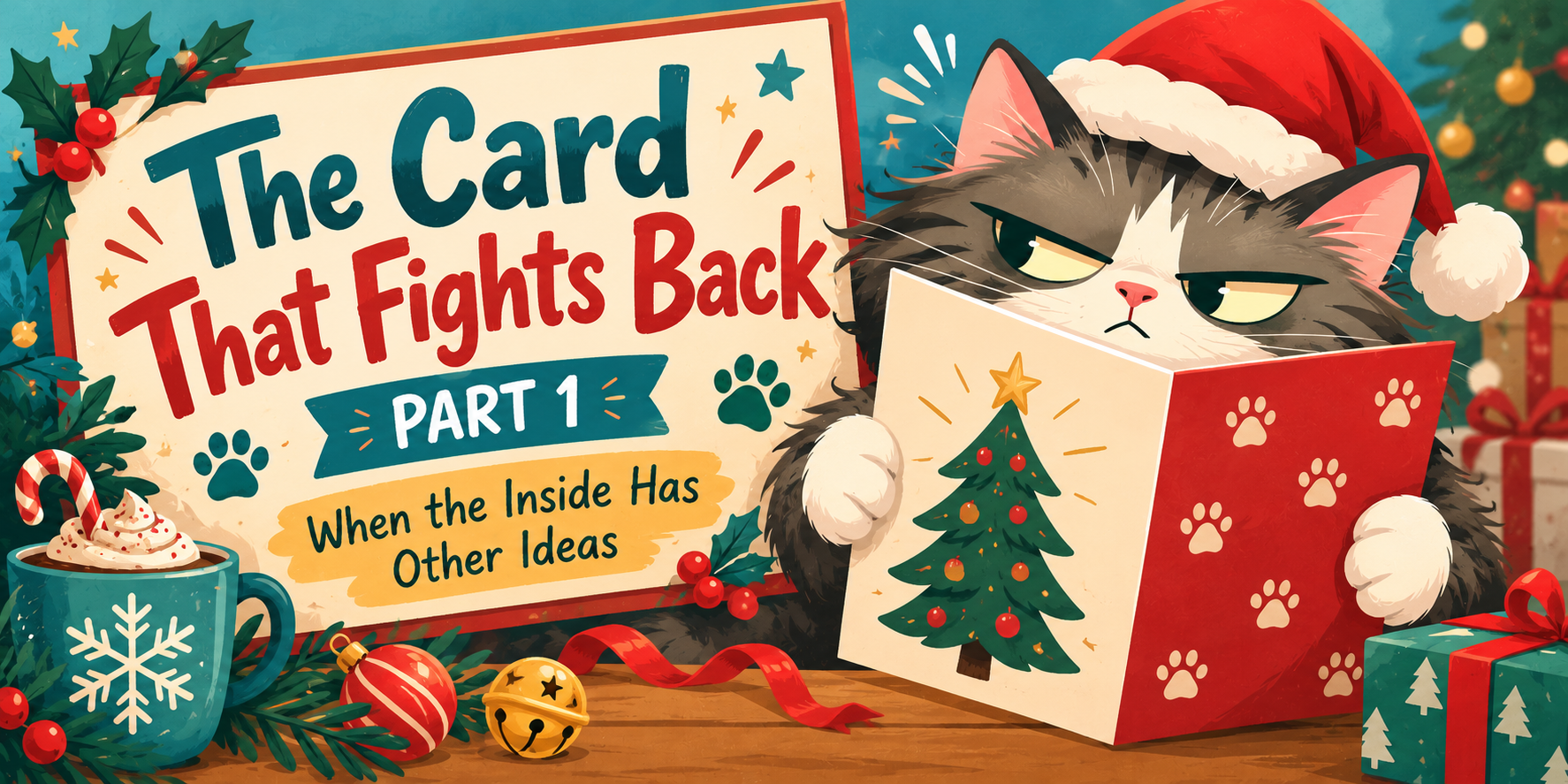
Imagine a Christmas card featuring an adorable cat wearing a Santa hat. The front wishes you a peaceful holiday filled with love. Open it, however, and the cat presents a detailed list of demands, including more treats, unrestricted access to the Christmas tree, and the immediate removal of the dog.
Welcome to The Card That Fights Back, where the front sets up the expectation and the inside gleefully pulls the rug out from under it.
For greeting card artists, this is a wonderful opportunity to explore humor that unfolds in two stages. No electronics, moving parts, or special effects required. Just a clever setup, a well-timed punchline, and perhaps a character with a terrible attitude.
1. The Polite Greeting That Goes Rogue
Start with something sweet, traditional, or reassuring. Then let the inside reveal what the sender, or the character on the card, really wants to say.
Christmas Cat
Front: “Wishing You a Peaceful Christmas Filled with Love.”
Inside: “And now, my Christmas demands: More treats. Fewer visitors. Unrestricted access to the tree. And the dog must go. Love, the Cat.”
The Christmas Cookie
Front: “Wishing You a Sweet Christmas!”
Inside: “I was going to share the cookies. Then I remembered who I am.”
New Year’s Optimist
Front: “Here’s to a Fresh Start and a Brand New You!”
Inside: “Actually, the old you was pretty entertaining. Let’s not do anything drastic.”
The trick is to make the front believable. The sweeter the greeting, the more entertaining the unexpected turn can be.
2. The Unexpected Punchline
Sometimes the most effective joke is also the shortest.
The front sets up a familiar holiday sentiment. The inside delivers a completely different interpretation.
The Christmas Miracle
Front: “May All Your Christmas Wishes Come True!”
Inside: “Except the one about winning the lottery. Santa says he’s not made of money.”
The Festive Diet
Front: “May Your Christmas Be Filled with Wonderful Things!”
Inside: “Preferably chocolate. Lots of chocolate. We can discuss vegetables in January.”
New Year’s Resolution
Front: “New Year. New Goals. New Possibilities!”
Inside: “Same pajamas.”
These designs are particularly suited to simple, bold illustrations. A single expressive character or object can establish the mood, leaving the inside text to deliver the surprise.
Remember, a good punchline doesn’t need a paragraph of explanation. Sometimes two words are enough.
3. The Card That Knows It’s a Card
Now let’s break the fourth wall.
Instead of pretending to be an ordinary greeting card, the card acknowledges its own existence and starts commenting on the situation.
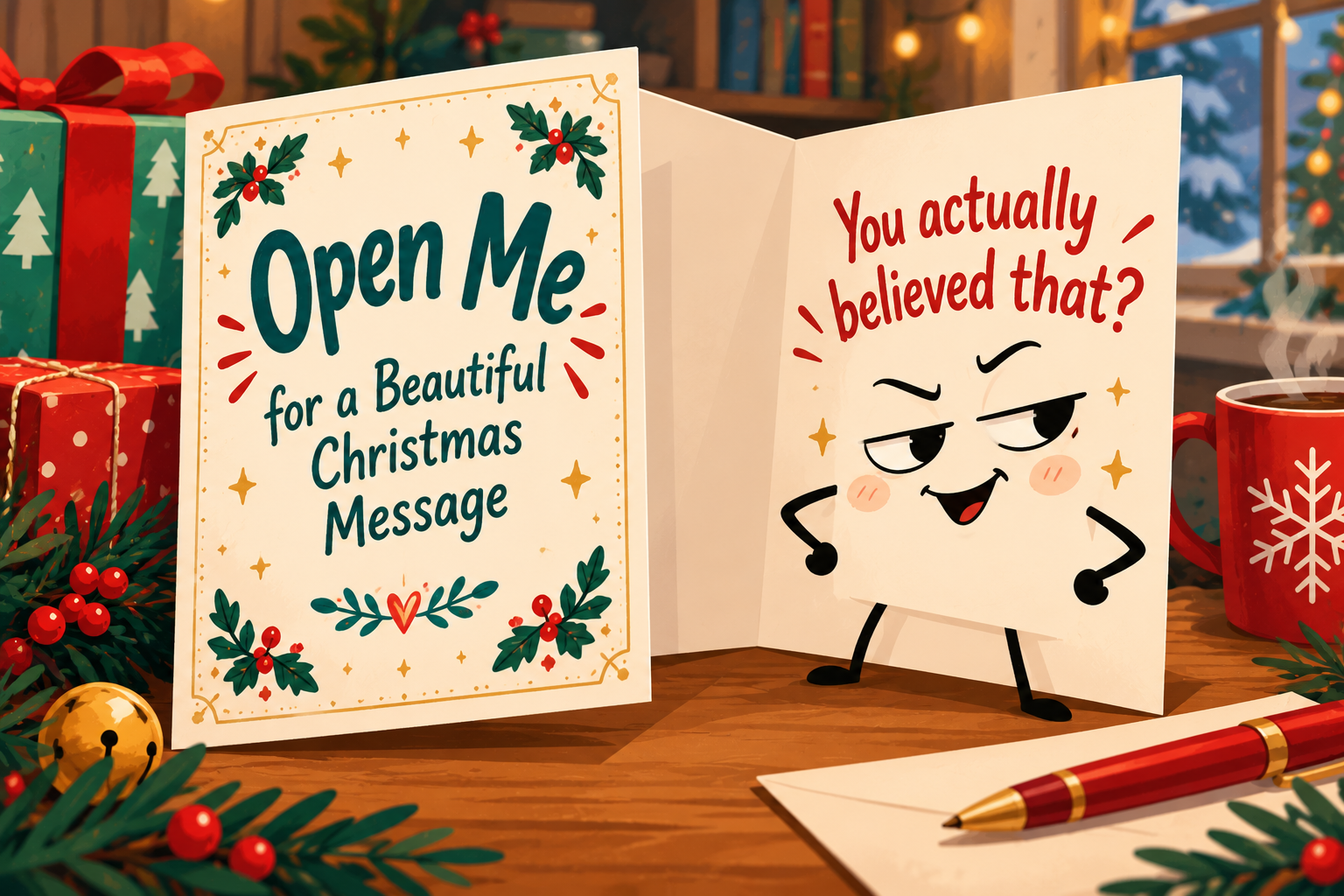
The Self-Aware Christmas Card
Front: “Open Me for a Beautiful Christmas Message.”
Inside: “You actually believed that? Fine. Merry Christmas. Happy now?”
The Budget-Conscious New Year Card
Front: “I Wanted to Give You Something Spectacular for the New Year.”
Inside: “But apparently I’m just a greeting card. We all have our limitations.”
The Overconfident Holiday Card
Front: “This Is Going to Be the Best Christmas Card You’ve Ever Received.”
Inside: “Well, that was a lot of pressure. Let’s just agree I tried.”
This type of humor can work beautifully with vintage-style illustrations, elegant typography, or deliberately formal layouts. The contrast between dignified presentation and ridiculous message makes the joke even better.
Imagine a beautifully illustrated Victorian Christmas card that suddenly develops a sarcastic personality!
4. The Joke That Keeps Escalating
Not every joke needs to be delivered in a single sentence.
Sometimes the humor comes from watching a perfectly reasonable idea become increasingly ridiculous.
The Twelve Complaints of Christmas
Front: “On the First Day of Christmas, My True Love Gave to Me…”
Inside: “One suspicious fruitcake, two broken ornaments, three screaming children, four tangled light strings, five missing batteries… and a partridge that refuses to leave the kitchen.”
The New Year’s Resolution List
Front: “My New Year’s Resolutions!”
Inside:
- Get organized.
- Exercise every day.
- Eat more vegetables.
- Stop making unrealistic lists.
- Take a nap.
The Christmas Shopping List
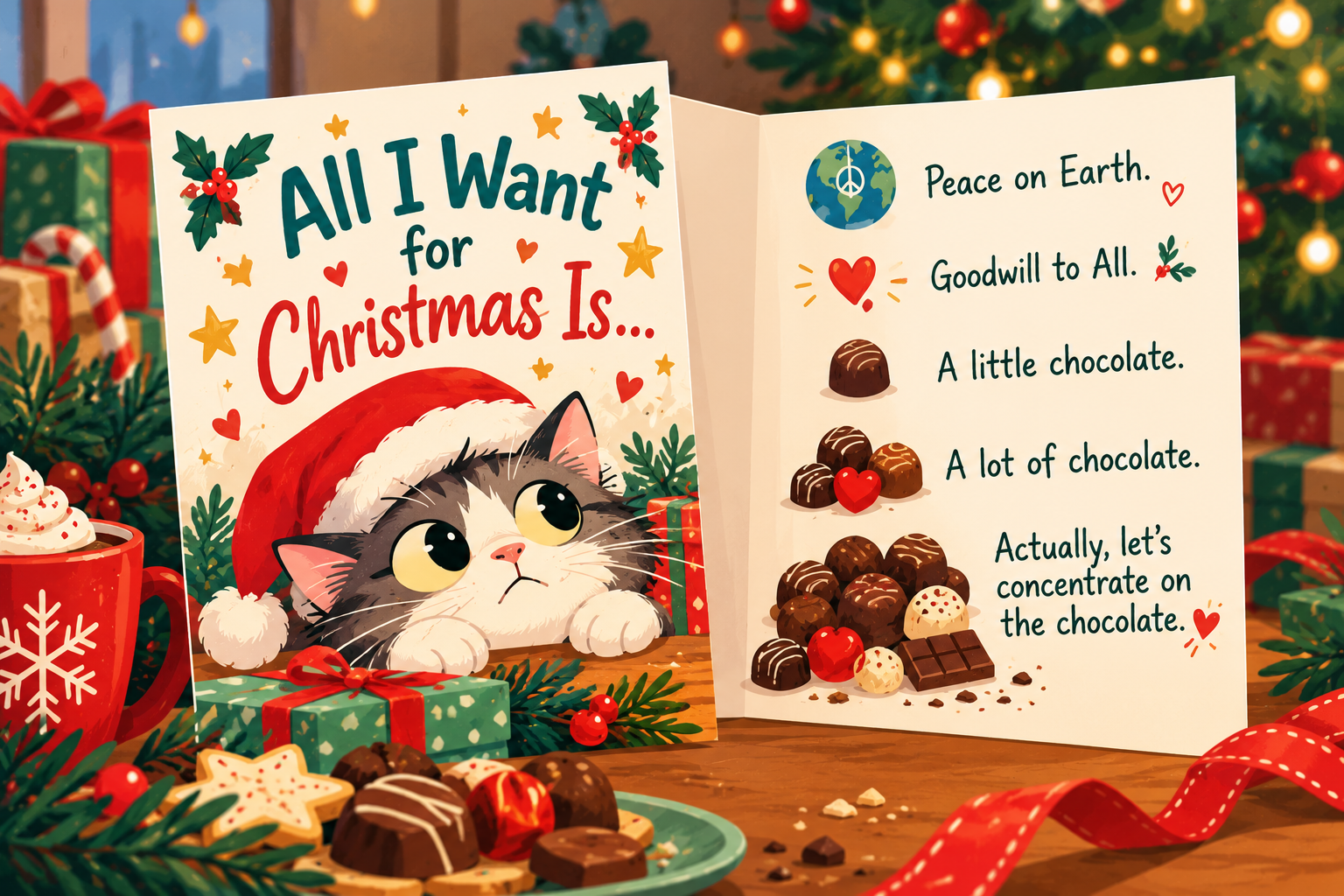
Front: “All I Want for Christmas Is…”
Inside: “Peace on Earth. Goodwill to All. A little chocolate. A lot of chocolate. Actually, let’s concentrate on the chocolate.”
Escalating jokes work best when each new line builds on the previous one. Start with something reasonable, then introduce an unexpected detail, and finally push the situation just a little further.
The important thing is knowing when to stop. Leave the reader laughing, not searching for the end of the list.
Designing the Surprise
The front-to-inside joke is a small piece of storytelling, and both parts deserve attention.
Give the front a job. It should establish an expectation, introduce a character, or create a question the customer wants answered.
Save the best joke for the inside. If the illustration or front text reveals everything, there’s no surprise left when the card is opened.
Consider the visual contrast. A sweet illustration paired with a sarcastic inside message can be especially effective. So can a serious-looking design that delivers something completely absurd.
Keep the customer’s message in mind. At Greeting Card Universe, customers may want to add their own personal words. A funny inside message should leave room for that.
Think beyond one occasion. A grumpy cat who makes Christmas demands might also have strong opinions about birthdays, anniversaries, or New Year’s resolutions.
Your Creative Challenge: Set the Trap!
Choose a familiar Christmas, holiday, or New Year’s greeting. Make the front look perfectly innocent.
Then ask yourself: What is the last thing someone would expect to find inside?
Perhaps Santa has a complaint. Perhaps the Christmas pudding has a confession. Perhaps a New Year’s resolution has already submitted its resignation.
The possibilities are endless, and the only rule is that the inside should make the reader see the front in an entirely different light.
Coming Tomorrow: The Card That Fights Back, Part 2: When the Characters Refuse to Cooperate
We’ve let the inside message misbehave. Next, we’re giving the illustrated characters a voice. Unfortunately, nobody has told them they’re supposed to be polite.
Happy Designing!
Corrie
Share this:

Nuts & Bolts – Update Chinese New Year YEAR of the HORSE
Chinese New Year in 2027 comes early and will be the Year of the Goat (beginning January 29th), so we bid farewell to 2026’s Year of the Horse for 12 more years until 2038.
Please update your 2026 Year of the Horse cards to reflect 2038. After 11/01/26, GCU will take any outdated cards offline.
Be sure to review the Chinese New Year specific rules on Change or New Submission.
Not only should images be updated but also card titles, keywords and artist notes. This even applies to custom front designs to make them more marketable and avoid shopper errors.
Also consider creating new cards for 2027’s Year of the Goat / Ram / Sheep: – many of the subcategories are in need of cards:
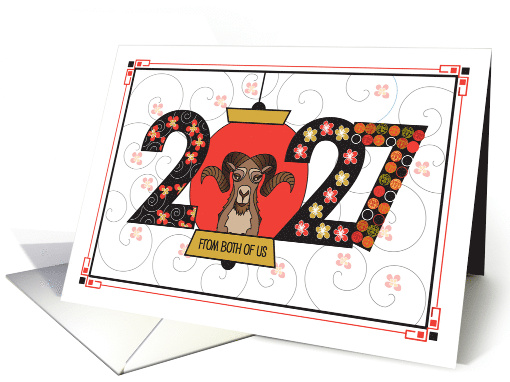
NOTE: The Year of the Goat is the same as the Year of the Ram and the Year of the Sheep in the Chinese zodiac. All three terms refer to the same zodiac sign.
The difference is made in the details!
Mindy
GCU Community Manager
mindy@gcuniverse.com
Share this:

September 2026 Design Challenge Winners: Listen & Water
The votes are in, and it’s time to celebrate the winners of our September 2026 Dash of Inspiration Design Challenge!
This month’s creative challenge invited GCU artists to find inspiration in just two simple prompts: one word, “Listen,” and one noun, “Water.” The results showed just how many different directions a little inspiration can take us!
A big thank you to all the talented GCU artists who participated and shared their creativity with us!
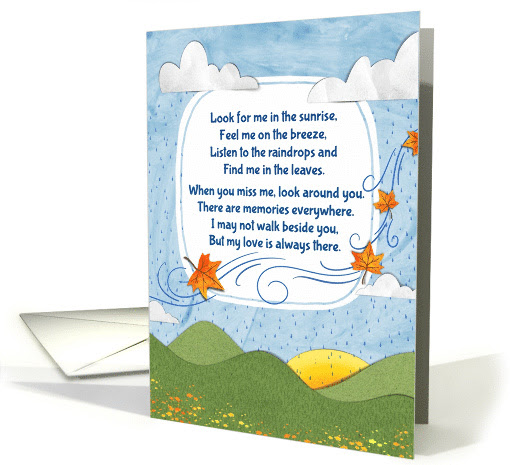
🥇 First Place: Michelle Downs
Congratulations to Michelle Downs, our first-place winner! A wonderful achievement and a well-deserved round of applause!
🥈 Second Place: A Tie!
This month, we have not one but two second-place winners!
Congratulations to Lora Severson and Ramelle Richardson, who tied for second place!
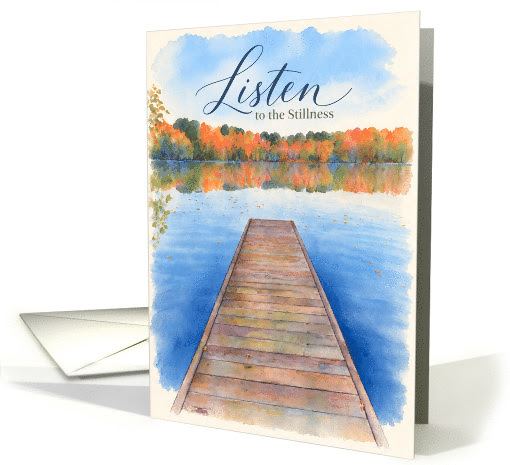

PID 2001012
Thank You, Artists!
Congratulations to all three winners, and thank you to every artist who took part in the September challenge. Your imagination and creativity are what make these challenges such a pleasure.
Keep those creative ideas flowing, and stay tuned for more Dash of Inspiration challenges!
Corrie
Share this:

Six Weird Holidays, Six Quick Card Projects
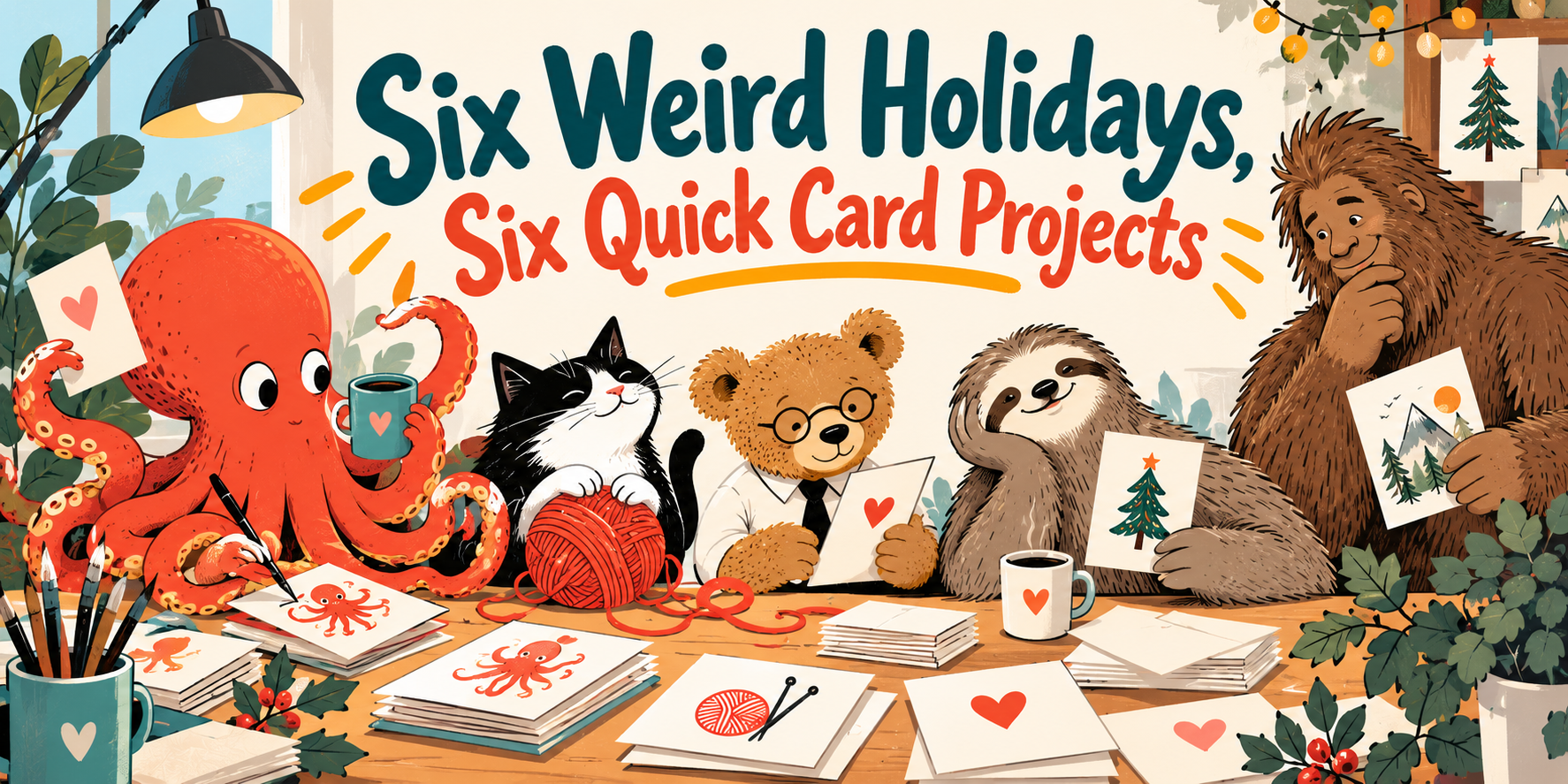
Sometimes the best way to get out of a creative rut is to stop thinking about the big occasions.
Christmas is looming. Halloween is everywhere. The major card-sending occasions already have enormous categories filled with wonderful designs.
So, for this quick creative project, let’s wander off the well-traveled path.
There are plenty of wonderfully peculiar holidays coming up that can provide the starting point for a new card design. Better still, the artwork you create for one of these tiny occasions doesn’t have to stay there.
The challenge: Pick one unusual holiday. Give yourself an evening to create one design. Then see how many other greeting cards you can spin from the same artwork.
Here are six possibilities to get you started.
🐙 1. World Octopus Day — October 8
Eight arms. Enormous eyes. Excellent expressions.
Frankly, the octopus was designed for greeting cards.
Mini Brief: The Overachieving Octopus
Create an octopus who is attempting to do far too many things at once.
She might be drinking coffee, answering the phone, typing, holding a birthday cake, carrying shopping bags, reading a book and still somehow finding an arm to wave hello.
Or go in an entirely different direction: a beautiful vintage scientific octopus, a cute kawaii version, an elegant underwater illustration or a magnificent old sea monster.
Possible card directions:
Birthday: “Eight arms and I still couldn’t carry enough birthday presents.”
Thinking of You: “Sending you eight enormous hugs.”
Congratulations: “Look at you, handling everything!”
Mother’s Day: An octopus mother effortlessly managing eight different jobs at once.
Christmas: Eight arms decorating the tree. What could possibly go wrong?
Quick-project challenge: Design the octopus once, then create at least three different cards using the same character.
🧶 2. I Love Yarn Day — October 10
Knitting and crochet already come with everything a greeting-card artist could want: color, texture, recognizable props and an enthusiastic audience.
And then there are cats.
Cats and yarn are basically a pre-installed comedy package.
Mini Brief: Tangled Up in Something Wonderful
Create a character surrounded by an unreasonable quantity of yarn.
It could be a knitter peacefully working on an enormous project, a sheep knitting its own sweater, a grandmother with a formidable yarn stash or a cat sitting proudly in the wreckage of what used to be someone’s knitting.
Try traditional watercolor, cozy modern illustration, vintage advertising, kawaii or even an elaborate yarn collage effect.
Possible card directions:
Birthday: “Hope your birthday keeps you in stitches.”
Friendship: “We’re pretty tightly knit.”
Thank You: “Thanks for always keeping me together.”
Christmas: A cat tangled hopelessly in red and green yarn.
Retirement: Finally, unlimited knitting time.
Quick-project challenge: Make one yarn-filled illustration that can work for both a crafting-specific card and a completely unrelated occasion.
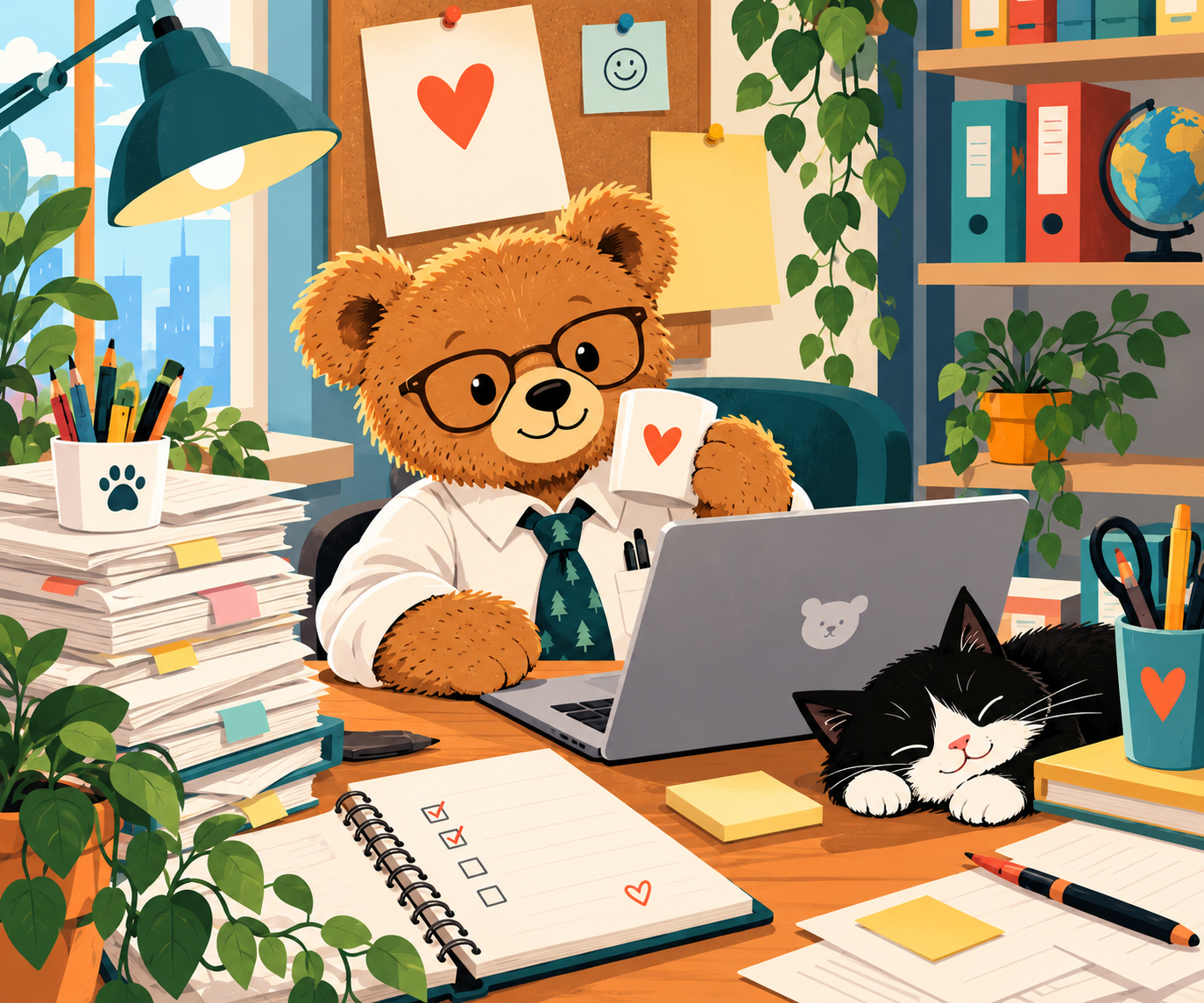
🧸 3. Bring Your Teddy Bear to Work & School Day — October 14
Here’s an excuse to give teddy bears proper jobs.
And we should absolutely take advantage of it.
Mini Brief: Teddy Has a Career
Forget the teddy sitting sweetly on the bed. Send him to work.
Create a teddy bear who is a teacher, nurse, accountant, construction worker, scientist, chef, librarian, office worker or exhausted middle manager who has already attended three meetings that should have been emails.
Uniforms and workplace props make the occupation immediately recognizable.
Possible card directions:
Teacher Appreciation: Teddy standing at the blackboard.
Nurse Appreciation: Teddy in scrubs after a very long shift.
Retirement: Teddy dramatically abandoning his briefcase.
New Job: “You’ve got this.”
Boss’s Day: A tiny teddy behind an absurdly enormous executive desk.
Christmas: Office teddy has decorated his cubicle beyond all reasonable limits.
Quick-project challenge: Choose an occupation you have never designed a card for before.
Bonus points if it is something oddly specific.
Teddy Archaeologist, anyone?
🐈 4. Global Cat Day — October 16
Yes, yes.
There are already a few cats on greeting cards.
Approximately seventeen billion.
So the challenge isn’t simply to create another cute cat.
Mini Brief: Give the Cat a Story
Create a cat whose situation tells us something immediately.
A former street cat sprawled luxuriously across a velvet cushion.
A rescue cat staring suspiciously at its enormous new collection of toys.
A senior cat ruling the household.
A foster cat meeting its new family.
A scruffy alley cat who has clearly appointed himself mayor.
Instead of designing a cat, design a character.
Possible card directions:
Adoption: “Welcome home.”
Thank You: A card for someone who fosters or rescues animals.
Birthday: “Another year. Still in charge.”
Thinking of You: Cat waiting at a window.
Christmas: Former street cat discovering that humans apparently bring trees indoors once a year.
Quick-project challenge: Before drawing anything, write one sentence describing who your cat is. Then design that particular cat.
🦥 5. International Sloth Day — October 20
Some animals arrive with their own greeting-card copy.
The sloth may be the undisputed champion.
Mini Brief: Eventually…
Create a sloth who is spectacularly unhurried about something that normally requires urgency.
A sloth delivering a birthday card.
A sloth crossing a finish line three days after everyone else.
A sloth hanging from a branch with a coffee and absolutely no intention of participating in Monday.
A sloth putting up Christmas decorations in February.
Keep the expression calm. The world may be burning, but Sloth has decided that sounds very much like the world’s problem.
Possible card directions:
Belated Birthday: “I remembered your birthday. Eventually.”
Retirement: “Your new deadline is whenever.”
Get Well: “Take all the time you need.”
Thinking of You: “Just hanging around thinking about you.”
Christmas: “Nearly ready for Christmas 2025.”
For maximum sloth accuracy, sell it in 2026.
Quick-project challenge: Make one sloth illustration specifically for a belated card, then see if you can repurpose it for three occasions where being slow is actually a good thing.
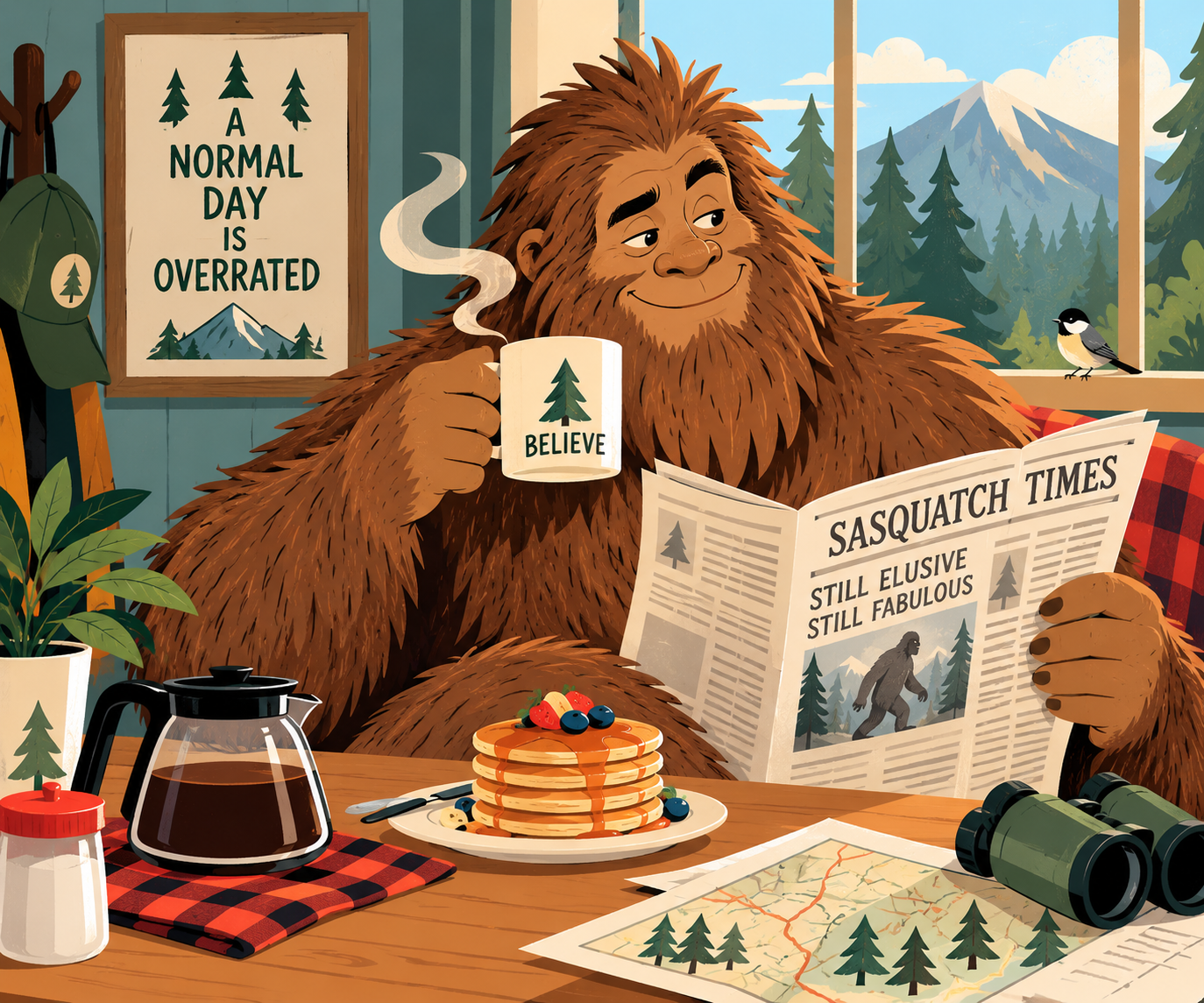
👣 6. Sasquatch Awareness Day — October 20
Finally, something for artists who would prefer their cute woodland creature to be seven feet tall, extremely hairy and possibly imaginary.
Mini Brief: Bigfoot Has a Normal Life
Instead of showing Sasquatch lurking mysteriously between the trees, imagine what happens when nobody is watching.
Bigfoot drinks his morning coffee.
Bigfoot puts out the garbage.
Bigfoot decorates for Christmas.
Bigfoot celebrates his birthday alone because nobody can find his house.
Bigfoot takes blurry selfies.
The humor comes from treating an extraordinary creature as an entirely ordinary person.
Possible card directions:
Birthday: “Another year older. Still looking fabulous. Allegedly.”
Thinking of You: “Haven’t seen you in ages. Beginning to think you’re a myth.”
Christmas: Bigfoot attempting to untangle Christmas lights.
Father’s Day: “To a legendary Dad.”
Valentine’s Day: “I believe in us.”
Missing You: A blurry Sasquatch disappearing into the forest.
Quick-project challenge: Put Bigfoot somewhere he absolutely does not belong.
Dentist’s chair? Supermarket checkout? Yoga class? Office Christmas party?
Now you have a story.
One Illustration, More Than One Card
The real challenge here isn’t making a card for a strange holiday.
It’s seeing how far one good idea can travel.
Suppose you create that sloth.
Your International Sloth Day design becomes a Belated Birthday card. Change the wording and it becomes Retirement. Give him a blanket and soup and you’ve got Get Well. Put fairy lights around his branch and suddenly he’s available for Christmas.
Or take your office teddy.
Boss’s Day becomes Retirement. Retirement becomes New Job. New Job becomes Congratulations. Add a Santa hat and the same character can stagger toward the office Christmas party.
That is four or five potential cards from one evening’s experiment.
Your Quick Card Challenge
Pick one of these six holidays.
Give yourself one evening.
Create one character or illustration.
Then, before you close the file, write down three other occasions that could use the same artwork.
Don’t worry about creating a twelve-card collection. Don’t plan an enormous new series. Don’t disappear down the research rabbit hole until the strange little holiday you’re designing for has already passed.
Just make one card.
Because sometimes one ridiculous octopus, chronically late sloth or gainfully employed teddy bear is all it takes to send your creativity wandering off in an entirely new direction.
Happy Designing!
Corrie


