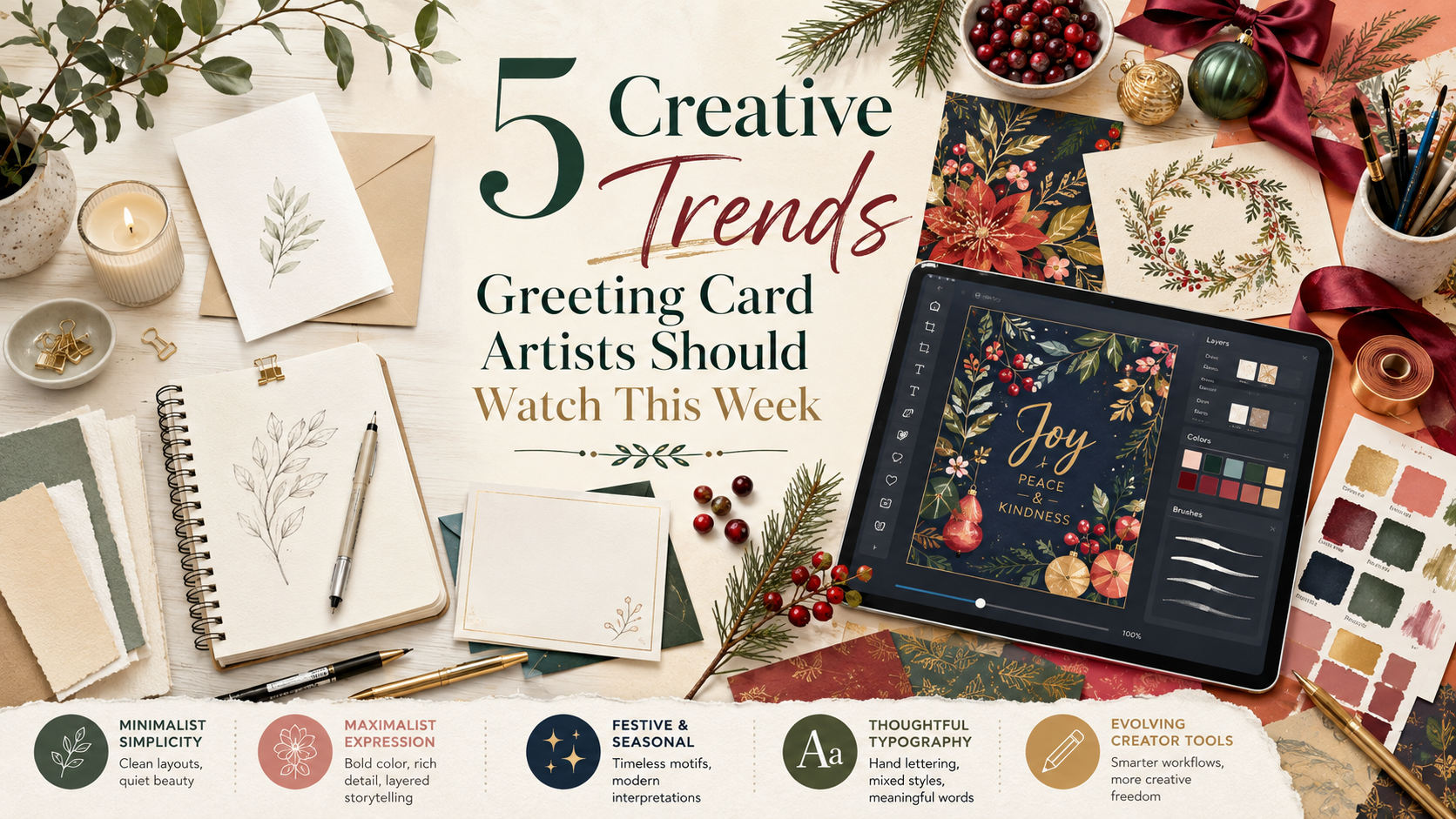
5 Creative Trends Greeting Card Artists Should Watch This Week
The creative world never sits still for very long. New design directions, tools, seasonal aesthetics and visual trends keep bubbling up, and some of them have real potential for greeting card artists.
Here are five developments worth keeping an eye on this week, especially if you are looking for fresh ideas for card design, illustration, typography, humor or seasonal work.
1. Greeting Card Award Winners Show What Stands Out
The 2026 Louie Awards recently highlighted some of the strongest work in the greeting card industry, with entries from a wide range of stationery brands and designers.
Awards like these are useful because they give us a snapshot of what professional judges are responding to right now: strong concepts, distinctive voices, thoughtful craftsmanship and cards that feel memorable rather than generic.
Why this matters for GCU artists
As polished imagery becomes easier to create, originality becomes even more important. A strong card idea, clever message, unusual visual treatment or recognizable personal style can still make a design stand out in a crowded marketplace.
2. Minimalism and Maximalism Are Happily Coexisting
One of the more interesting things happening in design right now is that two almost opposite styles are thriving at the same time.
On one side we are seeing clean layouts, restrained color palettes and editorial simplicity. On the other, there is a strong appetite for richer color, stripes, ornament, florals, texture and playful maximalism.
Rather than choosing one camp, designers are increasingly mixing the two.
Why this matters for GCU artists
A simple card layout can become much more distinctive with one deliberately over-the-top element: an enormous bow, dramatic typography, an ornate border, a theatrical stripe or a beautifully excessive floral detail.
Think clean structure with one element that refuses to behave.
3. AI Editing Tools Are Becoming More Precise
Creative AI tools are moving beyond generating complete images from scratch. Newer editing approaches are increasingly focused on making targeted changes to specific parts of an existing image.
That means creators can keep the composition, character or atmosphere they already like and adjust only the troublesome part.
Why this matters for GCU artists
This could make AI-assisted illustration much more practical for greeting card work.
Instead of regenerating an entire image because one hand, prop, expression or background detail is wrong, artists may increasingly be able to fix individual elements while preserving the rest of the design.
That is a much more useful workflow for finished card artwork.
4. Christmas 2026 Is Leaning Toward Nostalgia With Polish
Christmas design is showing signs of becoming richer, warmer and slightly more sophisticated.
We are seeing interest in vintage-inspired imagery, elegant serif typography, deeper seasonal colors such as cranberry, merlot, pine and champagne, and tactile details such as layered paper effects, die cuts and decorative framing.
The overall mood feels nostalgic, but not old-fashioned.
Why this matters for GCU artists
This creates plenty of room for artists who enjoy vintage, Victorian, mid-century or traditional Christmas imagery.
The trick is to borrow the visual language of the past without simply recreating it.
A vintage-looking image paired with modern humor, unexpected wording or a contemporary color palette can feel wonderfully fresh.
Let 1955 provide the wardrobe. Let 2026 write the punchline.
5. AI Is Becoming More Culturally Specific
Another interesting development is the growing push toward AI systems that better understand regional cultures, languages and visual traditions.
Instead of producing the same broadly Western-looking imagery for every prompt, future tools are likely to become better at handling culturally specific clothing, decorative traditions, celebrations, architecture and symbolism.
Why this matters for GCU artists
Greeting cards are deeply connected to culture, family traditions and celebrations.
Better culturally specific tools could open the door to more authentic card designs for holidays, communities and occasions that are currently poorly represented in generic image generators.
That could also help artists explore smaller and more specialized card categories with greater confidence.
The Bigger Creative Trend
There is an interesting thread connecting all five of these developments.
As technology makes polished imagery easier to produce, specificity becomes more valuable.
A distinctive sense of humor, unusual subject matter, culturally meaningful details, expressive typography, tactile-looking illustration and a recognizable artistic voice may become increasingly important.
In other words, the future may not belong to the artist who can make the most perfect image.
It may belong to the artist whose work is unmistakably theirs.
Three Ideas to Explore
If you are looking for somewhere to start this week, you might try:
- Create a card with a very clean composition and one deliberately extravagant element.
- Experiment with a vintage Christmas aesthetic paired with thoroughly modern wording.
- Look through underrepresented GCU categories and consider whether culturally specific or highly niche imagery could offer new opportunities.
Sometimes trends are most useful not as instructions, but as little doors.
You only need one of them to lead somewhere interesting.
Greeting Card Association – Louie Awards
https://www.greetingcard.org/louie-awards/
Home & Giftware Magazine – Trends in the Greetings Turret
https://giftwaremagazine.com/trends-in-the-greetings-turret/
Adobe – New Photoshop Innovations & AI Markup
Photoshop innovations
AI Markup in Photoshop
Brookhollow Cards – 2026 Holiday Card Trends
https://www.brookhollowcards.com/business-holiday-card-trends.aspx
Autumn Fair 2026
https://www.autumnfair.com/
Adobe, MCIT & HUMAIN – Culturally Specific AI Initiative
https://news.adobe.com/news/2026/08/adobe-mcit-and-humain-expand-partnership
Happy Designing!
Corrie


This is a great sentiment and inspiration, Corrie, thank you for sharing:
“… the future may not belong to the artist who can make the most perfect image. It may belong to the artist whose work is unmistakably theirs.”
I appreciate all the hard work you put into your columns. We artists look forward to your thoughts and suggestions. Thank you.
Gail