When a Christmas Card Becomes a Keepsake
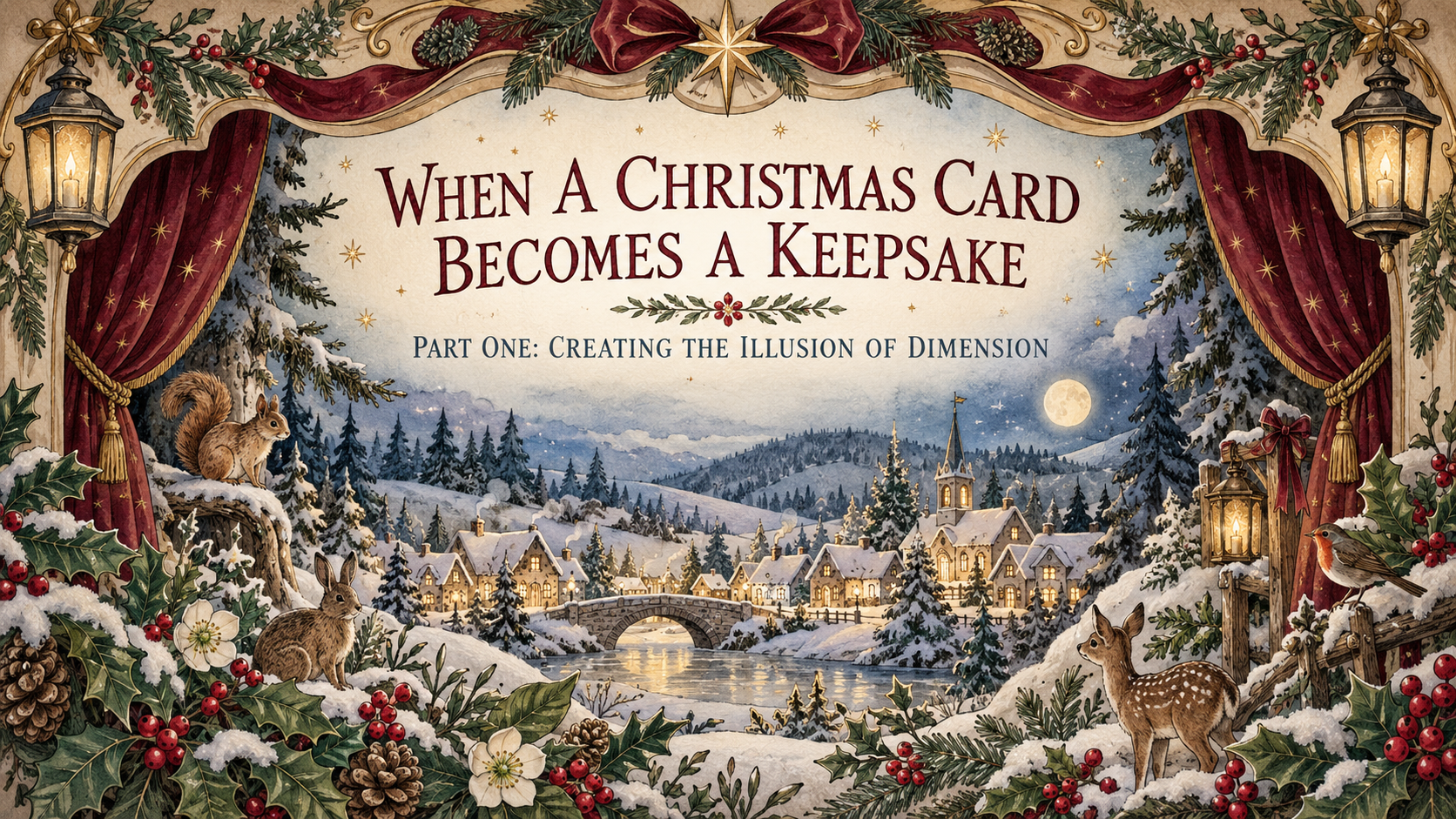
Part One: Creating the Illusion of Dimension
A Christmas card usually has one main job: to carry a warm message from one person to another. But some cards do a little more. They are displayed on the mantelpiece, admired by visitors and carefully packed away with the decorations when Christmas is over.
The following December, they may even come out again.
Those are the cards that have become keepsakes.
Dimensional Christmas Cards Move into Premium Retail
A recent development in the greeting-card world offers an interesting starting point for GCU artists.
Santoro’s three-dimensional pop-up Christmas cards have secured seasonal listings with major British retailers Waterstones and Fortnum & Mason. The collection uses paper engineering, moving parts and unusual constructions to position the greeting card somewhere between a traditional card and a small gift. One of the designs was also named a finalist in the 2026 Louie Awards.
You can read more about the collection in the Santoro Christmas collection report from Greetings Today.
This does not mean GCU artists should suddenly start designing actual pop-up cards. GCU produces traditionally folded printed cards and cannot reproduce moving parts, cut-outs, embossing, metallic finishes or complicated paper engineering.
What we can borrow is the idea behind these premium cards:
A Christmas card can feel like a beautiful little object worth displaying and keeping.
The challenge for GCU artists is to create that feeling entirely through the printed design.
Build a Miniature Christmas World
Instead of placing one Christmas character or object in the middle of the card, consider building an entire little world around it.
Rather than illustrating a single Christmas tree, show the room in which it stands. Add the armchair, the cat sleeping beneath the branches, the half-open presents, the firelight and the snowy garden visible through the window.
Instead of drawing one robin on a branch, create a miniature winter garden filled with berries, seed heads, frost, bird feeders and several tiny woodland visitors.
The more there is to discover, the longer someone will want to look.
Possible miniature worlds include:
- A Christmas Eve living room shown as an open dollhouse
- A tiny bookshop decorated for Christmas
- A woodland-animal village beneath the snow
- A festive greenhouse filled with winter plants
- A row of cottages with a different scene in every window
- Santa’s wonderfully cluttered study
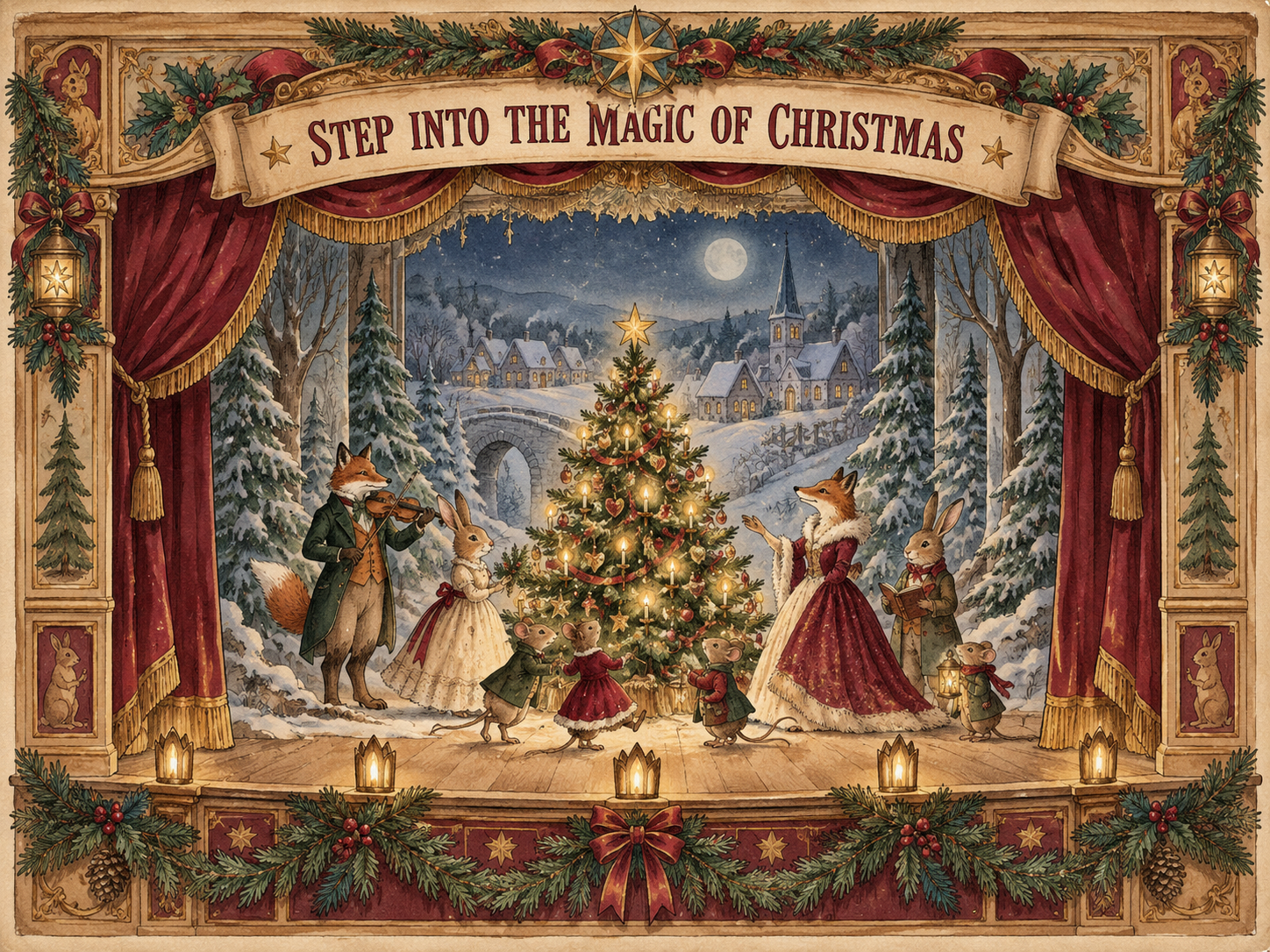
- A miniature Victorian Christmas theatre
- A magical cabinet of Christmas curiosities
- A snow globe containing an entire festive town
- A cat asleep in the middle of an elaborate model village
These scenes can be nostalgic, elegant, humorous or whimsical. What matters is that the illustration feels complete enough for the recipient to enter it with their imagination.
Borrow the Look of a Paper Theatre
Paper theatres, shadow boxes and pop-up books create depth by arranging the scenery in layers. The same effect can be suggested in a flat printed design.
A composition might include:
- A decorative foreground frame
- Characters or foliage overlapping the frame
- The main action in the centre
- A distant background visible through an arch, doorway or window
- Gentle shadows between the illustrated layers
Imagine an outer border of holly and ribbons, open theatre curtains behind it, a Christmas village in the centre and a moonlit forest disappearing into the distance. Nothing physically folds or pops forward, but the card still gives the impression of dimension.
Artists could create this effect with:
- Painted scenery
- Digital collage
- Papercut-style illustration
- Layered botanical elements
- Decorative arches and windows
- Folded-paper illusions
- Soft shadows behind individual elements
- Overlapping characters and objects
Be careful not to make the design so complicated that it loses its focal point. A richly detailed card should reward a closer look, but the main subject and greeting must still be clear when the card appears as a small online thumbnail.
Make the Card Resemble a Treasured Object
Another way to suggest keepsake value is to design the card front as though it were a decorative or collectible object.
It could resemble:
- An antique Christmas storybook
- A Victorian toy theatre
- An illuminated manuscript
- A vintage ornament box
- A miniature shopfront
- An advent-calendar window
- A carved wooden picture frame
- A decorative collector’s plate
- A stained-glass window
- A beautifully wrapped parcel
- An old-fashioned music box
- A Christmas recipe card passed down through generations
A trompe-l’œil approach could work particularly well. Illustrated fabric curtains, wooden frames, layered paper, ribbons, hinges, carved arches and folded edges can make the viewer momentarily believe they are looking at a constructed object.
The card is still conventionally printed, but it appears tactile and dimensional.
Look Through Windows and Doorways
Windows provide an easy way to create both dimension and story.
The viewer might be:
- Looking through a frosted window into a warm family kitchen
- Peering into Santa’s workshop after everyone has gone home
- Watching woodland animals celebrate inside a hollow tree
- Looking out from a cozy room toward a snowy landscape
- Standing outside a miniature Christmas shop
- Discovering a secret festive world behind an old cupboard door
Doorways, curtains, arches, keyholes and open books can achieve a similar effect. They turn the image into an invitation: something is waiting on the other side.
Use Borders Worthy of a Frame
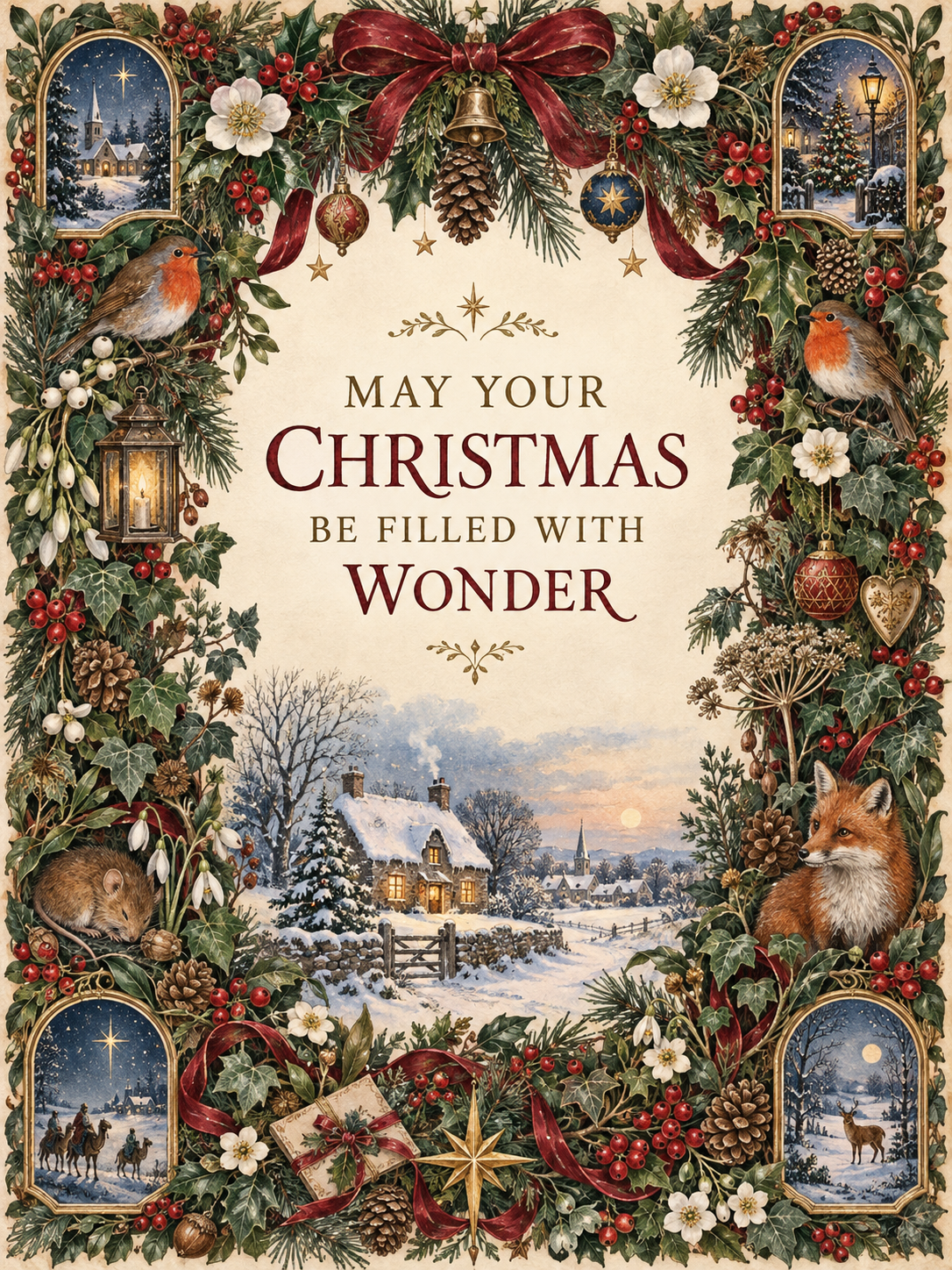
A strong decorative border can make a card feel like a small piece of art.
Possible approaches include:
- Layered winter botanicals
- Woodland animals hidden among the foliage
- Art Nouveau-inspired holly and mistletoe
- Stars, moons and celestial motifs
- Folk-art birds and flowers
- Antique toys and ornaments
- Gingerbread architecture
- Illustrated ribbons containing names or greetings
- Tiny windows showing different Christmas scenes
The border should lead the eye toward the central subject and wording rather than compete with them. Leave plenty of breathing room around the message, especially if the design can be customized.
Add a Little Movement to a Still Image
Although the card cannot physically move, the illustration can suggest that something has just happened—or is about to.
Try showing:
- A curtain being pulled open
- A door swinging inward
- Snow falling through several layers of scenery
- A present with its ribbon beginning to unravel
- A tiny train disappearing into a tunnel
- Santa’s legs vanishing up a chimney
- A cat reaching one paw toward a dangling ornament
- A family arriving at a warmly lit doorway
- A woodland procession travelling through the snow
This sense of unfolding action makes the card feel like one captured moment from a larger story.
A Flat Card Can Still Feel Special
GCU artists do not have to reproduce the physical construction of a premium pop-up card to learn from its success.
The real lesson is not about folds, tabs or moving parts. It is about giving the recipient more to experience: atmosphere, discovery, detail and the feeling of entering a miniature Christmas world.
In Part Two, we will take the idea one step further. Beautiful construction may make someone display a card, but personal meaning is what makes them keep it. We’ll explore storytelling, relationships, customization, collectible series and messages that deserve to be brought out again next Christmas.
Happy Designing!
Corrie


