Beyond the Christmas Cats: Turn One Card Idea Into a Collection
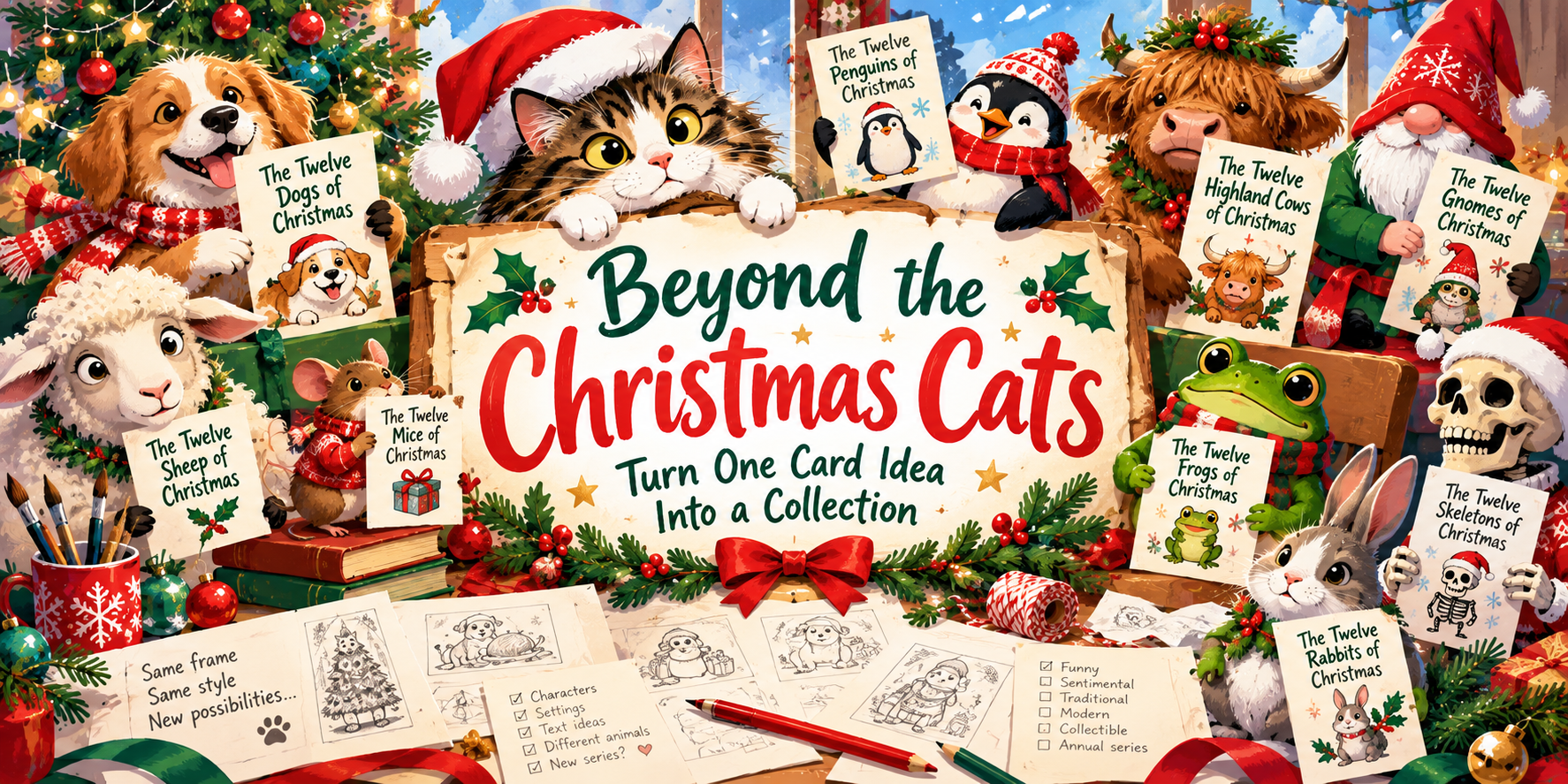
In Part One, we unleashed twelve cats on Christmas.
Trees were climbed. Baubles were destroyed. Presents were prematurely opened. A gingerbread house suffered a mysterious structural failure.
But The Twelve Cats of Christmas wasn’t really just an idea about cats.
It was an idea about collections.
Instead of creating one card, finishing it and immediately looking for an entirely new concept, what happens if you stop and ask:
Could this idea become a series?
That simple question can turn one promising design into an entire group of related cards.
Change the Animal
The easiest way to explore the idea is simply to change the star.
The Twelve Dogs of Christmas
Dogs provide entirely different possibilities.
A Labrador steals Christmas dinner.
A terrier disappears into a mountain of wrapping paper.
A dachshund wears an absurdly long Christmas jumper.
A guilty-looking dog sits beside an empty plate that previously contained cookies for Santa.
Possible text:
Santa, we need to talk about the cookies.
Dear Santa, define “naughty.”
I didn’t eat the Christmas dinner. I rescued it.
Christmas calories don’t count if they fall on the floor.
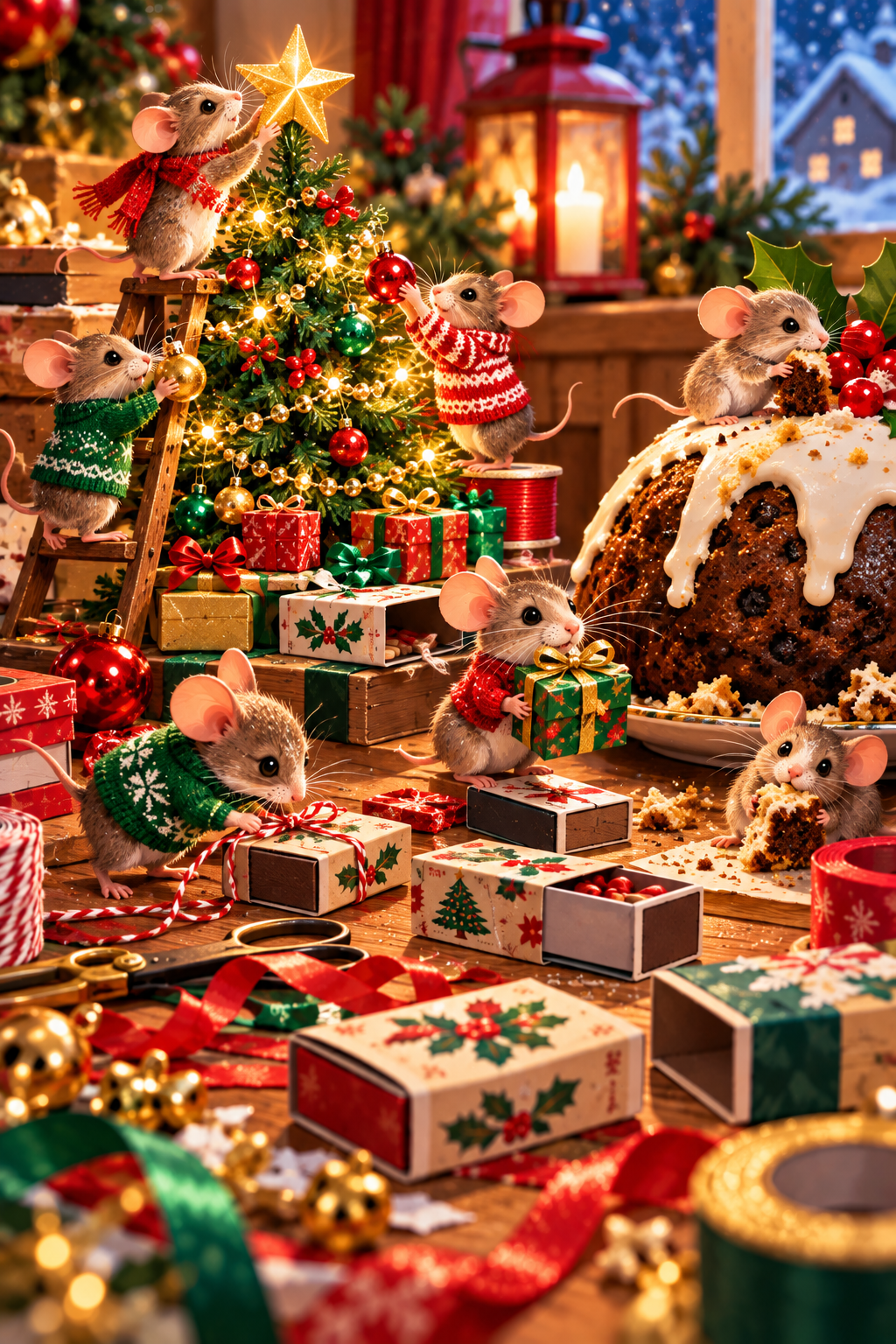
The Twelve Mice of Christmas
Go smaller.
Tiny mice could wrap matchbox presents, decorate miniature trees, steal crumbs from the Christmas pudding or hitch a ride in Santa’s sleigh.
Possible text:
Have yourself a merry little Christmas.
Christmas is made of little things.
Not a creature was stirring…
Except, apparently, these twelve.
The Twelve Sheep of Christmas
This one comes with a ready-made supply of terrible puns, which naturally makes it irresistible.
Fleece Navidad.
All I want for Christmas is ewe.
Season’s bleatings.
Baa humbug.
But you don’t have to stop at puns.
Imagine twelve increasingly chaotic sheep attempting to stage their own Christmas nativity play.
That could become a collection all by itself.
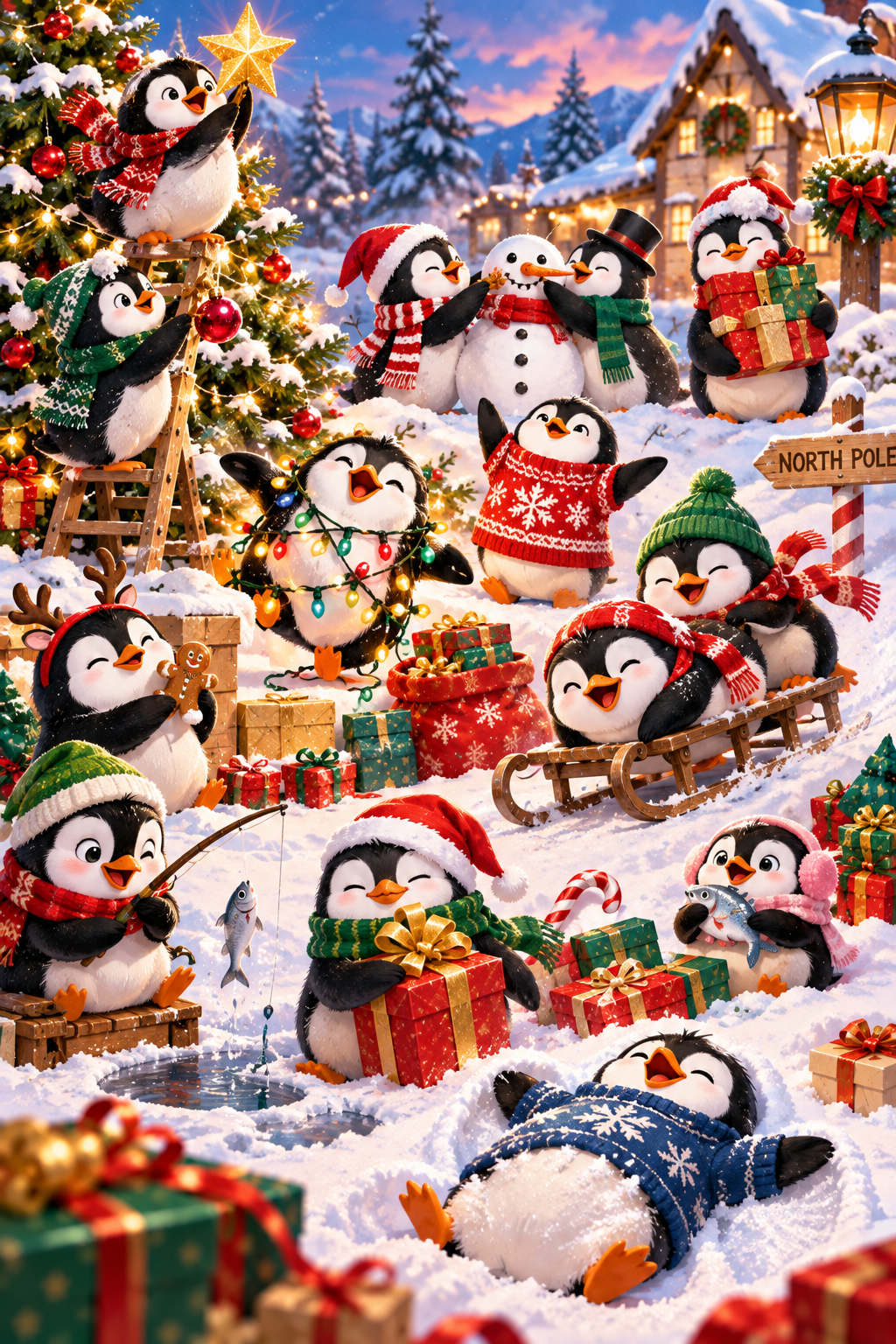
The Twelve Penguins of Christmas
Scarves. Snow. Ice. Presents. Christmas sweaters.
Penguins arrive practically pre-decorated for the season.
Have an ice Christmas.
Waddle I do without you?
It’s beginning to look a lot like Fishmas.
Or make the humor visual and let the sentiment remain traditional.
And Then Keep Going
Highland cows.
Rabbits.
Frogs.
Bears.
Capybaras.
Raccoons.
Hedgehogs.
Chickens.
Goats.
Or forget choosing one species and create The Twelve Pets of Christmas.
Each card could feature a completely different animal encountering the same strange human Christmas traditions for the first time.
It Doesn’t Have to Be an Animal
Once you start thinking in collections, the possibilities become much wider.
The Twelve Gnomes of Christmas could give each gnome a different seasonal responsibility.
One wraps presents.
One bakes cookies.
One decorates the tree.
One has clearly been sampling the mulled wine.
The Twelve Snowmen of Christmas could feature twelve different snow characters, occupations or unfortunate festive situations.
The Twelve Skeletons of Christmas could attempt normal seasonal activities despite their lack of skin, muscles and functioning digestive systems.
Imagine one sitting beside an enormous Christmas dinner.
I’ve been waiting all year for this.
Or a skeleton in a Christmas jumper:
Does this make me look bony?
The structure provides consistency while the individual scenes provide the surprise.

Create a Cast, Not Just a Collection
Another approach is to develop recurring characters.
Think about the personalities hiding inside your illustrations.
Perhaps your Christmas series contains:
the optimist who loves everything about Christmas,
the grump who wants January to arrive immediately,
the perfectionist decorating every branch,
the chaotic helper undoing everything,
the overeater,
the procrastinator wrapping gifts on Christmas Eve,
and the exhausted character who has simply fallen asleep underneath the tree.
These personalities can work with cats, dogs, gnomes, monsters, snowmen or humans.
Better still, customers may recognize themselves, friends or family members in them.
That gives you possibilities beyond a general Christmas card.
The grumpy character might become a Christmas card for a brother.
The Christmas perfectionist might work for Mom.
The exhausted character could become a card for a coworker.
One collection can begin branching into relationships and recipients.
Use a Visual System
A series doesn’t mean creating the same card twelve times.
The scenes should change, but something should tell us that these designs belong together.
That might be:
- one decorative frame
- consistent typography
- a recurring color palette
- the same illustration style
- a repeated title treatment
- a numbered badge
- the same background structure
Think of it as giving your collection its own little visual universe.
A customer doesn’t have to see all twelve cards together to understand one design.
But if they encounter another one later, there should be a tiny moment of recognition:
I’ve seen one of these before.
Number Them
If the collectible element suits your style, make it visible.
A small corner detail could say:
Christmas Cat No. 4
The Twelve Dogs of Christmas • No. 7
or
Christmas Skeleton No. 9: The Dinner Incident
The numbering itself becomes part of the joke and encourages the viewer to imagine the designs they haven’t encountered yet.
And there is no rule saying the collection has to stop after one Christmas.
Perhaps next year brings:
The Twelve Cats of Christmas: 2027 Collection
Same visual identity.
Twelve completely new crimes.
A Series Doesn’t Have to Be Funny
The same strategy can produce beautiful or sentimental collections.
Imagine twelve woodland animals travelling through a snowy forest, each carrying a different Christmas gift.
Twelve birds gathering around the same decorated tree.
Twelve cozy cats sleeping in different Christmas settings.
Twelve angels representing different Christmas wishes.
Twelve winter cottages, each with a different scene glowing through the windows.
The sentiments might be gentle rather than humorous:
May Christmas find you somewhere warm and wonderful.
Wishing you quiet moments, cozy corners and people who feel like home.
May your Christmas be filled with small comforts and gentle joys.
The collection method works just as well for elegant, sentimental, religious, vintage, cute or contemporary cards as it does for comedy.
Look at Cards You’ve Already Made
Here’s where this exercise becomes particularly useful.
You don’t necessarily need to start with a new idea.
Look through your existing Christmas designs.
Is there one character you particularly enjoyed creating?
One visual joke that could have several variations?
One illustration style that deserves a larger family?
One card that customers responded particularly well to?
Instead of asking yourself to invent something completely new, take that existing idea and ask:
What are the other eleven?
You may discover that you’ve already created the beginning of a collection without realizing it.
One Idea, Twelve Opportunities
Of course, twelve isn’t a magic number.
Make three.
Make six.
Make eight.
Make twenty-four and turn the idea into an Advent collection.
The important creative exercise isn’t the number.
It’s learning to recognize when an idea has more room inside it.
If you’ve drawn a Christmas cat tangled in fairy lights, perhaps you’ve already discovered a character.
What else would that character do?
What other Christmas traditions could go catastrophically wrong?
Could the same structure work with another animal?
Could those characters become birthday cards later?
Could the visual system become a recognizable collection across several occasions?
A strong card idea doesn’t always have to end when the card is finished.
Sometimes you’ve only made Card No. 1.
Happy Designing!
Corrie


