Critique Clinic – February 7-9, 2014

How does it work? For three days a week (Friday-Sunday midnight), I will open the clinic to any artist who wants an honest peer review and critique of a card which gets plenty of clicks but no sales, so something’s probably not quite right, or you’ve got a new design you want to test drive, or you’re unsure about the marketability of a card. Or perhaps you’re a newbie who isn’t sure if a card is up to a marketable standard. Anyone is welcome to participate. In fact, I encourage everyone to at least look at the cards in question and read the critique comments – you may learn something. The purpose of the clinic is to help artists improve the commercial appeal and marketability of their cards.
THE RULES
- ONE card per artist only.
- Card must be intended for sale at Greeting Card Universe.
- To submit a card for critique, post a link to the card at GCU in the comments section of this clinic post. Allowances will be made if you’ve had a card declined, or made a new design you’d like advice on before submission. Give us the link where we can see the card, such as your private gallery, Flickr, Tinypic, etc. If you do give a private gallery link, be sure your private module gallery is ON. Please do not post links to your Manage Cards section – do you really want strangers tinkering with your cards? And please don’t ask us to critique a card that’s pending review – we can’t see it until it’s approved.
- Any artist is free to comment and/or give a critique of a submitted card. HOWEVER, post-and-run comments like “great card” or “you suck” will not be tolerated, nor will abuse. Criticism should be constructive, not destructive. Play nice or you will be banned.
- I also won’t tolerate temper tantrums if you decide your “artistic integrity” is being stepped on because you asked for a critique, and someone told you the photo you’re using isn’t in focus. If you can’t take honest criticism, don’t submit. Once gets you a warning; twice and you’re banned from submitting in the future.
- Artists who critique may do so by giving their opinion, posting an example of another card, or pointing the submitter to a video, on-line article, or other helpful suggestion.
- Don’t forget that artists who are giving you tips and helpful advice are volunteering their time and trouble. Be nice. A link back to their store on your website or blog is appreciated (but not mandatory).
- You are free not to take any advice offered. There’s no guarantee any card will be a bestseller, so don’t come into the clinic with unrealistic expectations.
- Rules may change as we go along and we see how things turn out, okay?
So without any further ado, I declare this week’s Critique Clinic open!
Share this:

Design Spotlight: Shelby Allison

Our Design Spotlight falls on Shelby Allison of Origami Prints – Some very cool cards from a very new artist who just joined GCU in December 2013.
_________________________

My name is Shelby Allison and I fell in love with graphic design at a young age but didn’t entirely know it yet until years later. I used to play around and doodle on our computer and experiment with different art programs. In high school I took a basic web design class and that’s when I realized that all of those years playing around with Photoshop as a kid were beginning to pay off. Graphic design had started to become my passion.
After high school I obtained my associates degree in graphic design from our local community college. It wasn’t until I got engaged in 2010 that I began design cards, stationery, and invitations. I chose to design my own wedding invitations and spent weeks on end trying to decide on a design. I just had so much fun putting different ideas together that it was just too hard to choose just one. I realized then that I found my niche as an artist and that I would continue to design invites and other stationery items. I just loved it too much to stop and now, four years later, I’m still loving every minute of it!
Today, I mainly specialize in vector art for use on wedding invitations, holiday cards, baby showers, etc. I love experimenting with typography, discovering new fonts and trying out new mediums. Just recently, I’ve started practicing water color and hand drawing. So hopefully I’ll get to play around with incorporating that style into my card designs real soon. I think that continuing to test your skills as an artist and constantly learning new techniques is very important as a graphic designer.
The card I chose to share is a photo birth announcement that I designed for baby boys. I wanted the design to have sort of a “soft” and “peaceful” style so I chose shapes and patterns that reminded me of blankets and nurseries. I decided to compliment that style with “Garamond” as the main font. I just love designing cards for baby showers, birth announcements, etc because they’re so playful and cheery. They’re a lot of fun!
Share this:

Tips and Tricks: Bigstock Declines

Big Stock Declines
GCU’s newest feature – you can use photographs from Bigstock to make greeting cards. Check out the beta version here. Currently, artists can create up to 10 cards – please don’t exceed this amount yet.
The interface is straightforward, though supported only by Firefox and Chrome (not Internet Explorer). Go read Mindy’s Forum post for details. We’ll hit the highlights here.
You can add text to the front of the card. You add an inside verse. You include a title, keywords, and put a good description in the Artist’s Notes. Use the Notes to Reviewers to communicate to the reviewers any information they should have to allow them to make an informed decision (such as the intended category of the card).
When you submit the card, it will automatically go into your Private Gallery. If a card is Approved by a Reviewer, it will be placed in Collections > Off the Cuff Greetings. Hosever, if your card is extra special, unusual, and highly marketable, it could also be put into a regular category befitting the occasion addressed by the card.
It’s worth nothing at this time that Reviewers cannot Return a Bigstock card for Edits! If there’s an error or a miscalculation in composition, or any other problem, they can only Decline the card.
What can you do to avoid Declines?
- Police your spelling and grammar three times.
- Ensure your title and keywords are correct for the card/occasion.
- Be extra careful of your composition! Preview to check and double check (and triple, quadruple, etc) where the text falls on the photograph. You’ll probably have to play around to get the text in exactly the right spot so nothing in the photo (shadows, etc) obscures or interferes with the text.
- Don’t forget the same rules apply as for regular GCU card submissions.
- If you get a Decline, pay attention to the Reviewer’s notes to understand where things went wrong.
- Sometimes, it’s not you – it’s Bigstock. As we’ve gone further along in the process, it’s been found that not all the photos available are suitable (ie, trademarked image, etc). If that happens, just move on.
GCU is continuing to update and improve the feature’s functionality. We’ll be bringing you more tips soon.
Share this:

News: Email Notifications, Etc.

Couple of things to share today:
- Email notifications for sales may not be showing the correct amount the card(s) sold for, as a discount may have been applied by the customer. GCU is working to ensure the notifications give accurate information. Also don’t forget, when a customer uses a discount that reduces the price per card, your commission earned will be reduced too.
- Artists, if you haven’t tried out GCU’s new BigStock option for making cards, please do so. Keep in mind that only clever, unusual, and/or out of the ordinary designs will be considered for inclusion in the main categories. Otherwise, cards will be placed in your Private Gallery and a special Collections > Off the Cuff Greetings category for you to promote yourself. Currently, the feature is in beta. You can make up to 10 cards, so use your imagination and have fun!
- If you have more than one store and you want to combine the earnings when the next quarterly payment rolls around, you should read Mindy’s Forum announcement giving information on how to do this, and don’t put it off to the last minute.
- Please be a little more descriptive when you’re leaving a message in the Forum. Starting a thread that is titled “Frustrated!” or “I’m so upset” doesn’t really help you because the people you need to see your message – GCU Admin or Tech Support – might not see it. Using the title to communicate the subject of your concern gives you a better chance at being heard.
- To find the Artist’s Discount code for purchasing cards yourself, when you’re logged in, go to Manage Store > Administrative Settings. On the right side of the page under Account Messages, you will find the code. Please do not share or post this code anywhere – it is for artist’s only.
- February is National Weddings Month – now would be an excellent time to promote your wedding cards, especially those in unique categories (Will You Be My Veil Sponsor, etc).
That’s all, folks – have a great day!

Share this:

Dash of Inspiration: Sports Themes
A Dash of Inspiration, A Cup of Creativity by Doreen
Sports Themes

As the sweet aroma of my husband’s Smoked Turkey & White Bean Superbowl Chili wanders down the hallway and into my office, it’s no surprise that my inspiration for today’s post would be sports related. There are many great categories at GCU for sport themed cards, so here are some fun and versatile FREEBIES for your sporty designs.
Here are a couple of FREE Commercial Use fonts with a sporty feel:
Look at these great sport-themed goodies to design with:
90+ Sportsmen/Women Shapes for Photoshop
Sports Brushes by Obsidian Dawn for Photoshop, PS Elements & GIMP.
As always her TOU are on the page, be sure to read them!
CU Sport Related Elements from Scrap and Tubes
Remember most image editors open the PNG format.
CU Sports Scrapbook Elements from CUDigitals.com
Look at all these categories you could design sports related cards for!
So, until next week … Learn … Create … Inspire!

Share this:

Critique Clinic – January 31-February 2, 2014
How does it work? For three days a week (Friday-Sunday midnight), I will open the clinic to any artist who wants an honest peer review and critique of a card which gets plenty of clicks but no sales, so something’s probably not quite right, or you’ve got a new design you want to test drive, or you’re unsure about the marketability of a card. Or perhaps you’re a newbie who isn’t sure if a card is up to a marketable standard. Anyone is welcome to participate. In fact, I encourage everyone to at least look at the cards in question and read the critique comments – you may learn something. The purpose of the clinic is to help artists improve the commercial appeal and marketability of their cards.
THE RULES
- ONE card per artist only.
- Card must be intended for sale at Greeting Card Universe.
- To submit a card for critique, post a link to the card at GCU in the comments section of this clinic post. Allowances will be made if you’ve had a card declined, or made a new design you’d like advice on before submission. Give us the link where we can see the card, such as your private gallery, Flickr, Tinypic, etc. If you do give a private gallery link, be sure your private module gallery is ON. Please do not post links to your Manage Cards section – do you really want strangers tinkering with your cards? And please don’t ask us to critique a card that’s pending review – we can’t see it until it’s approved.
- Any artist is free to comment and/or give a critique of a submitted card. HOWEVER, post-and-run comments like “great card” or “you suck” will not be tolerated, nor will abuse. Criticism should be constructive, not destructive. Play nice or you will be banned.
- I also won’t tolerate temper tantrums if you decide your “artistic integrity” is being stepped on because you asked for a critique, and someone told you the photo you’re using isn’t in focus. If you can’t take honest criticism, don’t submit. Once gets you a warning; twice and you’re banned from submitting in the future.
- Artists who critique may do so by giving their opinion, posting an example of another card, or pointing the submitter to a video, on-line article, or other helpful suggestion.
- Don’t forget that artists who are giving you tips and helpful advice are volunteering their time and trouble. Be nice. A link back to their store on your website or blog is appreciated (but not mandatory).
- You are free not to take any advice offered. There’s no guarantee any card will be a bestseller, so don’t come into the clinic with unrealistic expectations.
- Rules may change as we go along and we see how things turn out, okay?
So without any further ado, I declare this week’s Critique Clinic open!
Share this:

Design Spotlight: Nat Lazakis
Our Design Spotlight falls on the lovely and colorful floral paintings of Nat Lazakis, a new artist who joined GCU in December 2013.
_________________________

This garden-themed series explores the transformation of observed objects into visual memories. The point of departure is realistic depiction, but the goal is to gain insight into how we often tend to remember complex patterns, not discrete units. This ongoing process is suggested here through pictorial techniques which destabilize the boundaries between units. Distinct planes, for instance, are flattened into an exaggerated unity. What starts out as a crisp outline crumbles into a shadow. The empty spaces between individual plants collapse. Viewers are invited to reflect on the mysterious mental afterlife of a briefly glimpsed patch of ground.
Share this:

Inspiration Station: 2014 Design Trends

For those who may not know, Shutterstock owns Bigstock, and Bigstock and GCU’s partnership has given artists a wonderful opportunity to create cards using high quality images. As of this writing, the process is still in beta, but all artists are encouraged to try out the service (you can make up to 10 cards right now).
Greeting Card Universe/Bigstock Card Creator
The usual rules apply. The card will automatically be placed in your Private Gallery. Once a reviewer has a chance to check it out, it may or may not be moved to a regular category. If not, it’ll be in the general category of Collections > Off the Cuff Greetings.
If you find a bug, report it here. You can find out more info at the same Forum link.
We’ll be bringing you some awesome tips on this new opportunity soon. In the meantime, enjoy this infographic from Shutterstock about 2014 Design Trends. While not every point applies, it’s worth taking notes and deciding how you can tailor card designs to take advantage of a trend.
Infographic: Shutterstock’s Global Design Trends 2014

Share this:

Font Frenzy: Reliant on Sale!

Reliant is a somewhat more formal script type font, but it does offer those fancy ligatures that allow flowing embellishments such as those popular on blackboard/chalkboard designs and occasions like weddings. Pair with a nice, plain, sans serif font and use Reliant for impact. See an example below. The font contains diacritical marks, too. On sale at the moment, you can get the regular and bold versions of Reliant for $4.94 each. Have fun!

Share this:

Dash of Inspiration: FREE Pattern Makers
A Dash of Inspiration, A Cup of Creativity by Doreen
FREE Pattern Makers
I ran across these fun little sites to make your own patterns and thought some of you might enjoy making patterns for your own projects. Once you create and save your little seamless pattern square, you’ll need to bring it into whatever software you use to create cards (Photoshop, Illustrator, GIMP, Paint Shop Pro) and define/install the patterns you’ve created before you can use them to ‘fill’ a background.
All three allow you to use a color picker or enter your own color numbers to match your design.
Tartan Maker allows you to have beyond 10 color choices. You can change the band size for each color giving an unlimited number of pattern variations you can make. Also if you change the ‘yarn size’, you get larger results.
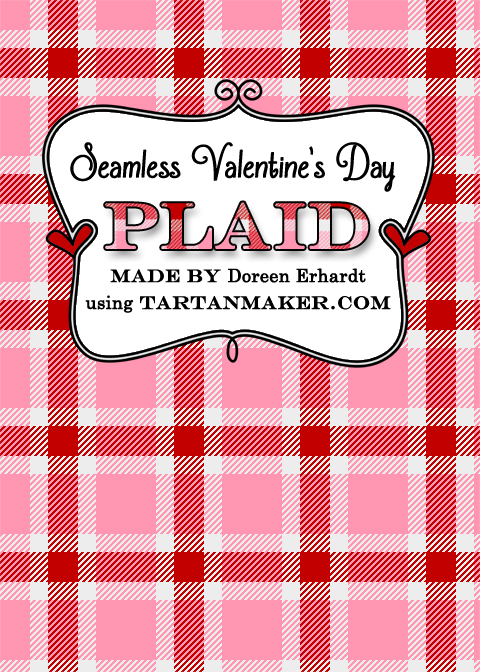
In case you aren’t having enough fun making plaid patterns, here is Stripe Generator 2.0 so that you can make striped patterns to match your designs! You can have up to five stripe colors, plus the background color. There are eight directional choices for the stripe variations and many other variables you can modify unlimited patterns.

Want to make some patterns other than plaids & stripes? Try this fun pattern generator called BGPatterns! Yes, you are limited to the ‘theme elements’ they provide, but you have those elements, plus color choices for both, choosing a texture; and then you can play with the size and rotation options, therefore the choices are almost limitless if you let your creative juices get rolling!

Enjoy this week’s FREEBIES! As always, have fun and let your imagination run wild!
If you don’t know how to transform these little pattern squares into seamless patterns within your design software, visit this previous Tips & Tricks: Creating Patterns.
So, until next week … Learn … Create … Inspire!


