Tips and Tricks: Facebook Hashtags

Recently, Facebook has rolled out hashtags (and they’re still rolling it out gradually to their users as they normally do, so don’t panic if you don’t see it yet. You will, probably in the next few weeks.) Those of you who use Twitter, Tumblr, Pinterest, and Instagram will be familiar with the concept. This is great news for anyone using FB as part of their marketing effort.
Basically, on FB, a hashtag (example: #corriekuipers) works like a clickable search term. What this means for you is that you can expand your marketing by using hashtags.
If you post greeting cards on FB, some suggested hashtags to add to the end of your update are: #yourname or #yourbusinessname, #greetingcarduniverse. Other relevant hashtags such as #upcomingholiday, #occasion, or #art, #photography, etc can be added as desired.
Be careful, though. You don’t want to pile on the hashtags. Adding twenty hashtags to a one line status update would be crazy. Choose your hashtags wisely.
Read more about Facebook hashtags.
Another use for hashtags from a marketing perspective is “eavesdropping” or getting information to target your audience. For example, let’s say you search for hashtags about the Fourth of July (like #fourthofjuly, #fireworks). If you see a lot of people using a specific hashtag, make a FB post with a Fourth of July card and use the same hashtag. By taking advantage of a trend, you can expand your marketing outside your usual circle.
Have fun!
Edited to add tip by Susan Herbst: “It’s also important to note that if your Facebook feeds to your Twitter account, it’ll be helpful to get those hashtags in the first 100 characters or so. Then they do double duty.”
Thanks, Susan!
Share this:

Dash of Inspiration: Typography – Color
A Dash of Inspiration, A Cup of Creativity by Doreen
Typography: Color

Let’s keep this series going by moving into the TYPOGRAPHY grouping of the Submission Guidelines, and next up is:
TYPOGRAPHY: Color
The Submission Guidelines state this:
Again, text needs to be very legible. Using a pretty blue on a bright purple background is not only illegible, it’s unappealing. Stick to colors which harmonize with your image and are light or dark enough to be clearly legible. Declines may include, but are not limited to: colors which clash and cause chaos within the design, colors that cause it to be illegible, too dark, too light, etc.
Inexperienced greeting card designers have a tendency to want the text color to be some color within the design when it may not be as legible or standout as well as a simple choice of white or black. Here are some simple tips to follow from the professionals:
- Medium-colored text + medium-colored background = low legibility. To obtain the best legibility, choose either a very light font on a very dark background or a very dark font color on a very light background.
- When a customer can’t read text instantly, they will not engage and will move on to a different card.
- Contrast between the font color and the background color is very important, so evaluate your background color and choose a high-contrast color for your text.
- If you simply must choose more than one text color for your image, be careful to not turn a good image into a chaotic one by making the wrong color choices.
- Nothing ruins a good design like a font with a fully saturated bright color on a medium-colored background. Bright colors are hard to read, and can really look amateurish when used in excess and/or on a busy or colored background.
- Just like a good design, reference one of the readily available color palettes when necessary to ensure your text stands out within your design.
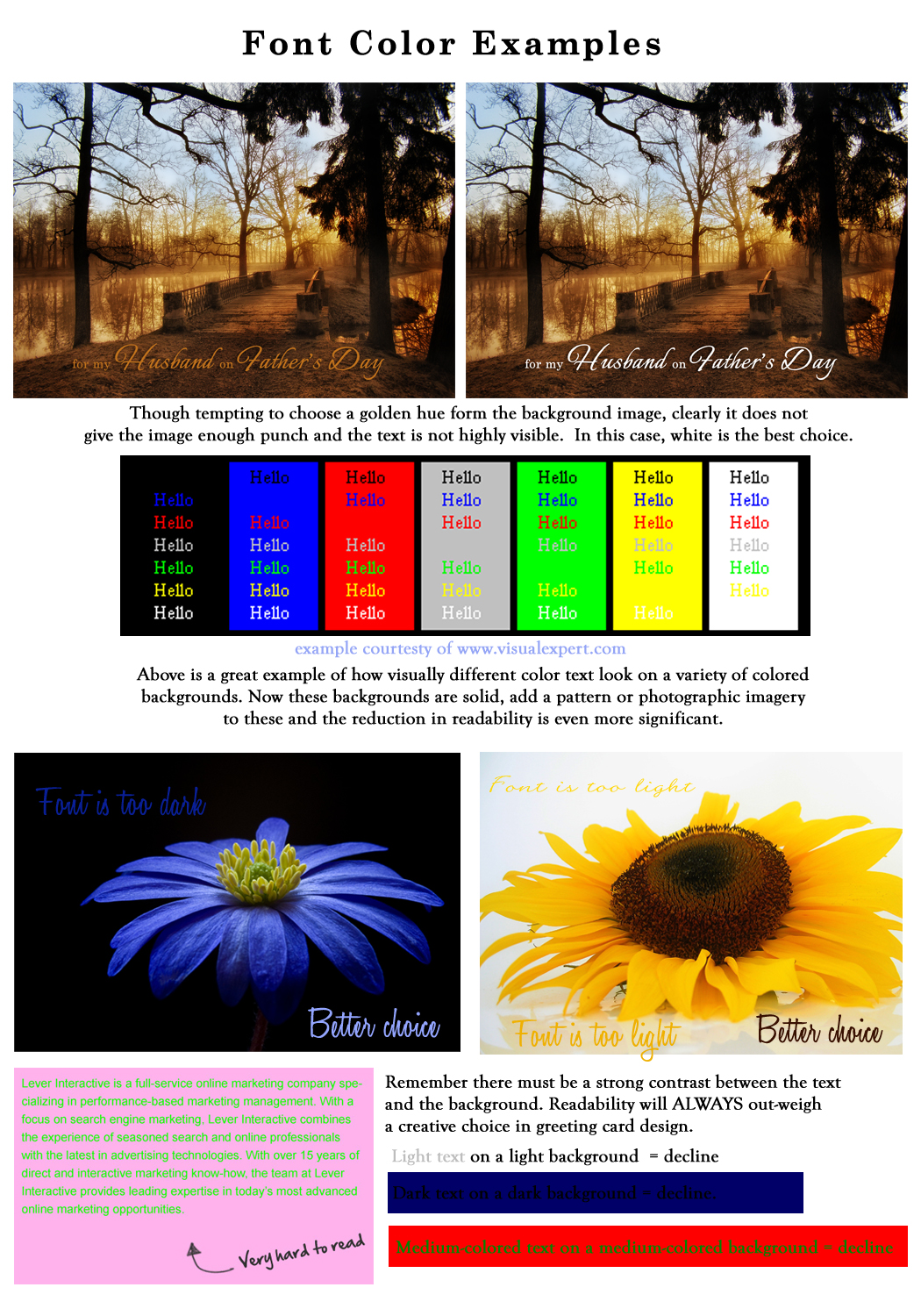
Clashing Colors: As with choosing colors for any design, many colors tend to clash visually, just like some patterns clash with each other. When you choose a color for your text be careful to choose complimentary colors within the image and color wheel. Too many colors in the text combination can cause chaos within a design. In a busy design, even adding a single colored text of a color not prominent within the design can cause chaos.
Too Light/Too Dark: Again, remember that the color of your text, combined with your font choice has a lot to do with the legibility of the text on your card. If your text is too light on a light background, it becomes difficult to read. Same goes for using a dark colored text on a dark background. Within a greeting card design, legibility of the message is of utmost importance.
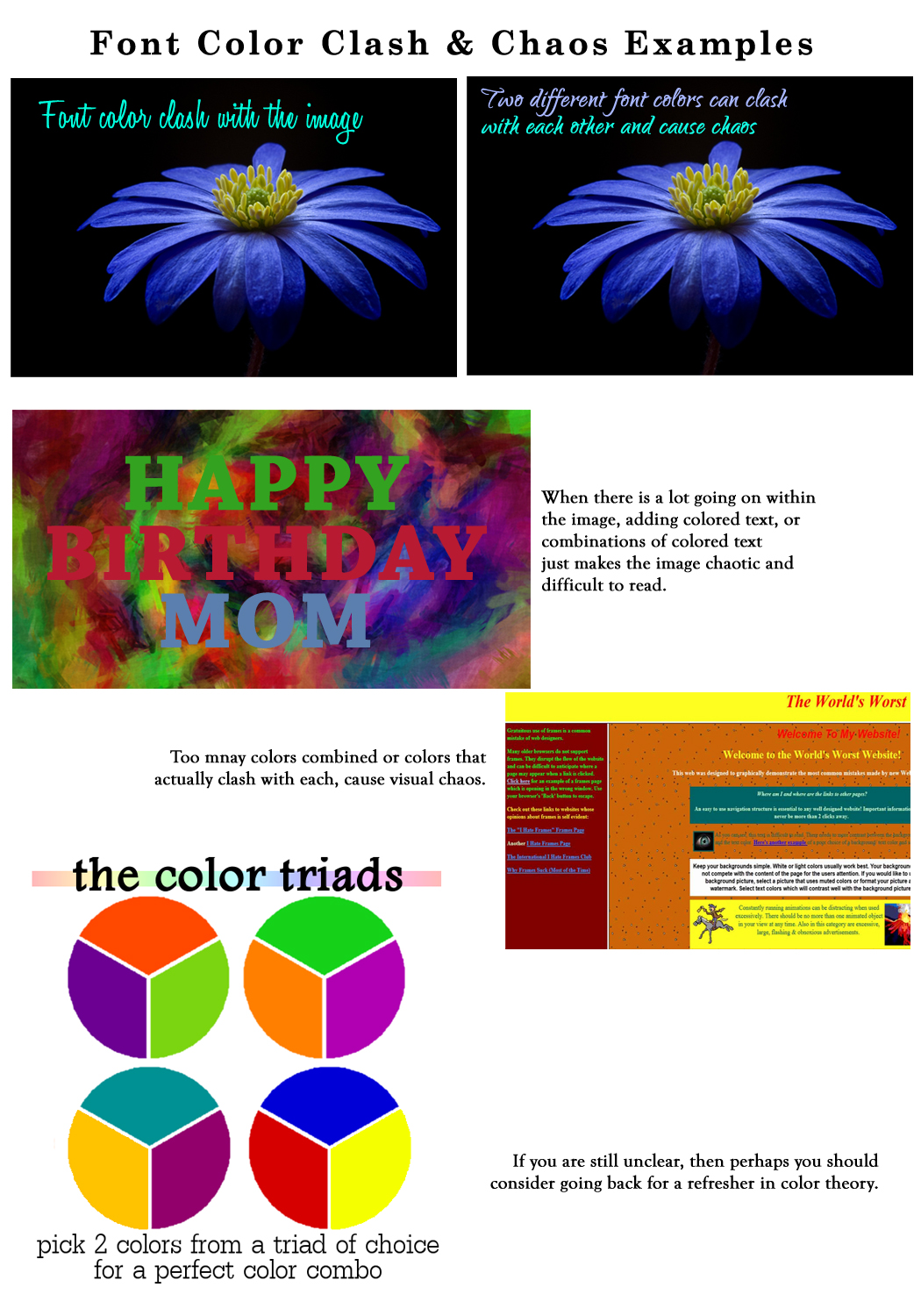
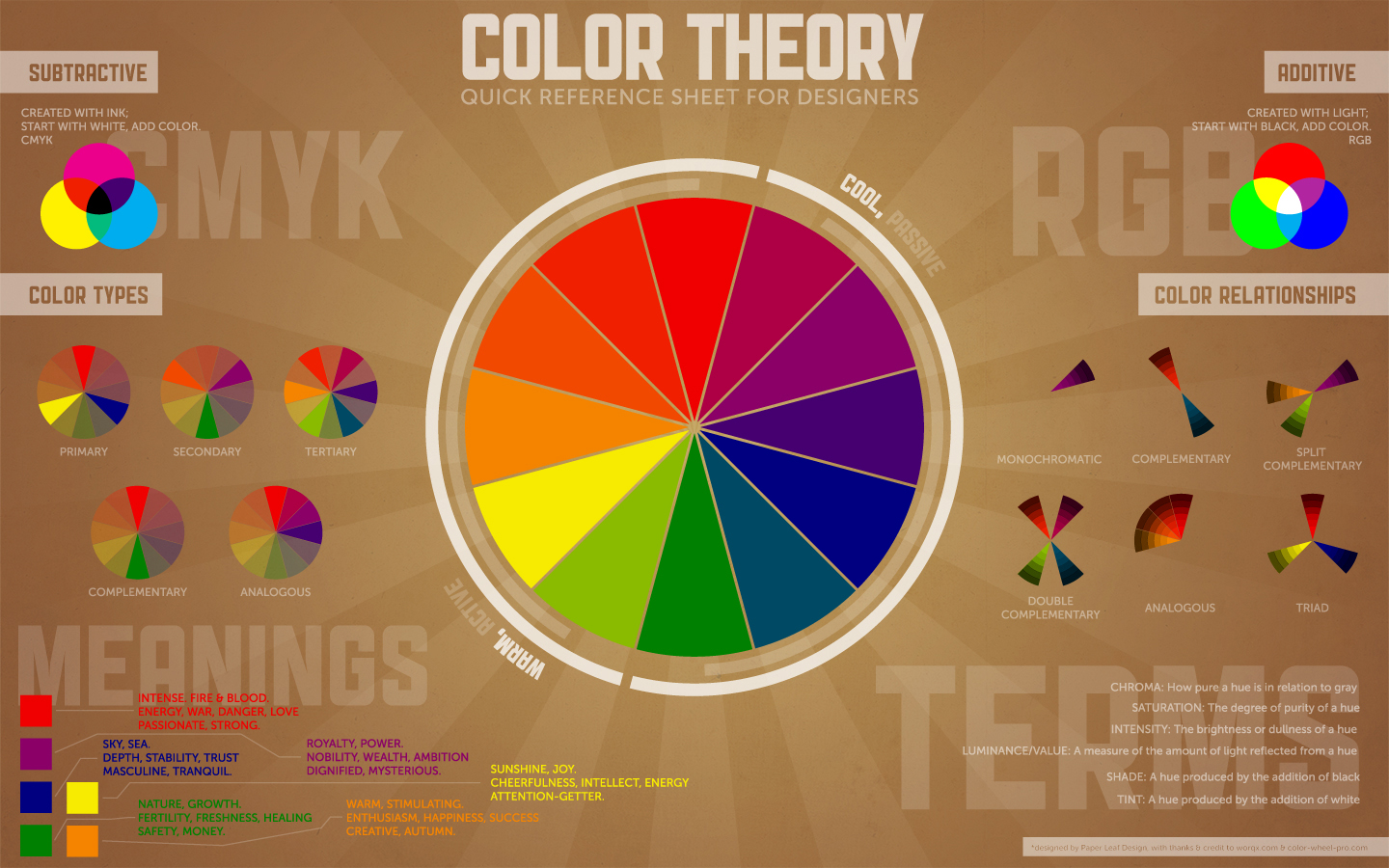
When all else fails, it may be time to go back for a refresher course in color theory.
Here is a link to Color Theory
Next week we’ll continue on our Typography journey into Text Placement to finish up the Typography section . Till next week, I hope I’ve inspired you to go look through your store and see if you can weed out any images that the reviewers will find during their weeding which might fit TYPOGRAPHY: Font Color issues … and if so, best get to reworking the text on those cards before the reviewers get to them and decline them!
For great resources & tips visit the SalonOfArt
Nothing ruins a good font like a fully saturated neon green or red fill. These colors are hard to read, and just look amateurish. So tone down those saturation levels, and go easy on your viewers eyes. Also, if you’re going with white text on black, it’s a good ideas to tone down the the brightness to 80 or 90.
Choosing the right fonts, and using them correctly is a simple way to help raise the overall production value and make it more professional. So the next time you’re in the edit room, consider these tips, and take your project to the next level.
Share this:

Critique Clinic – June 14-16, 2013

How does it work? For three days a week (Friday-Sunday midnight), I will open the clinic to any artist who wants an honest peer review and critique of a card which gets plenty of clicks but no sales, so something’s probably not quite right, or you’ve got a new design you want to test drive, or you’re unsure about the marketability of a card. Or perhaps you’re a newbie who isn’t sure if a card is up to a marketable standard. Anyone is welcome to participate. In fact, I encourage everyone to at least look at the cards in question and read the critique comments – you may learn something. The purpose of the clinic is to help artists improve the commercial appeal and marketability of their cards.
THE RULES
- ONE card per artist only.
- Card must be intended for sale at Greeting Card Universe.
- To submit a card for critique, post a link to the card at GCU in the comments section of this clinic post. Allowances will be made if you’ve had a card declined, or made a new design you’d like advice on before submission. Give us the link where we can see the card, such as your private gallery, Flickr, Tinypic, etc. If you do give a private gallery link, be sure your private module gallery is ON. Please do not post links to your Manage Cards section – do you really want strangers tinkering with your cards? And please don’t ask us to critique a card that’s pending review – we can’t see it until it’s approved.
- Any artist is free to comment and/or give a critique of a submitted card. HOWEVER, post-and-run comments like “great card” or “you suck” will not be tolerated, nor will abuse. Criticism should be constructive, not destructive. Play nice or you will be banned.
- I also won’t tolerate temper tantrums if you decide your “artistic integrity” is being stepped on because you asked for a critique, and someone told you the photo you’re using isn’t in focus. If you can’t take honest criticism, don’t submit. Once gets you a warning; twice and you’re banned from submitting in the future.
- Artists who critique may do so by giving their opinion, posting an example of another card, or pointing the submitter to a video, on-line article, or other helpful suggestion.
- Don’t forget that artists who are giving you tips and helpful advice are volunteering their time and trouble. Be nice. A link back to their store on your website or blog is appreciated (but not mandatory).
- You are free not to take any advice offered. There’s no guarantee any card will be a bestseller, so don’t come into the clinic with unrealistic expectations.
- Rules may change as we go along and we see how things turn out, okay?
So without any further ado, I declare this week’s Critique Clinic open!
Share this:

Design Contest: Free Spree!


It’s summer and the temperature’s rising, so let’s showcase our hottest greeting cards in a Design Contest: Free Spree! Nominate your favorite card, your best selling card, your most popular card, your newest card – anyone will do, I’ll leave the choice up to you. Are you ready? Let’s have some fun and show off out best and brightest!
RULES
- One card per artist.
- Enter by making a comment on this post. Comment must contain the link to the card at GCU.
- Deadline to enter is June 19, 2013.
On June 20, I will post all the nominees and the voting will begin. The artist who receives the most votes will win a $10 Amazon.com gift certificate or 5 free card credits.
It’s that simple. So what are you waiting for? 🙂 Go pick a card!
Share this:

Rainbow Connection: Coral and Mint

One of the hottest continuing color trends is coral and mint – that hot and cool combination is wowing brides and popping up on party invitations, birthday cards, and a whole lot of other designs. The colors really pop. If you want to make a bright impression in your cards, you can’t get much prettier. And the design scheme will work for cards for woman AND men – I’d just stay on the more orange side of the spectrum and avoid too much pink for the guys.
Below you’ll find a palette of coral/mint you can use + a link to a whole slew of inspirational boards on Pinterest featuring this color combo. Have fun!


Share this:

News: May Design of the Month Contest is Live

Artists who receive a Design of the Day Award are automatically eligible and entered into the Design of the Month contest on Facebook. This month, the person who receives the most votes will win a $150 VISA certificate!
Put out the word on your social media sites like FB and Twitter, tell your family and friends, and get those votes. Your supporters can vote once a day, by the way. Click below to get started by viewing the entries and casting your vote for your favorite artist … or yourself! Remember, if you don’t get the highest amount of votes, you can’t win.

Share this:

Dash of Inspiration: Typography – Effects
A Dash of Inspiration, A Cup of Creativity by Doreen
Typography: Effects
Let’s keep this series going by moving into the TYPOGRAPHY grouping of the Submission Guidelines, and next up is:
TYPOGRAPHY: Effects
The Submission Guidelines state this:
Keep your text effects to a minimum, if you choose to use them. Once in awhile a slight shadow or thin outline (stroke) can lift the text off the background for a finished look. In general, using effects such as beveling and outer glow can go from “adding the right touch” to “excessive and unpleasant use” in a hurry. Declines may include, but are not limited to: excessive beveling on the text, excessive glow, deep shadows which cause the text to become blurry, thick strokes, filtering, and styles used on text which appear unprofessional, any text which draws so much attention that the image is lost, etc.
Sometimes it’s hard to resist the urge to apply cool and awesome effects to your text, but on greeting cards these effects must be used with a very light hand or it simply overwhelms the design. Design trends apply to typography as they do to any other phase of design, so greeting card designers must pay attention in order to stay current and create designs which are marketable in today’s greeting card market.
Beveled Text: Now there’s an effect that is long past it’s expiration date. Excessive beveling of text went out in the late 90s/early 2000s and though there are still some uses for a slight beveling of your text, they are rare. Today’s typography trends are much more minimalistic with simple, uniform edges which have no effects whatsoever, with the occasional subtle shadow or outline.
- An exception to beveled text can be when creating a realistic metallic text such as; gold and silver. Be very picky when you choose a metallic ‘style effect’, most will require significant adjustments to reduce the heavy overly done effects.
- If you choose to add a bevel, try a variety of font choices. These effects look radically different from one font to another. On some it may look slight and appealing whereas on a thicker, bolder font it will look bulky and quite unsightly. Metallic text looks best when used on a thin, elegant font choice.
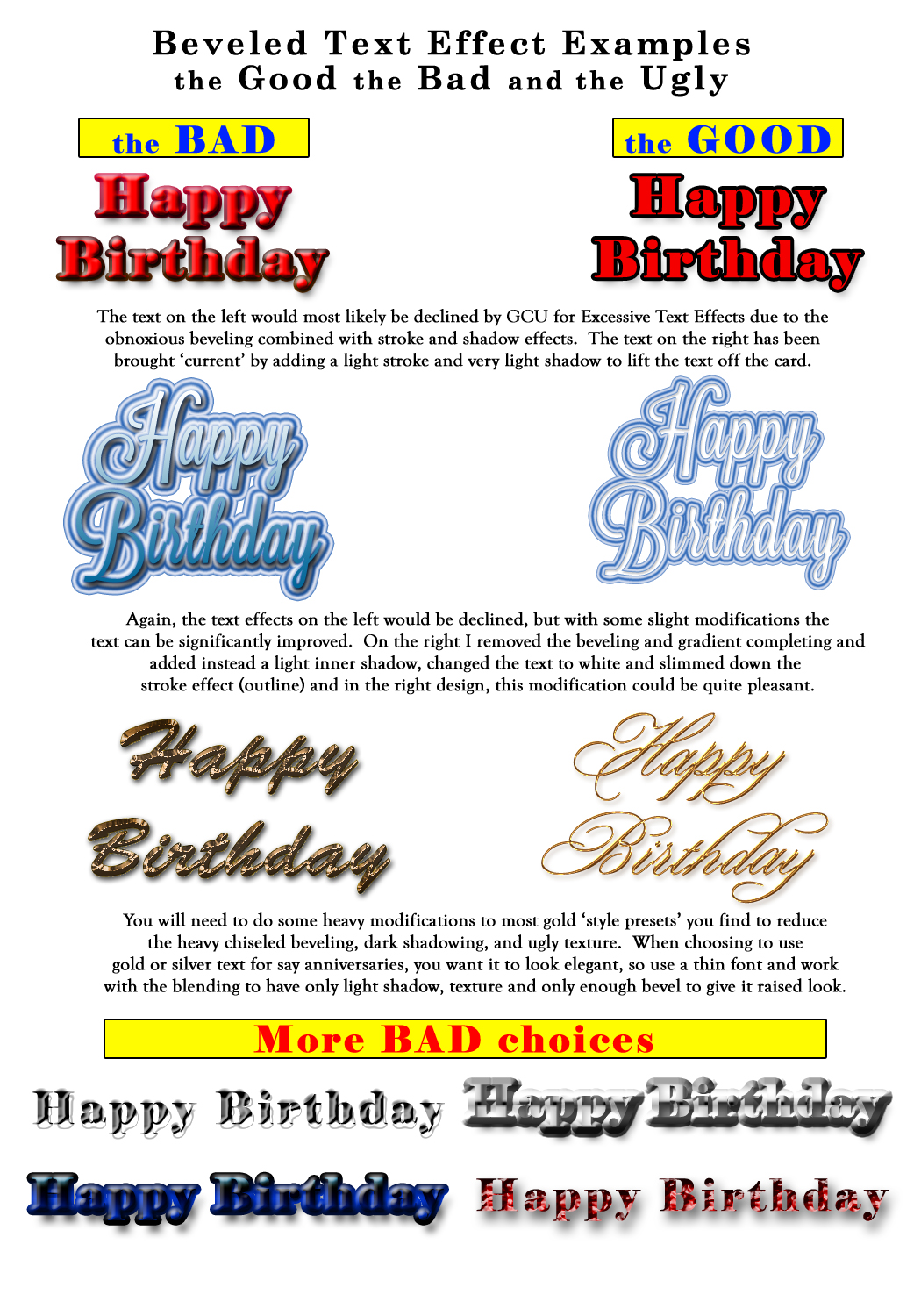
Glows and Shadows: Just like beveling, these effects can make or break a design. Shadows, when done well and applied with a light touch, can lift text off the page creating almost a 3-D look and classy feel to your design. However, it’s often used to excess creating one of two extremes, a blurry blob around your text which looks like an ink smear when printed or a too-heavy dark and bulky line equally disturbing to look at.
Similarly, glow effects can sometimes be the right tool for enhancing text in a difficult to see area, however most of the time you are better off using the glow effect to back-light the area behind the text resulting in your words being more clearly legible rather than the common mistake of using light colored ‘glow balls’ around your text.
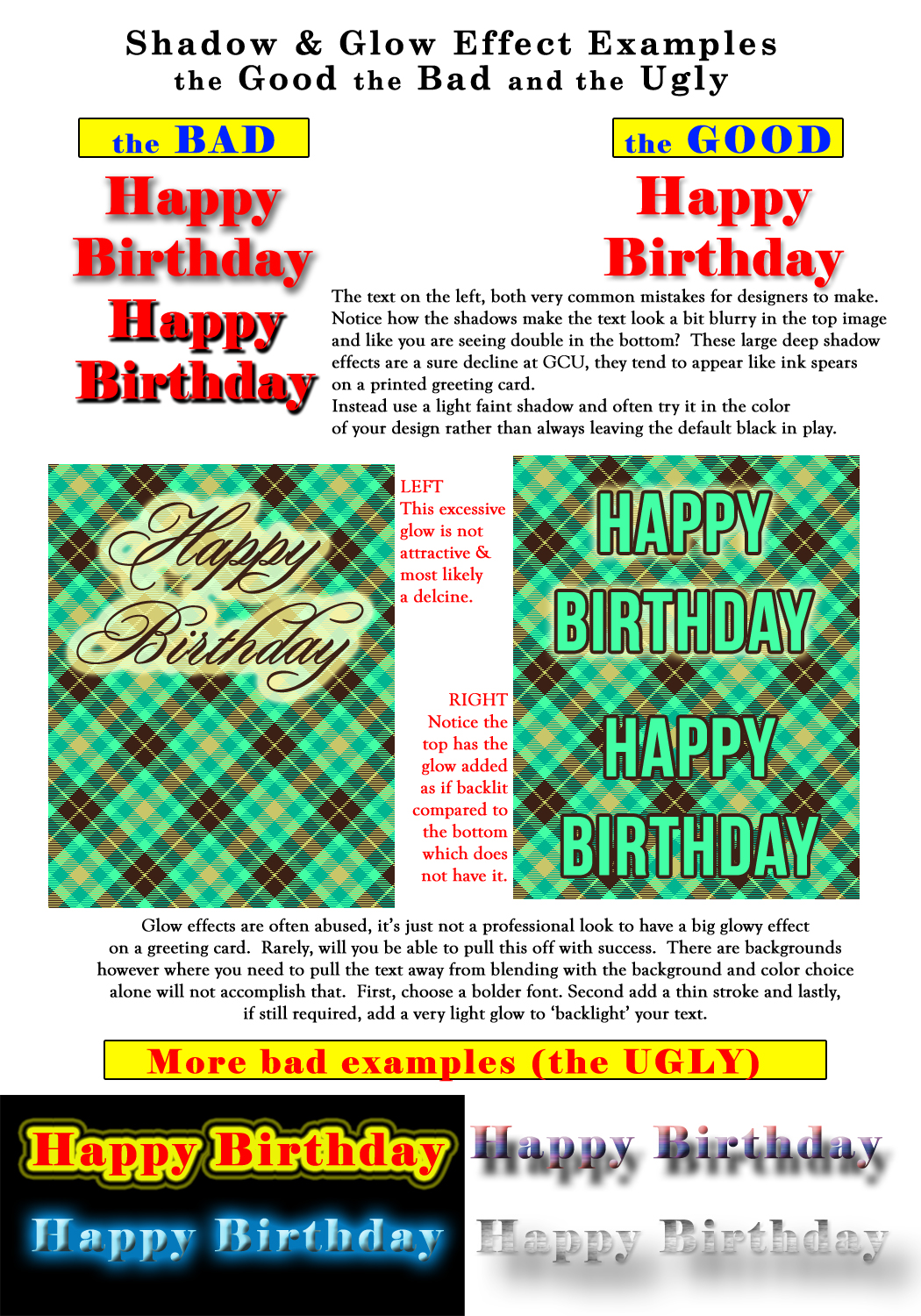
The bottom line is that any use of effects on text which distorts, impacts legibility, causes the text to appear blurry, or is so excessively executed to the extent it screams for the spotlight and fights with the other elements within your design is cause for a decline. So choose wisely.
Next week we’ll continue on our Typography journey into Font Color . Till next week, I hope I’ve inspired you to go look through your store and see if you can weed out any images that the reviewers will find during their weeding which might fit TYPOGRAPHY: Excessive Effects … and if so, best get to reworking the text on those cards before the reviewers get to them and decline them!
For great resources & tips visit the SalonOfArt
Share this:

Critique Clinic – June 7-9, 2013
How does it work? For three days a week (Friday-Sunday midnight), I will open the clinic to any artist who wants an honest peer review and critique of a card which gets plenty of clicks but no sales, so something’s probably not quite right, or you’ve got a new design you want to test drive, or you’re unsure about the marketability of a card. Or perhaps you’re a newbie who isn’t sure if a card is up to a marketable standard. Anyone is welcome to participate. In fact, I encourage everyone to at least look at the cards in question and read the critique comments – you may learn something. The purpose of the clinic is to help artists improve the commercial appeal and marketability of their cards.
THE RULES
- ONE card per artist only.
- Card must be intended for sale at Greeting Card Universe.
- To submit a card for critique, post a link to the card at GCU in the comments section of this clinic post. Allowances will be made if you’ve had a card declined, or made a new design you’d like advice on before submission. Give us the link where we can see the card, such as your private gallery, Flickr, Tinypic, etc. If you do give a private gallery link, be sure your private module gallery is ON. Please do not post links to your Manage Cards section – do you really want strangers tinkering with your cards? And please don’t ask us to critique a card that’s pending review – we can’t see it until it’s approved.
- Any artist is free to comment and/or give a critique of a submitted card. HOWEVER, post-and-run comments like “great card” or “you suck” will not be tolerated, nor will abuse. Criticism should be constructive, not destructive. Play nice or you will be banned.
- I also won’t tolerate temper tantrums if you decide your “artistic integrity” is being stepped on because you asked for a critique, and someone told you the photo you’re using isn’t in focus. If you can’t take honest criticism, don’t submit. Once gets you a warning; twice and you’re banned from submitting in the future.
- Artists who critique may do so by giving their opinion, posting an example of another card, or pointing the submitter to a video, on-line article, or other helpful suggestion.
- Don’t forget that artists who are giving you tips and helpful advice are volunteering their time and trouble. Be nice. A link back to their store on your website or blog is appreciated (but not mandatory).
- You are free not to take any advice offered. There’s no guarantee any card will be a bestseller, so don’t come into the clinic with unrealistic expectations.
- Rules may change as we go along and we see how things turn out, okay?
So without any further ado, I declare this week’s Critique Clinic open!
Share this:

Font Frenzy: College BB

Here’s a different kind of font – College BB is hand drawn, chunky, somewhat childish, but above all, readable and legible. This font would work well for informal designs. You’ll see a sample below. College BB is on sale right now for $12. Have fun!

Share this:

Nuts and Bolts: To Verse or Not to Verse

To Verse or Not to Verse…
The question is often asked on the Forum. Should I bother putting an inside verse in my card? How well to “blank note cards” and “art cards” sell? Can’t shoppers put their own message in the card and leave me out of it?
The truth is, shoppers on GCU often search for a very specific card, such as “Happy 67th Birthday.” So it is definitely to your benefit to put verse on your cards, inside and out, relevant to the category. Here are a couple of articles that you will find helpful as you design your cards.
Nuts & Bolts: Front of Card Text
Nuts & Bolts: Inside Verse
What about blank cards? What if you prefer not to sully your gorgeous nature photographs with text? That’s your prerogative, of course. And sure, some shoppers prefer to add their own message inside a card. Just make sure you place your cards in the correct Collections category or categories.
Savvy artists will cover all their bases by uploading a design with verse AND a blank card. Since you’re allowed to use the same image 3x, this is the best compromise.
Everyone who designs greeting cards should be capable of producing verses.
So the answer to the original question – to verse or not to verse – is … do both! That way you’ll have twice as many chances to make a sale.


