Design Spotlight: Liz Van Steenburgh

Our Design Spotlight today falls on Liz Van Steenburgh of Starstock Greetings – thanks for letting us catch a glimpse of you and your work!
_________________________
 I’m Liz Van Steenburgh from Starstock Greetings. I’m a self-taught photographer and graphic designer from rural New York State.
After many years with a strong interest in photography and other creative endeavors, I took the plunge about 7 years ago with a cheap $100 camera and joined a few stock photography agencies, when they were all brand new businesses. Being a stock photographer has taught me quite alot about photography and creativity in general. I now work full time for one of the major stock photo companies in a much less glamorous position 🙂
My focus soon turned to graphic design, and I learned about GCU through my friend and fellow contributor, Denise, from dbvisualarts, and started making cards from my stock photos. Needing a little more variety, I started buying commercial-use graphics and clipart from people with much more talent for Illustration than I could ever hope to have.
Thanks to their talent and generosity in offering products and licenses that allow me to create cards and products from their work, I now enjoy a fairly successful graphic design business, making cards, invitations and other printable items. I really enjoy mixing graphics, type and colors to come up with something new. I also enjoy blending my photographs with grungy textures to give them a whole new (old) look, as I’m a big fan of that whole aged, textured, torn and tattered look.
Despite all the graphic art I have purchased and all the photographs I have taken, my best selling card series at GCU doesn’t incorporate graphics OR photography. I made this using some basic Photoshop shapes and 1 bow brush. It continues to sell constantly, much to my amazement. I guess there’s something to be said about “less is more”. I hope it encourages those who may feel that only professional photographers or artists can succeed, because this card clearly shows that is not necessarily the case at all.
Thank you for the opportunity to share a little bit about myself with all of you.
Share this:

Nuts and Bolts: When To Make Holiday Cards

When To Make Holiday Cards
It’s a new year, and we’ve already had a couple of holidays come and go. One thing I notice in the New Cards section – which, like most artists, I check out now and then – is that when a holiday approaches, there’s a sudden flurry of cards uploaded for that holiday. I’ve also seen in the Forum when artists make a post about how long it’s taking to get a card reviewed, and how much they want it approved to be in time for a holiday that’s just around the corner.
Also, like many artists, I’ve experienced longer delays in approvals during the Thanksgiving/Christmas season due to the sheer number of new cards being uploaded for those important card-giving holidays.
It’s been stated time and time again that if you want your holiday cards in time to sell, you need to get them done 3-6 months in advance. Why? Because that’s how long it can take for search engines to index your new content. Last minute cards rarely sell since they haven’t been around long enough.
I’ll let you in on a little secret: I, too, make holiday cards at the last minute. I mean, are you really in the mood to make Christmas cards in July? But there’s something I’ve learned over the course of my four years as an artist at Greeting Card Universe, and it’s this … even six months is probably not enough lead-in time for most cards.
If we make Christmas cards this year, even if we make them in February, we’re not expecting sales this year. Oh, we may sell one or two to browsing customers, but it’s the second year when we tend to make more sales. The third year is even better. After that, a card’s performance is usually pretty consistent. We’re designing cards for the long haul, looking 2-3 years into the future, not just 3-6 months.
How can you help overcome this gap between designing a card and selling that design? Specific marketing can gain more attention in a more timely fashion. But if you’re content to sit back and do nothing once the initial upload has been made, it can be a couple of years before you begin to see sales of a new card design.
The name of the greeting card game really is PATIENCE.
So observe the 3-6 month lead-in time for new greeting cards if you want. Make your Christmas designs in July if you can (if only to avoid the December rush). But don’t worry if you can’t get cards approved “in time.” You’re well in time for next year’s sales.
Share this:

Dash of Inspiration – Blue Skies
A Dash of Inspiration, A Cup of Creativity by Doreen
Blue Skies

Artist’s who paint can create the sky in their paintings any way they wish; in rich blue hues or deep stormy grays, but photographers must make a decision at the time of capture as to what they ultimately wish to portray.
To the human eye the sky should be blue on a sunny day, not white and washed out. Professional photographers know that regardless of what the sky looks like on any given day while out shooting, the final ‘print’ needs to be rich in color and contrast in order to attract attention.
When out taking photographs where sky will be included, ask yourself this; “Am I taking this photograph to document the area, therefore using it in journalism, or am I taking this photograph to use creatively on greeting cards, calendars, and/or prints to frame?” If the answer is for use in journalism, then capture the sky as is and you’ve done your job. If the answer is to use it to sell as an artistic rendering of the moment, then a sky without color, whether sunny or stormy, is simply not marketable. The average customer will not be drawn to a photograph with a ‘washed out sky’ (a sky with no detail and little to no color).
So today I thought I’d share some links to help the photographers out there to both improve the sky during capture and when necessary how to punch it up in post processing. There are so many ways to improve a weak sky, you are sure to find methods that suit your style.
This first link is to an article I wrote a couple years ago on Traditional Camera Filter Recommendations for use on the camera when out shooting and also a link on how to properly use a Polarizing Filter.
DSLR Tips: Using polarizing filters video tutorial by: CameraLabs

card by: M Brandes at Photography by Melissa Brandes
Post-processing is always an option for old photographs and for those occasions when you simply could not improve the sky during capture. If your exposure was calculated well enough that you actually captured the detail in the sky even though it appears washed out, you can bring those details out; and for the really tough cases, you can even replace the sky entirely through post-processing methods. Below are some tutorials and goodies to make your skies really pop. Many professional photographers, myself included, also have the Topaz Labs bundle which makes many of these types of tedious tasks a breeze. So if you are interested, they have 30-day trial offers and you may choose individual plug-ins, so look them up.
Enhancing The Sky In A Photo Tutorial by PhotoEssentials.com
Intensify A Dull Sky Tutorial by PSHero
How to Replace a Sky in Photoshop by Helen Bradley at Digital Photography School
21 Realistic Sky Gradients by Adobe.com
I hope I’ve inspired you to explore how you can get your gray skies to clear up!
Share this:

Critique Clinic – February 18-19, 2012

How does it work? For three days a week (Friday-Sunday midnight), I will open the clinic to any artist who wants an honest peer review and critique of a card which gets plenty of clicks but no sales, so something’s probably not quite right, or you’ve got a new design you want to test drive, or you’re unsure about the marketability of a card. Or perhaps you’re a newbie who isn’t sure if a recently submitted card is up to a marketable standard. Anyone is welcome to participate. In fact, I encourage everyone to at least look at the cards in question and read the critique comments – you may learn something. The purpose of the clinic is to help artists improve the commercial appeal and marketability of their cards.
THE RULES
- ONE card per artist only.
- Card must be for sale at Greeting Card Universe.
- We will take an unlimited number of artists, including those who have submitted recently, HOWEVER I reserve the right to close a clinic for the day if the submissions become overwhelming. If the clinic has been closed, and you submit a card, your comment will be deleted.
- To submit a card for critique, post a link to the card at GCU in the comments section of this clinic post. Allowances will be made if you’ve had a card declined, or made a new design you’d like advice on. Give us the link where we can see the card, such as your private gallery, Flickr, etc.
- Any artist is free to comment and/or give a critique of a submitted card. HOWEVER, post-and-run comments like “great card” or “you suck” will not be tolerated, nor will abuse. Criticism should be constructive, not destructive. Play nice or you will be banned.
- I also won’t tolerate temper tantrums if you decide your “artistic integrity” is being stepped on because you asked for a critique, and someone told you the photo you’re using isn’t in focus. If you can’t take honest criticism, don’t submit. Once gets you a warning; twice and you’re banned from submitting in the future.
- Artists who critique may do so by giving their opinion, posting an example of another card, or pointing the submitter to a video, on-line article, or other helpful suggestion.
- Don’t forget that artists who are giving you tips and helpful advice are volunteering their time and trouble. Be nice. A link back to their store on your website or blog is appreciated (but not mandatory).
- You are free not to take any advice offered. There’s no guarantee any card will be a bestseller, so don’t come into the clinic with unrealistic expectations.
- Rules may change as we go along and we see how things turn out, okay?
So without any further ado, I declare this week’s Critique Clinic open!
Share this:

Blast From the Past: Leveraging Card Designs
This article first ran in the Newsletter on July 14, 2011
Applying a Little Leverage
Let’s talk about designing, shall we? Artists and photographers can spend hours working on one card design, getting it exactly right. The color, composition, design elements and text have to come together to make an appealing and attractive package.
You decide your design is perfect for a birthday card. You upload it, add some snazzy inner verse that’s quite clever, if you do say so yourself. And you sit back with a smile, waiting for the sales to roll in ‘cause that card’s clearly a winner.
But somehow, the sales don’t come. Or you sell one here and there. What’s the matter with shoppers, anyway? Don’t they see how brilliant your card is? Why aren’t they buying?
To get to the bottom of the conundrum, we’re going to have to touch on a delicate subject, one which has baffled, disgusted and riled artists since GCU’s beginnings. I’m talking about…repetitions.(cue dramatic crescendo)
Yes, those long, never ending, tedious lists of duplicate cards that pop up in the New Cards section. The same design, repeated over and over, the only difference being the age, relationship, or both. THOSE cards. You know what I mean.
A couple of the most asked questions from the GCU forum come to mind – “How can any artist possibly stand to do all that repetition?” and “How can customers stand to wade through all that repetition – it’s so boring!”
I’ll start with something which may not have occurred to some artists: Greeting Card Universe is a retail site meant to entice shoppers and fulfill their needs. I understand why artists might view 100+ cards of the same design with dismay, but shoppers don’t think that way, and they aren’t using the site the same as you are.
Very often, when shoppers come to GCU, they do so through a search for a specific kind of card, such as “happy 50th birthday to my uncle.”
When shoppers are browsing, they’ll often start with a specific category, then drill down as needed. For example, the other day I had a shopper buy a card after browsing Invitations >> Wedding Attendants/Bridal Party Invitations >> Be My Ring Bearer?
Your sales notifications can make interesting reading.
The beauty of GCU is that shoppers can have it any way they want it – they can do an off-site or on-site search for a specific card, or they can dig into categories and sub-categories until they find what they’re looking for, or a combination of both.
Another thing to note is that per the Big Kahunas at GCU, who presumably know best, shoppers hardly ever browse the New Cards section. It’s just us artists who can be a wee bit obsessive about it.
As to how artists can stand the mind-numbingly task of creating duplicate cards, the answer is simple: money. I make repetitious cards all the time. It’s boring. Believe me, I’d much rather be doing something else. But I keep myself going by thinking about sales and how much money I’ll make when shoppers buy my cards. It’s a powerful incentive, especially now that I have several years worth of data telling me that for me, specific cards outsell general cards by a significant margin.
Apparently, people like sending a “Happy Mother’s Day to my Birth Mom” card in lieu of a general Mother’s Day card, even when the designs are the same.
Don’t forget that when shoppers are either browsing by drilling down categories, or searching for a specific card, they rarely see duplicate content because all those repetitive cards are each in their own sub-categories. You see them in a big boring lump in New Cards, but in reality, they’re scattered across GCU’s categories list.
When I make a new design for a category like Father’s Day, I consider how best I can leverage that design to make it go as far as it can and work for me as much as possible. If appropriate, I make a general card + a series of relationship cards or age specific cards. I might also recycle that design for a totally different category, since by GCU’s rules, I can use the same design 3 times (age and relationship specific cards count as one use).
Do the work once, leverage it to work for you many times.
If you can’t bring yourself to do age and relationship specific and other repetitious cards, I understand. This isn’t for everyone. As I said, it’s a lot of work. However, if you feel like you can stand it, leveraging your designs could work for you.
P.S. – I’ve been told that UK card buyers prefer blank cards. There’s no reason you can’t include one blank card as one of your “three image use” designs. In fact, many artists already do that to cover all the bases.
Share this:

Orphan Categories
Here’s a Newsletter article that first ran in October 2011:
Little Orphan Category
What’s an “orphan” category, you ask? It’s a category at Greeting Card Universe that contains few or no greeting cards. It’s a category that’s neglected. Unloved. Begging for attention.
And you should give those poor little orphan categories your attention. Know why? Because adopting an orphan category can lead to some very nice sales for you because you’ll have hardly any competition.
Here’s how it breaks down: in a popular category like, say, Birthday – General, you’re competing with thousands and thousands of other artists, some of them pretty heavy hitters whose cards are well established. Some sub-categories, however, are wide open with very little competition. By focusing on those, I may be able to take advantage of my fellow artists’ lack of attention by designing cards to fit those neglected sub-categories.
It gets better, because sometimes you can find a whole CATEGORY that contains very few cards, and adopt that as your own. I did that not too long ago, and I’ve already sold a few hundred cards – and no, I’m not telling you which one 
Most of us design generic cards suitable for a multitude of recipients, but in addition to that, if you want to see your artist commissions go up, you should be designing cards for specific specialty categories and sub-categories … and you should also be adopting those poor, lonely orphans while you’re at it.
Share this:
Custom Corner: Sandra Rose Designs
From time to time, we like to bring you a story of a custom request and how it turned out. Here’s Sandra from Sandra Rose Designs – thanks!
_________________________
Custom requests create in me a little excitement and a bit of concern, depending on how busy I am at the moment. The day I opened my mailbox and saw the heading “Greeting Card Universe – GCU Custom Request # ” was no different. I had little time to work with the request that day, but I would be able to handle it in a couple of days. But of course, my interest and excitement took over, and I was eager to see what it was all about.

There is a link in the email from GCU that says “Click here to access your Custom Card Requests” so that takes me to the location where our emails to each other can be accessed.
I emailed her right back and let her know that I would be happy to help her. I would be able to complete the changes in 2 days. Would that be acceptable to her? I would change the colors on the card for her from the original pink to a green and add some touches of yellow, and add “future daughter-in-law” on the front of the card for her. Was there a particular color of green that she had in mind? (I feel it is important to spell out exactly what we are agreeing on, so that we are on the same page.)
She responded to me (I receive all communication in my regular email, but can access it through the link that is always available to me) that the timeline was fine. This was a wedding shower for her future daughter-in-law, and that her colors were sage green and yellow, and the shower had the theme of umbrellas. She felt that my card with her colors would be perfect. I responded one more time with great – she would hear from me in 2 days with the card link where she could make her purchase.
I added it to my calendar for the appropriate day. When I began working on it, I researched on line the color sage green – in wedding sites to see exactly what she might be referring to. I quickly got the pulse for “sage green” and proceeded to change my color to a sage green. I brightened it up just a bit – because the sage was a bit “heavy” for a card. I liked it better. The spokes on the umbrella were already yellow, and I thought that was enough yellow. I liked the white hearts within the background of the card. I changed the front text to include the relationship. That was a lot more text than the original card, so I resized my umbrella to fit with the added text.
This is the card that resulted.
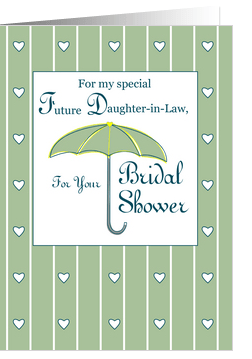
After I uploaded it, I emailed her back to let her know that the card was finished, and that when reviewed and approved by Greeting Card Universe, I would send her the link.
It was not a “private card” so I just uploaded it in the appropriate category, and within a few hours, it was approved and I sent her the link with instructions that she could make the purchase from this link along with any other card she might find. I also wished her luck with the shower and upcoming wedding and how special she must feel as the Mother of the Groom.
Before the day was through, the email came through that this card had been sold.
The important thing I always try to remember is that to a customer, we are the “face” of this huge universe of cards at GCU. It is a person to person contact, and clarity, friendliness, and professionalism will help to communicate well. I considered what she desired, and using my design skills and eye – work to create a card that suits their needs but also looks good to me, and meets my standards.
Good luck to all of you when you get that email that says: GCU Custom Request # …
Sandra Rose
Share this:

Dash of Inspiration – Easter Egg Hunt
A Dash of Inspiration, A Cup of Creativity by Doreen
Easter Egg Hunt
It’s not too late to add a few Easter cards to your stores! Even though we are cutting it close, if you don’t get sales from your new Easter cards this year you’ll certainly be ready for next year 🙂 Keeping it simple this week with a focus on images to inspire Easter creations and some tools to get you started!
I always find it very inspirational to see how artists in different mediums convey their unique messages, in this case their Easter visions, so here is a link to Easter Art on Redbubble.
So, for those of you who have never attempted to create an Easter Egg in your design program, here are some tutorials to get you started.
PHOTOSHOP Tutorial by Sanja Soltic at CSSCreme
ILLUSTRATOR Tutorial by PeHaa at PEHAA’s Blog
PAINT SHOP PRO Tutorial by Nightshadow FX
GIMP Video Tutorial by GIMPTricks
Here’s a few goodies to add to your digital toolbox and remember; ALWAYS do your own research on CU TOU. I try to offer only those items which are okay to use for our Greeting Card designs, BUT I don’t always have the time to dig deep enough. So grab the items and read the terms! Actual license TOU is often in the download file.
Okay so here ya go . . .
6 Free Easter Egg Shapes from Gaudi at Brusheezy
13 Hi-Res Photoshop Easter Eggs Brushes by PeHaa at Brusheezy
Easter Pattern from Pattern8.com
Easter Art DINGBAT Font by GemFonts
I hope to have inspired you to think outside the box for your Easter card creations!

Image by Sharon Bree
Share this:

Critique Clinic – February 10-12, 2012
How does it work? For three days a week (Friday-Sunday midnight), I will open the clinic to any artist who wants an honest peer review and critique of a card which gets plenty of clicks but no sales, so something’s probably not quite right, or you’ve got a new design you want to test drive, or you’re unsure about the marketability of a card. Or perhaps you’re a newbie who isn’t sure if a recently submitted card is up to a marketable standard. Anyone is welcome to participate. In fact, I encourage everyone to at least look at the cards in question and read the critique comments – you may learn something. The purpose of the clinic is to help artists improve the commercial appeal and marketability of their cards.
THE RULES
- ONE card per artist only.
- Card must be for sale at Greeting Card Universe.
- We will take an unlimited number of artists, including those who have submitted recently, HOWEVER I reserve the right to close a clinic for the day if the submissions become overwhelming. If the clinic has been closed, and you submit a card, your comment will be deleted.
- To submit a card for critique, post a link to the card at GCU in the comments section of this clinic post. Allowances will be made if you’ve had a card declined, or made a new design you’d like advice on. Give us the link where we can see the card, such as your private gallery, Flickr, etc.
- Any artist is free to comment and/or give a critique of a submitted card. HOWEVER, post-and-run comments like “great card” or “you suck” will not be tolerated, nor will abuse. Criticism should be constructive, not destructive. Play nice or you will be banned.
- I also won’t tolerate temper tantrums if you decide your “artistic integrity” is being stepped on because you asked for a critique, and someone told you the photo you’re using isn’t in focus. If you can’t take honest criticism, don’t submit. Once gets you a warning; twice and you’re banned from submitting in the future.
- Artists who critique may do so by giving their opinion, posting an example of another card, or pointing the submitter to a video, on-line article, or other helpful suggestion.
- Don’t forget that artists who are giving you tips and helpful advice are volunteering their time and trouble. Be nice. A link back to their store on your website or blog is appreciated (but not mandatory).
- You are free not to take any advice offered. There’s no guarantee any card will be a bestseller, so don’t come into the clinic with unrealistic expectations.
- Rules may change as we go along and we see how things turn out, okay?
So without any further ado, I declare this week’s Critique Clinic open!
Share this:

Contest: A Little Help From My Friends – Results!

The results are in on our Blog Carnival/Design Contest mash-up: A Little Help From My Friends!
Third Place: Laura J. Holman with 12 votes
Second Place: Doreen Erhardt with 28 votes
First Place: Sri Devi with 47 votes
Congratulations to Sri (and to Susan Alison, whose card she submitted)! Each artist wins a $10 Amazon gift certificate or 5 free card credits!
So here’s a quickie poll you can all participate in: Should we continue having Design Contests or not – what’s your opinion?


