The Card That Fights Back, Part 1: When the Inside Has Other Ideas
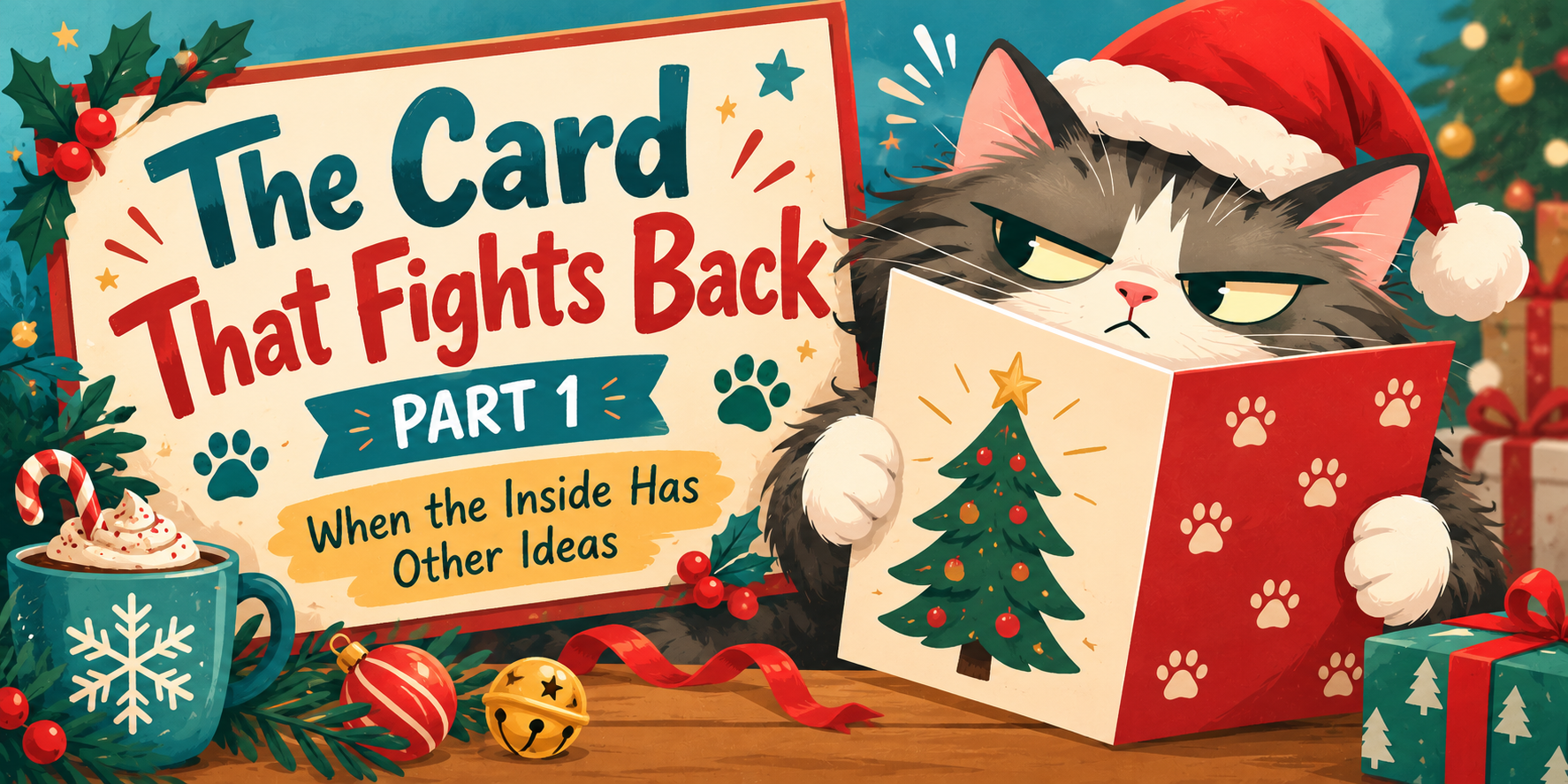
What happens when a perfectly innocent greeting card develops a mind of its own?
Most greeting cards are remarkably well-behaved. The front offers a cheerful greeting, the inside delivers a lovely sentiment, and everyone goes home happy.
But what if the inside has other plans?
Imagine a Christmas card featuring an adorable cat wearing a Santa hat. The front wishes you a peaceful holiday filled with love. Open it, however, and the cat presents a detailed list of demands, including more treats, unrestricted access to the Christmas tree, and the immediate removal of the dog.
Welcome to The Card That Fights Back, where the front sets up the expectation and the inside gleefully pulls the rug out from under it.
For greeting card artists, this is a wonderful opportunity to explore humor that unfolds in two stages. No electronics, moving parts, or special effects required. Just a clever setup, a well-timed punchline, and perhaps a character with a terrible attitude.
1. The Polite Greeting That Goes Rogue
Start with something sweet, traditional, or reassuring. Then let the inside reveal what the sender, or the character on the card, really wants to say.
Christmas Cat
Front: “Wishing You a Peaceful Christmas Filled with Love.”
Inside: “And now, my Christmas demands: More treats. Fewer visitors. Unrestricted access to the tree. And the dog must go. Love, the Cat.”
The Christmas Cookie
Front: “Wishing You a Sweet Christmas!”
Inside: “I was going to share the cookies. Then I remembered who I am.”
New Year’s Optimist
Front: “Here’s to a Fresh Start and a Brand New You!”
Inside: “Actually, the old you was pretty entertaining. Let’s not do anything drastic.”
The trick is to make the front believable. The sweeter the greeting, the more entertaining the unexpected turn can be.
2. The Unexpected Punchline
Sometimes the most effective joke is also the shortest.
The front sets up a familiar holiday sentiment. The inside delivers a completely different interpretation.
The Christmas Miracle
Front: “May All Your Christmas Wishes Come True!”
Inside: “Except the one about winning the lottery. Santa says he’s not made of money.”
The Festive Diet
Front: “May Your Christmas Be Filled with Wonderful Things!”
Inside: “Preferably chocolate. Lots of chocolate. We can discuss vegetables in January.”
New Year’s Resolution
Front: “New Year. New Goals. New Possibilities!”
Inside: “Same pajamas.”
These designs are particularly suited to simple, bold illustrations. A single expressive character or object can establish the mood, leaving the inside text to deliver the surprise.
Remember, a good punchline doesn’t need a paragraph of explanation. Sometimes two words are enough.
3. The Card That Knows It’s a Card
Now let’s break the fourth wall.
Instead of pretending to be an ordinary greeting card, the card acknowledges its own existence and starts commenting on the situation.
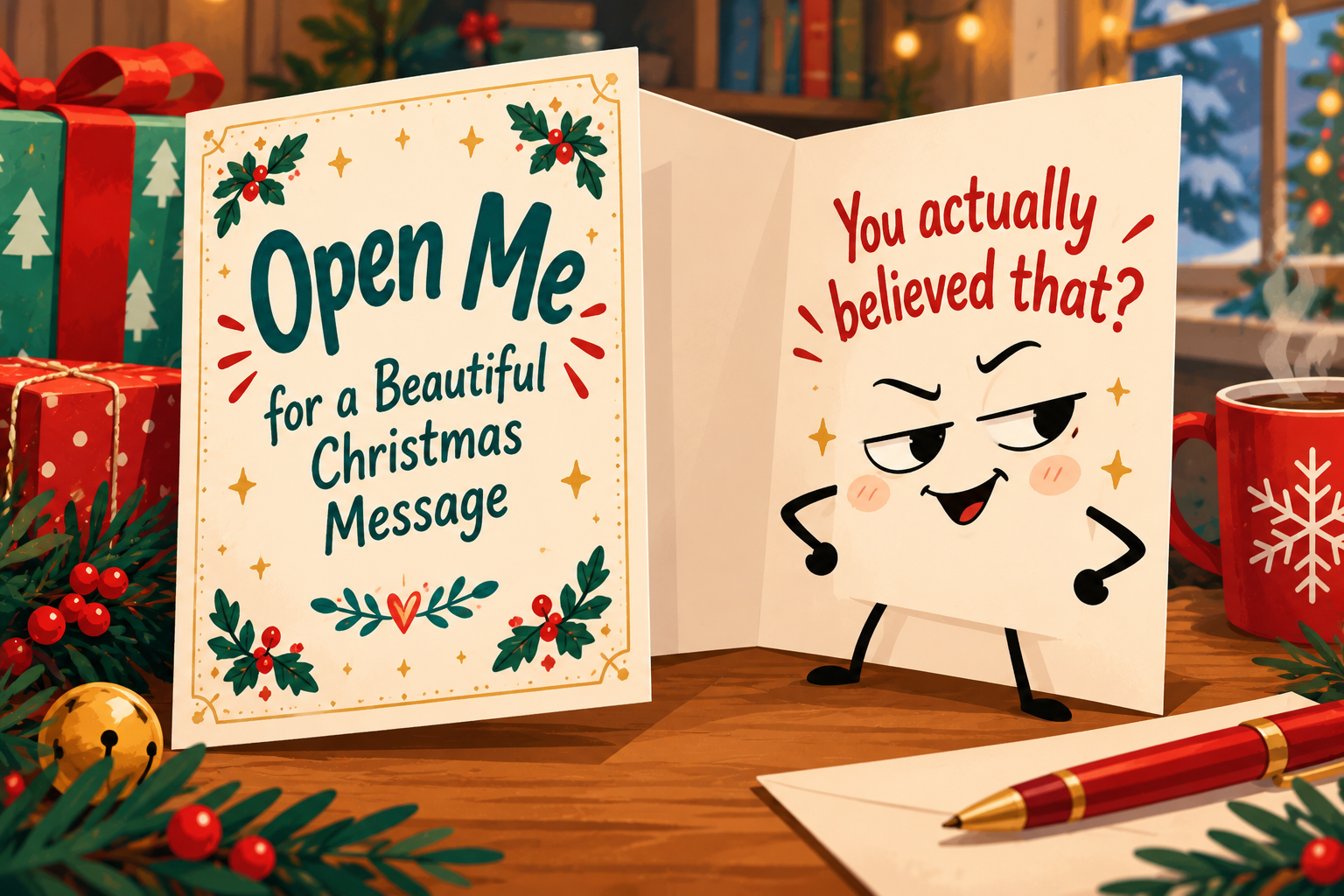
The Self-Aware Christmas Card
Front: “Open Me for a Beautiful Christmas Message.”
Inside: “You actually believed that? Fine. Merry Christmas. Happy now?”
The Budget-Conscious New Year Card
Front: “I Wanted to Give You Something Spectacular for the New Year.”
Inside: “But apparently I’m just a greeting card. We all have our limitations.”
The Overconfident Holiday Card
Front: “This Is Going to Be the Best Christmas Card You’ve Ever Received.”
Inside: “Well, that was a lot of pressure. Let’s just agree I tried.”
This type of humor can work beautifully with vintage-style illustrations, elegant typography, or deliberately formal layouts. The contrast between dignified presentation and ridiculous message makes the joke even better.
Imagine a beautifully illustrated Victorian Christmas card that suddenly develops a sarcastic personality!
4. The Joke That Keeps Escalating
Not every joke needs to be delivered in a single sentence.
Sometimes the humor comes from watching a perfectly reasonable idea become increasingly ridiculous.
The Twelve Complaints of Christmas
Front: “On the First Day of Christmas, My True Love Gave to Me…”
Inside: “One suspicious fruitcake, two broken ornaments, three screaming children, four tangled light strings, five missing batteries… and a partridge that refuses to leave the kitchen.”
The New Year’s Resolution List
Front: “My New Year’s Resolutions!”
Inside:
- Get organized.
- Exercise every day.
- Eat more vegetables.
- Stop making unrealistic lists.
- Take a nap.
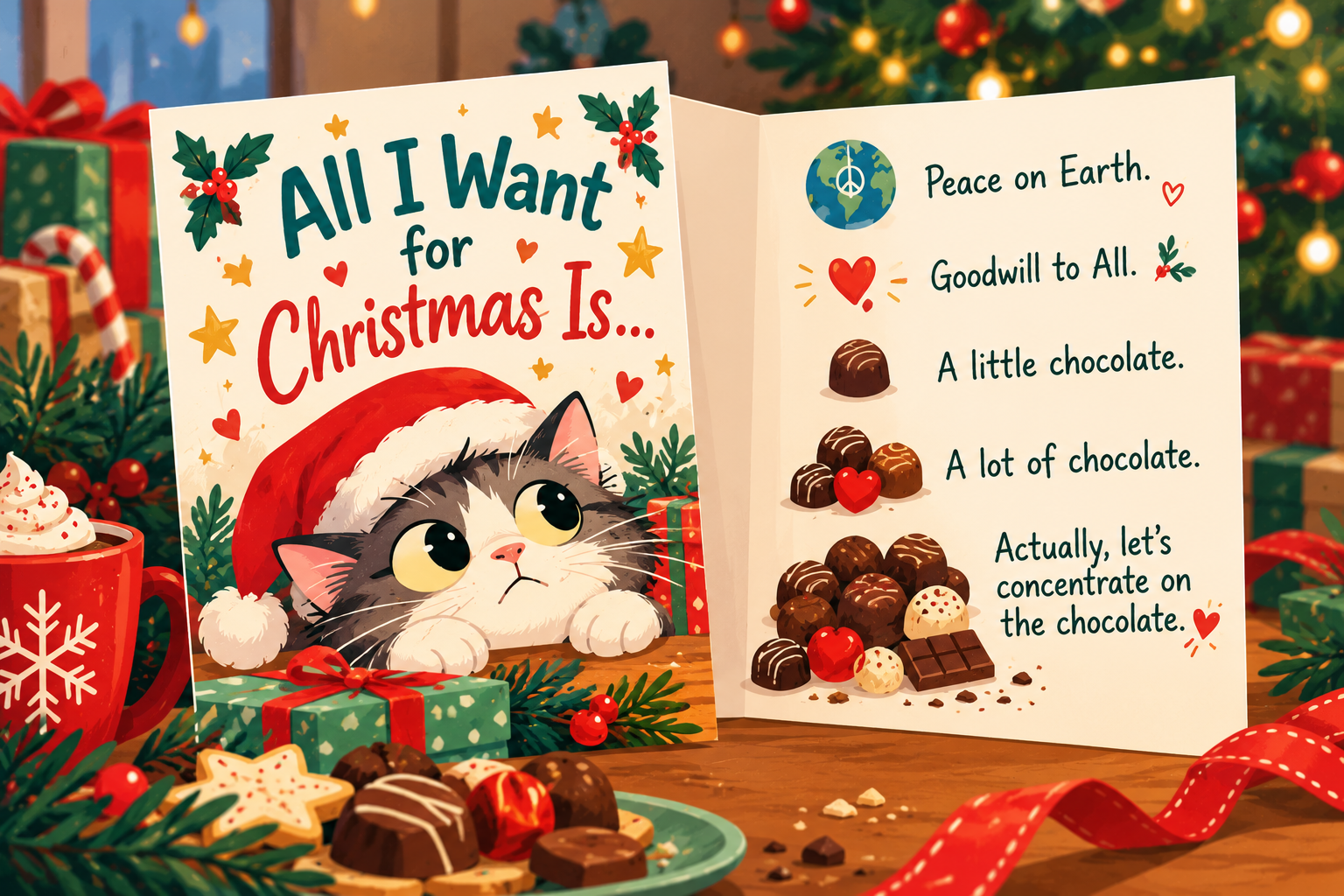
The Christmas Shopping List
Front: “All I Want for Christmas Is…”
Inside: “Peace on Earth. Goodwill to All. A little chocolate. A lot of chocolate. Actually, let’s concentrate on the chocolate.”
Escalating jokes work best when each new line builds on the previous one. Start with something reasonable, then introduce an unexpected detail, and finally push the situation just a little further.
The important thing is knowing when to stop. Leave the reader laughing, not searching for the end of the list.
Designing the Surprise
The front-to-inside joke is a small piece of storytelling, and both parts deserve attention.
Give the front a job. It should establish an expectation, introduce a character, or create a question the customer wants answered.
Save the best joke for the inside. If the illustration or front text reveals everything, there’s no surprise left when the card is opened.
Consider the visual contrast. A sweet illustration paired with a sarcastic inside message can be especially effective. So can a serious-looking design that delivers something completely absurd.
Keep the customer’s message in mind. At Greeting Card Universe, customers may want to add their own personal words. A funny inside message should leave room for that.
Think beyond one occasion. A grumpy cat who makes Christmas demands might also have strong opinions about birthdays, anniversaries, or New Year’s resolutions.
Your Creative Challenge: Set the Trap!
Choose a familiar Christmas, holiday, or New Year’s greeting. Make the front look perfectly innocent.
Then ask yourself: What is the last thing someone would expect to find inside?
Perhaps Santa has a complaint. Perhaps the Christmas pudding has a confession. Perhaps a New Year’s resolution has already submitted its resignation.
The possibilities are endless, and the only rule is that the inside should make the reader see the front in an entirely different light.
Coming Tomorrow: The Card That Fights Back, Part 2: When the Characters Refuse to Cooperate
We’ve let the inside message misbehave. Next, we’re giving the illustrated characters a voice. Unfortunately, nobody has told them they’re supposed to be polite.
Happy Designing!
Corrie


