The Card That Fights Back, Part 2: When the Characters Refuse to Cooperate
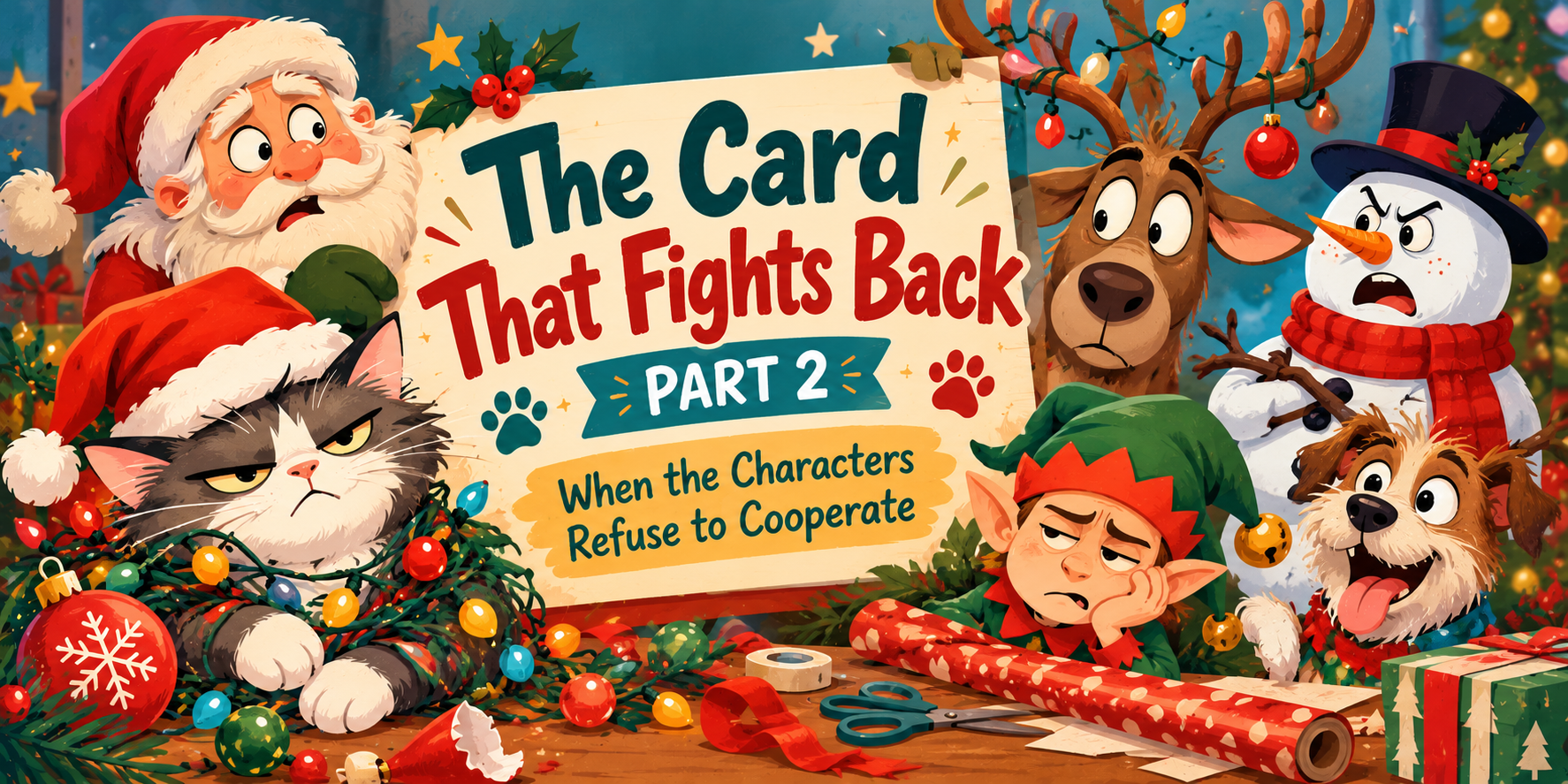
Santa has complaints. The snowman is offended. And the cat would like to speak to management.
In Part One: When the Inside Has Other Ideas, we explored greeting cards that set up a perfectly innocent message on the front, only to deliver an unexpected punchline inside.
But there’s another way to make a greeting card fight back.
What happens when the characters in your illustrations refuse to cooperate?
Imagine a group of adorable woodland animals gathered around a Christmas tree. They’re supposed to be delivering a cheerful holiday greeting. Unfortunately, the rabbit has objections, the fox wasn’t consulted, and the bear is only interested in the refreshments.
Suddenly, the illustration isn’t just decorating the card. It’s participating in the joke.
For Greeting Card Universe artists, character-driven humor opens up a world of possibilities, especially for Christmas, the winter holidays, and New Year.
Let’s give those characters something to say.
1. The Character Who Hijacks the Message
Start with a perfectly normal greeting, then introduce a character who takes exception to it.
The Offended Snowman
Front: “Wishing You a Warm and Wonderful Christmas!”
Inside:
Snowman: “WARM?!”
Penguin: “Oh dear. You’ve upset him again.”
The Reindeer With Questions
Front: “May All Your Christmas Dreams Take Flight!”
Inside:
Reindeer: “Flight? Nobody mentioned flying.”
Santa: “It’s literally your job.”
Reindeer: “I want to see my contract.”
The New Year’s Party Cat
Front: “Let’s Celebrate the New Year in Style!”
Inside:
Cat: “Define ‘celebrate.'”
Dog: “Music! Dancing! Fireworks!”
Cat: “Absolutely not.”
The beauty of this technique is that the interruption becomes the punchline. One character delivers the traditional sentiment, while another refuses to play along.
A dramatic facial expression on the front can make the reader curious about what happens next.
2. The Card That Argues With Itself
Why stop at one opinionated character when you can have an entire cast?
Multiple characters allow you to create little conversations, misunderstandings, and escalating disagreements.
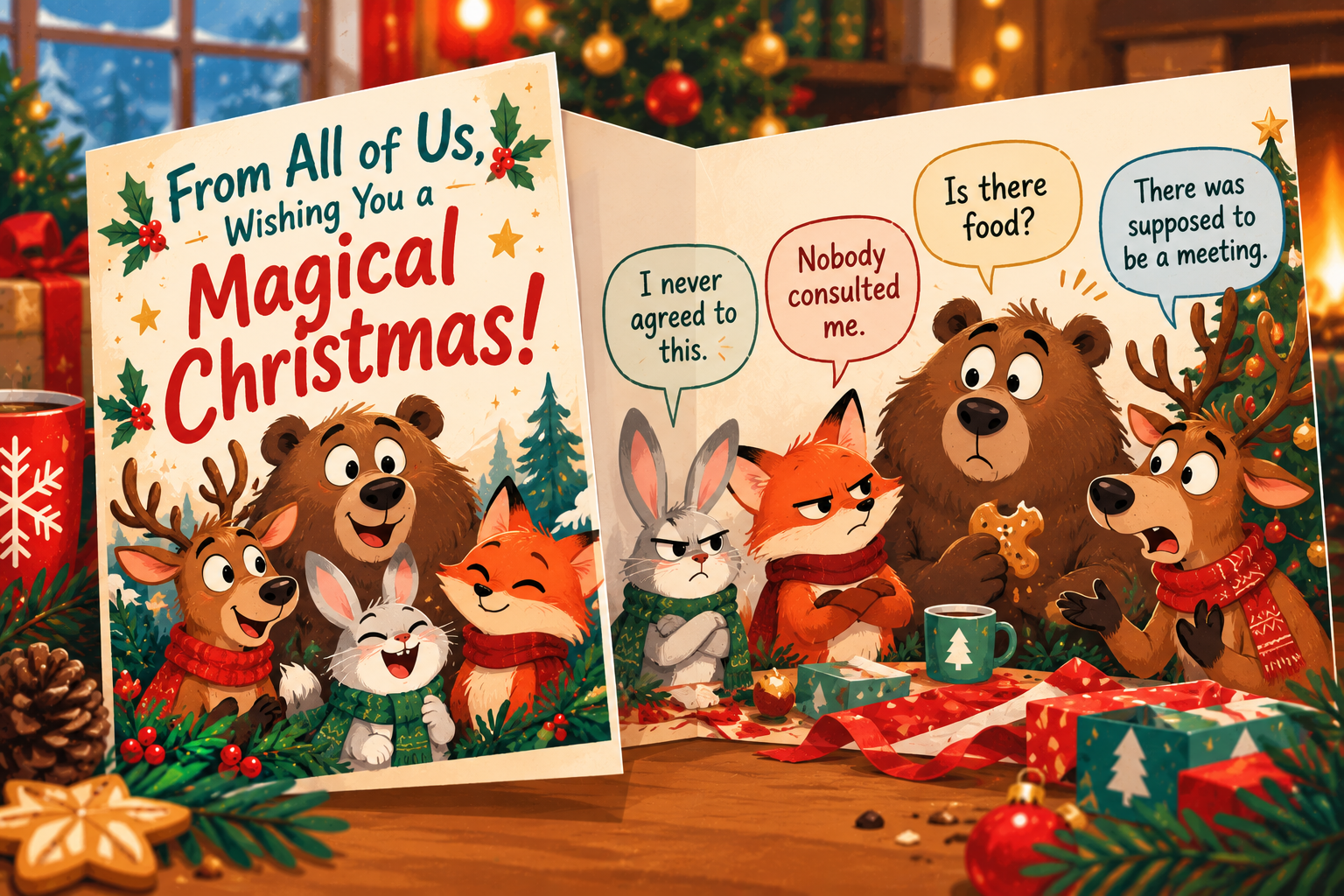
The Christmas Committee
Front: “From All of Us, Wishing You a Magical Christmas!”
Inside:
Rabbit: “I never agreed to this.”
Fox: “Nobody consulted me.”
Bear: “Is there food?”
Rabbit: “There was supposed to be a meeting.”
Santa’s Budget Meeting
Front: “Have Yourself a Merry Little Christmas!”
Inside:
Santa: “Little?”
Elf: “We had budget cuts.”
Santa: “Again?”
Elf: “Don’t ask about the reindeer.”
The New Year’s Resolution Committee
Front: “New Year. New You!”
Inside:
Dog: “We could exercise more!”
Rabbit: “We could eat healthier!”
Cat: “We could mind our own business.”
This approach works particularly well when the characters have contrasting personalities.
One might be enthusiastic, another deeply suspicious, and a third completely uninterested in the conversation.
The comedy comes from their reactions to one another.
3. The Reluctant Holiday Participants
Not everyone loves the holidays. And that includes fictional characters.
A grumpy character surrounded by excessive holiday cheer can be a wonderful starting point for a humorous card.
The Introverted Christmas Dragon
Front: “Let the Christmas Festivities Begin!”
Inside:
Dragon: “I have decorated my cave, prepared snacks, and locked the entrance. Perfect.”
The Exhausted Elf
Front: “Christmas Magic Is in the Air!”
Inside:
Elf: “That’s glitter. The ventilation system exploded.”
The New Year’s Dinosaur
Front: “Ready to Roar into the New Year?”
Inside:
Dinosaur: “I was. Then I remembered how the last one went.”
The Antisocial Holiday Cat
Front: “There’s No Place Like Home for the Holidays!”
Inside:
Cat: “Especially when nobody else is in it.”
These characters are particularly effective because their personalities are instantly recognizable.
A grumpy cat doesn’t need much introduction. Neither does a tired elf, a nervous reindeer, or a dragon who prefers a quiet evening at home.
The illustration establishes the personality, and the inside text lets it speak.
4. Let the Front Illustration Set Up the Punchline
Not every joke needs a long conversation. Sometimes the funniest part is what the reader imagines happening next.
Imagine a Christmas card featuring a beautifully decorated tree, with a suspiciously innocent-looking cat sitting beside it.
Front: “May Your Christmas Be Perfect in Every Way!”
Inside: “The tree was perfect. Briefly. Then the cat got involved. We don’t talk about the tree anymore.”
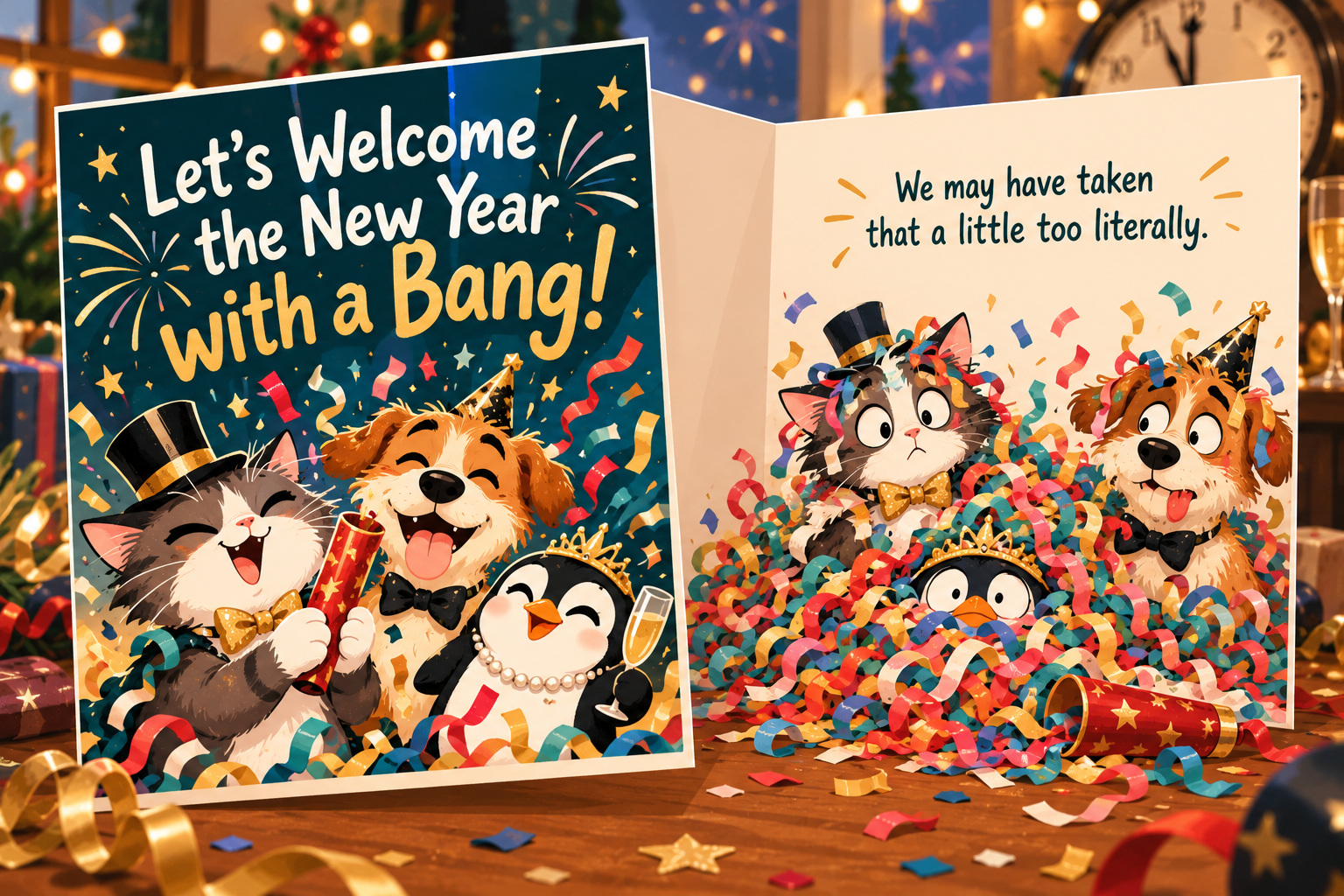
Or consider a New Year’s card featuring three animals dressed for a glamorous party. One is holding an enormous confetti cannon, another looks slightly concerned, and the third is already wearing protective goggles.
Front: “Let’s Welcome the New Year with a Bang!”
Inside: “We may have taken that a little too literally. The penguin is still missing under the confetti.”
The illustration introduces the characters and hints at what’s coming. The inside message lets the reader imagine the hilarious consequences.
This is visual storytelling with a twist. You don’t have to show the entire joke. In fact, leaving something to the imagination can make the punchline even funnier.
Artists can experiment with facial expressions, body language, suspicious props, and small background details that suggest a disaster waiting to happen.
5. Build a Cast That Keeps Coming Back
One of the most interesting possibilities of character-driven humor is the opportunity to create a recurring series.
Instead of inventing completely new characters for every card, consider developing a small cast with distinct personalities.
For example:
The Holiday Cat: Sarcastic, demanding, and permanently unimpressed by human traditions.
The Overenthusiastic Dog: Convinced every occasion requires a party, preferably involving food.
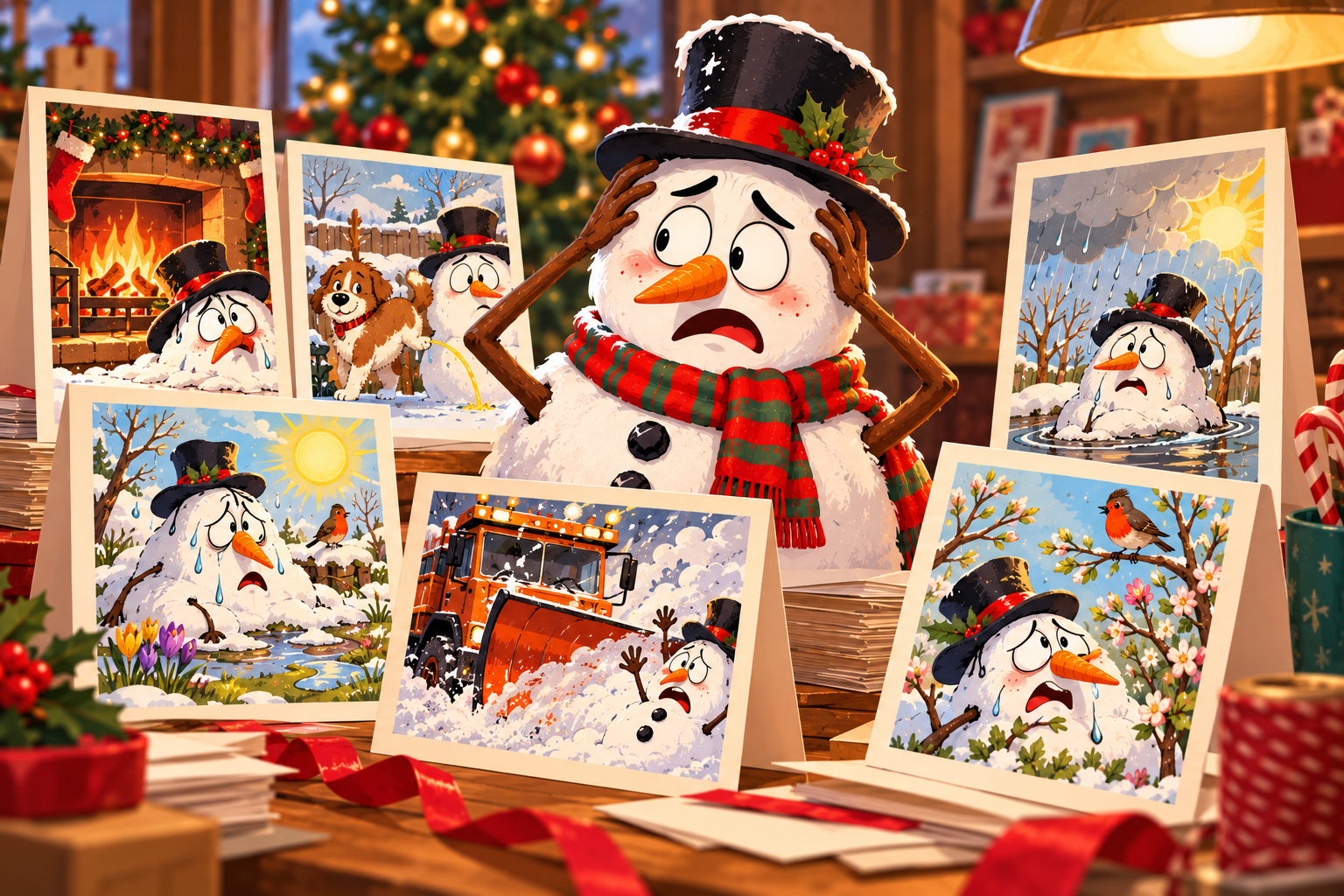
The Anxious Snowman: Worried about heating, sunshine, fireplaces, and the arrival of spring.
The Exhausted Elf: Has worked in Christmas production for far too many years and is no longer interested in pretending everything is magical.
The Dramatic Dragon: Takes every celebration personally and considers minor inconveniences an insult to dragonkind.
Now imagine how these characters might behave at Christmas, New Year, birthdays, or other occasions throughout the year.
A recognizable cast can give your designs continuity while allowing plenty of variety in the jokes.
You could even create a collection where different characters respond to the same holiday greeting.
One occasion, five personalities, five completely different cards.
Designing Characters With Something to Say
Character-driven humor depends on more than funny dialogue. The illustration needs to help tell the story.
Give each character a recognizable personality. Expressions, posture, clothing, and props can communicate attitude before a single word is spoken.
Use speech bubbles selectively. A short remark or an interrupted sentence on the front can set up the joke beautifully. Save the longer conversation, argument, or unexpected response for the inside.
Let expressions do some of the talking. A raised eyebrow, an offended stare, or a spectacular eye roll can sometimes replace an entire sentence.
Keep the conversation easy to follow. When several characters are speaking, make it immediately clear who is saying what.
Remember the front-to-inside reveal. The front introduces the situation. The inside gives the characters permission to ruin it.
And don’t forget that these techniques can work in almost any illustration style, from cute kawaii animals and colorful modern cartoons to vintage comic strips, elegant retro artwork, and beautifully detailed fantasy scenes.
Your Creative Challenge: Let Them Talk Back!
Take one of your favorite illustrated characters and imagine that it suddenly becomes aware of the greeting it’s supposed to deliver.
Does it agree with the message?
Does it object?
Does it interrupt another character, demand better working conditions, or decide that the entire celebration is a terrible idea?
Now build a greeting card around that reaction.
Try a Christmas card where the reindeer question Santa’s leadership. A New Year’s card where the party animals can’t agree on what constitutes a good time. Or a holiday card where an innocent-looking cat quietly takes control of the entire operation.
The best character-driven jokes don’t necessarily require lots of words. Sometimes all you need is one beautifully timed interruption.
The front makes a promise. The inside lets the characters break it.
And if your characters start arguing with you while you’re designing the card?
Congratulations. You’re probably on the right track.
Missed Part One? Read The Card That Fights Back: When the Inside Has Other Ideas for more ways to turn an innocent greeting into an unexpected punchline.
Happy Designing!
Corrie


Wow, have I missed something? Can you add drawings to the inside of cards as shown on the “The Christmas Committee” and “Let’s Welcome the New Year with a Bang!”? If so, can you please let me know how to do so?