Labor Day

Happy Labor Day, America!
We resume our regular posts tomorrow. In the meantime, have a great holiday.
Share this:

Critique Clinic – August 30-31 and September 1, 2013

How does it work? For three days a week (Friday-Sunday midnight), I will open the clinic to any artist who wants an honest peer review and critique of a card which gets plenty of clicks but no sales, so something’s probably not quite right, or you’ve got a new design you want to test drive, or you’re unsure about the marketability of a card. Or perhaps you’re a newbie who isn’t sure if a card is up to a marketable standard. Anyone is welcome to participate. In fact, I encourage everyone to at least look at the cards in question and read the critique comments – you may learn something. The purpose of the clinic is to help artists improve the commercial appeal and marketability of their cards.
THE RULES
- ONE card per artist only.
- Card must be intended for sale at Greeting Card Universe.
- To submit a card for critique, post a link to the card at GCU in the comments section of this clinic post. Allowances will be made if you’ve had a card declined, or made a new design you’d like advice on before submission. Give us the link where we can see the card, such as your private gallery, Flickr, Tinypic, etc. If you do give a private gallery link, be sure your private module gallery is ON. Please do not post links to your Manage Cards section – do you really want strangers tinkering with your cards? And please don’t ask us to critique a card that’s pending review – we can’t see it until it’s approved.
- Any artist is free to comment and/or give a critique of a submitted card. HOWEVER, post-and-run comments like “great card” or “you suck” will not be tolerated, nor will abuse. Criticism should be constructive, not destructive. Play nice or you will be banned.
- I also won’t tolerate temper tantrums if you decide your “artistic integrity” is being stepped on because you asked for a critique, and someone told you the photo you’re using isn’t in focus. If you can’t take honest criticism, don’t submit. Once gets you a warning; twice and you’re banned from submitting in the future.
- Artists who critique may do so by giving their opinion, posting an example of another card, or pointing the submitter to a video, on-line article, or other helpful suggestion.
- Don’t forget that artists who are giving you tips and helpful advice are volunteering their time and trouble. Be nice. A link back to their store on your website or blog is appreciated (but not mandatory).
- You are free not to take any advice offered. There’s no guarantee any card will be a bestseller, so don’t come into the clinic with unrealistic expectations.
- Rules may change as we go along and we see how things turn out, okay?
So without any further ado, I declare this week’s Critique Clinic open!
Share this:

Design Contest: Simply the Best RESULTS

The voting is over and the results are in – John H. Johnson wins our design contest with 58 votes!
Congratulations to our winner!
John, get in touch with me via the Contact Corrie link on the right side of this page and let me know which prize you’d like to receive – 5 free card credits or $10 Amazon.com gift certificate
Share this:

Font Frenzy: Discount Font Source

Today, we’re bringing you not one font, but a link to an ever changing source of discounted fonts.
My Fonts: Special Offers lists fonts on sale at the site. Some fonts are truly deeply discounted, making them very affordable. Others have a small percentage shaved off their price. As with any sales offers, there are deadlines.
As to the prices, your mileage may vary. Some fonts are just expensive, even on sale. Others are more affordable. What fonts you like and what you choose to spend is up to you.
Since the My Fonts: Special Offers page is continually updated, I usually go there once or twice a month to see what’s on sale. I’ve picked up some nice cheap fonts that way.
Below are just a couple of samples of fonts currently on sale. Good luck!



Share this:


Submitting Your Site to Search Engines: Part 1
by Cheryl Hall at Golden Jackal Card Store
How do you submit a site to search engines?
You don’t need SEO (search engine optimization) to submit your site to Google, Yahoo or Bing. It’s also free to get into the big three search engine listings. By the way, Bing powers Yahoo results (since 2013).
The best way to actually get into the top search engines is for the search engine spider to find your site through a link that is already on another website, one that Google already has in it’s index. For example, a link from a blog, forum or other website. Any link from another website will do as long as it seen as a link.
What about directory submission services to help me get a website into search engines? Of course you can submit/register your site to directories like Google, Yahoo and Bing.
Here is a list to get you started:
Submit site to Bing Webmaster Tools
How social media sites can help get your site indexed by search engines: if you already do it, then it can’t hurt!
Google have their spiders crawl over Facebook, Twitter, and Google Plus. Apparently, Bing spiders Facebook pages too (it is believed that they have an agreement with Facebook). Links on these websites often spread to other places on the web, meaning that creating a profile on social networks can help a website get into search engines.
Think long term. Search engine submission is a not a quick fix. To be successful you need to keep on top of these things in particular:
- Position your keywords in the most effective place and structure your pages correctly. (I will have more on this in future posts)
- Register with as many web directories as possible.
- Build a great site and have unique content that other websites will want to link to.
- Concentrate your efforts on these things and within a few months you’ll start to see the fruits of you labor.
I know all this can be confusing and overwhelming but just take a deep breathe and in time you will get there!
Happy submitting! f you can’t wait to read Part 2 of Submitting you site to search engines, you can read it right now.
For more helpful tips visit Golden Jackal
Share this:

Dash of Inspiration: Marketability – Photo Card Area
A Dash of Inspiration, A Cup of Creativity by Doreen
Marketability: Photo Card Area

Let’s keep this series going by heading into the last grouping of the Submission Guidelines; Marketability and next up is Photo Card Area.
MARKETABILITY: Photo Card Area
The Submission Guidelines state this: On photo card designs, the photo area should serve as the focal point of the overall design. Compositional emphasis should be on the photo, not other elements on the card. Maximize the photo size as the focal point. Specifically: Entire photo area (a single photo or multiple photos) should ideally use 1/3 to 1/2 of the card’s surface. If design is used to create multiple cards, elements should vary and be appropriate by occasion, age, relation, and gender.
A mistake many artists make is trying to ‘shove’ a photo area into an existing ‘standard’ design. Though this works occasionally, most of the time the photo card tends to look as though this was the technique used and therefore just isn’t a good photo card. Here are examples of this type of card, all of which would most likely be declined.


By: Penny Cork – This is an outstanding design, so obviously created as a well thought out photo card. It’s a perfect magazine cover.

By: ©Doreen Erhardt – A very popular holiday photo card created to give the customer a ‘year at a glance’ style for their annual season’s greetings.
Photo cards which sell well, therefore highly marketable, are those designed specifically as photo cards. The photo area and the custom text are the focal points of the design. There are some great examples below of various types of photo card styles. As always there are exceptions to the rules, in this case exceptions to the 1/3 to ½ of the card’s surface being dedicated to the photo area. Look at those examples and you can see, these were designed with ‘smaller’ photo areas in mind to compliment the overall design.
Two good examples of when breaking the 1/3 to ½ of the card’s surface actually works and all elements blend beautifully with each other to create a marketable photo card.

By: Anura Design Studio

By: Debbie Fieno
Here are some great tips:
Nuts & Bolts: Photo Cards
Blast From the Past: Tips for Photo Cards
Dash of Inspiration: Custom Front of Card Tips
Next week we’ll continue in the final group of the Submission Guidelines: MARKETABILITY and talk about Creative Use Policy. Till next week, I hope I’ve inspired you to create better Photo Cards.
For great resources & tips visit the SalonOfArt
Share this:

Critique Clinic – August 23-25, 2013
How does it work? For three days a week (Friday-Sunday midnight), I will open the clinic to any artist who wants an honest peer review and critique of a card which gets plenty of clicks but no sales, so something’s probably not quite right, or you’ve got a new design you want to test drive, or you’re unsure about the marketability of a card. Or perhaps you’re a newbie who isn’t sure if a card is up to a marketable standard. Anyone is welcome to participate. In fact, I encourage everyone to at least look at the cards in question and read the critique comments – you may learn something. The purpose of the clinic is to help artists improve the commercial appeal and marketability of their cards.
THE RULES
- ONE card per artist only.
- Card must be intended for sale at Greeting Card Universe.
- To submit a card for critique, post a link to the card at GCU in the comments section of this clinic post. Allowances will be made if you’ve had a card declined, or made a new design you’d like advice on before submission. Give us the link where we can see the card, such as your private gallery, Flickr, Tinypic, etc. If you do give a private gallery link, be sure your private module gallery is ON. Please do not post links to your Manage Cards section – do you really want strangers tinkering with your cards? And please don’t ask us to critique a card that’s pending review – we can’t see it until it’s approved.
- Any artist is free to comment and/or give a critique of a submitted card. HOWEVER, post-and-run comments like “great card” or “you suck” will not be tolerated, nor will abuse. Criticism should be constructive, not destructive. Play nice or you will be banned.
- I also won’t tolerate temper tantrums if you decide your “artistic integrity” is being stepped on because you asked for a critique, and someone told you the photo you’re using isn’t in focus. If you can’t take honest criticism, don’t submit. Once gets you a warning; twice and you’re banned from submitting in the future.
- Artists who critique may do so by giving their opinion, posting an example of another card, or pointing the submitter to a video, on-line article, or other helpful suggestion.
- Don’t forget that artists who are giving you tips and helpful advice are volunteering their time and trouble. Be nice. A link back to their store on your website or blog is appreciated (but not mandatory).
- You are free not to take any advice offered. There’s no guarantee any card will be a bestseller, so don’t come into the clinic with unrealistic expectations.
- Rules may change as we go along and we see how things turn out, okay?
So without any further ado, I declare this week’s Critique Clinic open!
Share this:

Font Frenzy: Facunda – Free!
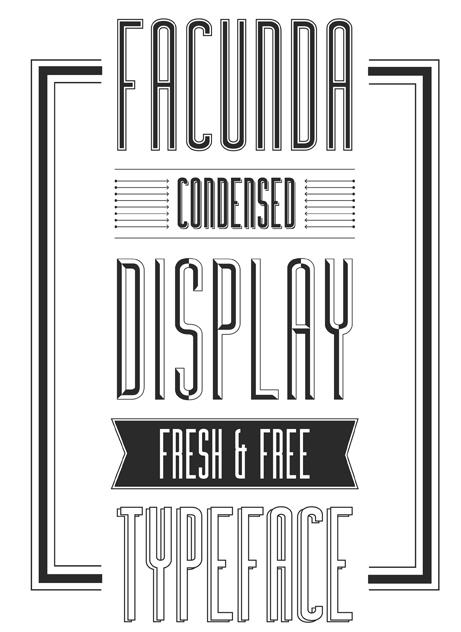
Today’s type-alicious treat is Facunda, a versatile sans serif font family. In the download, you’ll get regular, italic, shadow, alternate, and alternate italic. The font would fit certain types of nostalgia or retro designs, but there’s enough modernity here that you could use it in combination with other fonts (like script). Best of all, the license is OK and free for commercial use. You’ll see a sample of Facunda below. Have fun!
Share this:

Design Contest: Simply the Best – VOTE!

Apologies for the delay, folks, but we’re here and we’re ready to open the voting on our Design Contest: Simply the Best!
Nominated cards are below. Click a card to see the bigger size, then return here to vote in the poll.
One vote per person. Anyone may vote, so be sure to promote your entry on social media sites like Facebook and Twitter. Voting deadline is August 27. The artist who receives the most votes will be declared the winner and receive their choice of 5 free card credits OR a $10 Amazon.com gift certificate.
Are we ready? Get set … go!
_________________________
1.  2.
2.  3.
3. 
4.  5.
5. 
6.  7.
7.  8.
8. 
9.  10.
10.  11.
11. 
12.  13.
13.  14.
14. 
Share this:

Nuts and Bolts: International Artists’ Withholding Tax

It’s an issue international artists have dealt with since the news was first announced in this Forum thread back in 2011.
US tax law requires GCU withhold 30% of your earnings unless you file both a W8-BEN form AND obtain an ITIN (Individual Taxpayer Identification Number) or EIN (Employer Identification Number) from the IRS. If you are a citizen of a country other than the United States, you will be affected.
In this article, we’ll try to explain what’s going on, what you can do, and give you tips on possibly where to find more information. We obviously can’t provide ALL the answers to your questions as each individual country will likely have different procedures and requirements.
Please be aware the Powers-That-Be at GCU have already done research, spoken extensively to the IRS (the US Internal Revenue Service), and US tax law experts. They are aware that many POD and stock agencies do not require all the same paperwork. Believe me, international artists have made their feelings known on many occasions and the issue has been hotly debated since 2011. If you want to add your voice to the rest, your best bet is placing your comments in this Forum thread or any other Forum thread relating to the issue. GCU Admin will not see or respond to comments made on this post.
What is this tax withholding thing all about?
Some time ago, many countries in the world got together and signed tax treaties with the other countries. These tax treaties laid out what percentage, if any, of tax would be paid by citizens of one country doing business and/or earning income generated in another country.
Why do you have to pay the American tax agency (IRS) anything when you’re already paying taxes on your income in your own country?
It’s that pesky tax treaty again (see above). Countries who signed a tax treaty with the US have negotiated the amount of tax their citizens have to pay the IRS when earning money from a US based business. The good news is, many countries have a 0% withholding rate or at least less than 30%. Citizens of countries who do not have a tax treaty must pay a 30% withholding rate, period.
This is totally not fair!
Sorry. That’s the law. As we all already know, there’s only one way of getting out of paying taxes. 😉 If it’s any consolation, every other international artist is in the same boat.
What does GCU do with the tax money they withhold from your earnings?
Any money collected for tax purposes is forwarded to the IRS as required by law.
What’s the first step?
Before you commit yourself to spending time and money wrangling red tape in your country, first do a little research and decide if this is something you even want to do.
Tax Treaty Countries and Article Numbers – Go here to find out if your country has a tax treaty with the US and what percentage of tax GCU is legally required to withhold from your artist’s earnings. If your country does not have a tax treaty with the US, or the withholding is already at 30%, or you do not wish to go to the trouble of additional paperwork to claim a treaty benefit (meaning a lower or no withholding rate, which is the case for many countries) you need do nothing except fill out and file a W-8BEN form with Greeting Card Universe.
The W-8BEN form is required by the IRS for all non-US citizens earning income from a United States business. Regardless of whether you choose to accept the 30% withholding or want to go further and claim a treaty benefit, you will need that W-8BEN form filled out. If you don’t fill out a W-8BEN form, GCU cannot pay you any of your earnings. You don’t have to file this form with the IRS. Links below to the necessary forms.
W-8BEN (Certificate of Foreign Status of Beneficial Owner For United States Tax Withholding)
Instructions for filling out Form W-8BEN
Send the completed W-8BEN form to susan @ bigdates.com
If you have questions about the W-8BEN, you can send them here: gcuw8 @ bigdates.com
You’ll notice there’s a box on the W-8BEN form asking for an ITIN. We’ll get into that in the next section. At this point, if you’ve decided paying 30% withholding is okay, leave the ITIN box blank and send the otherwise completed W-8BEN form to Susan Tricca.
What do you do if you don’t want 30% withheld from your earnings, your country’s tax treaty with the US is less than 30% or zero, and you want to claim the benefit?
To claim the tax treaty benefit you’re entitled to, you will need to do some paperwork and fill out a W-7 form to get an ITIN from the IRS. Yes, this tax stuff is complicated and confusing, so we’ll do our best to help you out. If you’re really stuck, we suggest making a plea for help in the Forum asking fellow artists in your country for assistance. Links to the necessary forms below.
W-7 (Application for IRS Individual Taxpayer Identification Number)
Instructions for filling out Form W-7
On the form, you’ll be claiming Exception 1(d) to the stated requirement for a US tax return. This means you do not need to provide said tax return. This section is on the form for foreign citizens legally working in the United States.
To find your country’s tax treaty article number, check the Tax Treaty Countries and Article Numbers link above.
To go with your filled out W-7 form, which will have to be filed with the IRS, you will need a letter from GCU. Send a request for the letter stating you’re applying for an ITIN to gcuw8 @ bigdates.com or susan @ bigdates.com.
You will also have to include with your W-7 form certified copies of proof of identity and foreign status. These certified copies must be less than 12 months old. The only acceptable documents are:
- Passport
- National identification card (with photo, name, current address, date of birth, and expiration date)
- US driver’s license
- Foreign driver’s license
- US state identification card
- Foreign voter’s registration card
- U.S. military identification card
- Foreign military identification card
- Visa (not the credit card)
- US Citizenship and Immigration Services (USCIS) photo identification
If you’re sending a certified copy of your passport (not the passport itself) that’s the only document you need. Otherwise you will need certified copies of two other documents from the list.
How you get certified copies of your documents is something you’ll have to find out yourself. Every country has a different procedure. For example, in the Netherlands, I needed to call my local City Hall for a certified copy of my passport. Getting a certified copy of a document may be as simple as going to your country’s equivalent of a notary public or you may have to go through a government agency. Either way, a fee will be involved. How much depends on your country.
Try a Google search for “certified documents + name of your country” in your native language. For example, a quick search for “certified documents Canada” yielded this result with the necessary information.
To go along with the certified document(s), you will also need an Apostille for each one. Basically, an Apostille is a form or stamp issued by your government that makes your certified documents legally acceptable to the US. Without an Apostille, your certified documents will not be accepted by the IRS and your ITIN application will be rejected.
Apostilles may be issued by local, county, state, province, or national government agencies. A fee is normally charged and you’re usually also required to include a simple letter with the request stating which country the Apostille is for.
To find out how to get an Apostille in your country, we suggest Googling “apostille + name of your country” in your native language. For example, a one-second search for “Apostille UK” resulted in this government website with all the information needed. Make sure you deal with a government agency, not a company offering to get your documents for a price. Such businesses charge whopping fees and it’s much, much cheaper to do it yourself. In our case, a business wanted the equivalent of $400. We did the paperwork ourselves and paid the government office only $10. Big difference!
Finally, you need a letter from GCU. Send a request to Susan Tricca – susan (at) bigdates.com.
Once you’ve filled out the W-7 form and attached your document(s) with Apostille(s), send everything to the IRS address you’ll find on the W-7 form. After that, you wait. We received our ITIN in about four weeks or so, but be patient. One way or the other, you’ll hear about the status of your request in due time.
Be aware if you’ve incorrectly filled out the form, attached the wrong documents, or failed to provide Apostille(s), the IRS will reject your application and you’ll have to start over from the beginning. Your documents will very likely not be returned.
What do you do once you have your ITIN?
Get in touch with Susan Tricca (her email address is above) if you’ve already given GCU a W-8BEN form.
If you haven’t given them a W-8BEN yet, now’s the time to fill in the blank box asking for the ITIN. Once you’ve done that, send the completed W-8BEN form to Susan Tricca. And you’re finally done – congratulations!
While the task ahead may seem daunting, it’s really pretty simple once you strip out the jargon and get down to the basics. We hope we’ve answered at least some of your questions in the article and allowed you to make an informed decision.
Who Qualifies for an EIN?
If you are a recognized business entity in your country (as opposed to an individual), you can apply for an EIN instead of an ITIN. Both the EIN and ITIN are used to avoid double taxation.
What Do I Need to Do to Apply For An EIN?
There are several options for applying including by phone. Go to How To Apply for an EIN to get all the necessary information, including a link to Form SS-4.
Good luck!


 GCU Community