Design Spotlight: Tamara Dawn Adams

Today’s Design Spotlight shines on Tamara Dawn Adams who’s been a GCU artist since 2008 – the featured Nurse card is too cute!
_________________________
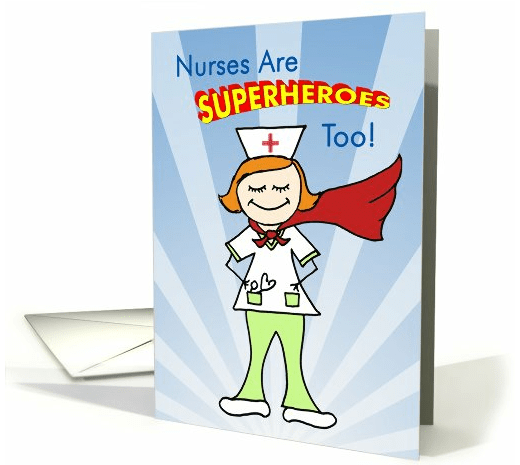
My “Nurses are Superheroes, Too” card is definitely my most popular card, beating out all the other selections in my store. This card was inspired by the mother of one of my patients who called the nurses “superheroes” for taking care of her child and all that the nurses did to make her child well again.
I’ve been a pediatric nurse for 18 years, working in the same hospital for all of this time. I really love that with this card, I have the ability to allow anybody to thank a nurse with humor and appreciation.
I actually drew this at work, sketching it on a paper towel in pencil, using a cafeteria coffee cup to trace the head. I then traced it onto paper, then went over the pencil line in sharpie. I scanned this image into Adobe Photoshop Elements to clean it up, color it and turned it into this card. Old-fashioned and time consuming, I know. I just bought a Wacom tablet and I look forward to creating more artwork, quicker.
I have always loved to draw, although most of my drawings tend toward the stick figure variety. I have tons of sketches and card ideas swirling in my head at any one time, needing to be put to some kind of use.
I am primarily a photographer, mostly self-taught, although I did take a black and white film photography class in college years ago. I enjoy photographing anything that catches my eye, and I especially love all things in nature, pets, and I also do family portrait photography on the side.
I live in Southern California in the foothills of the San Bernardino mountains. I’m married to a teacher and we have two awesome kids. We like to travel while my husband and kids are on breaks from school, so I can take even more photographs.
I am grateful to Greeting Card Universe for giving me the opportunity to have a creative and fun outlet for my artwork. I am also thankful for the GCU customers for choose my cards with all the other incredible choices that are available.

Share this:

Dash of Inspiration – Finding CU Elements
A Dash of Inspiration, A Cup of Creativity by Doreen
Finding CU Elements

Last week I shared a bit of information on what to look for when reading the TOU for elements to use in derivative designs. It’s important to keep in mind that when/if you try to find Free Clipart, most of what you will find is low in resolution and will serve a very limited purpose in high-resolution card designs. What many of us designers do is to seek out quality Scrapbooking sites and purchase a Commercial license or those which offer CU simply with the purchase of each scrapbook kit (which range from .89-cents to $7.00). So this week I thought I’d share some links to get you rolling on looking for some great additions to your design arsenal.
When browsing these sites, BEFORE you even look to see what they have, head for the TOU section and read their terms – it will save you time. Look for sites which state one or all of the criteria below; and when in doubt contact them with an explanation of how you use the graphics and where you sell – give them links to a couple of your derivative works. When I’ve done this I’ve been given lifetime rights to use their elements in my designs for resale.
- Purchasing a Commercial License as a one-off lifetime fee: This can be a real bargain in the long run if you find a site which offers a style of graphics which suit you and you see new elements are posted frequently. These Lifetime CU licenses can be as little as a one-time fee of $15 and I’ve seen them as high as $250.
- CU4CU products can be used to make items that you offer for sale to others as CU, as long as they are not offered or sold “as is” they have to be changed/transformed into new products in a major way.
- Print On Demand/POD : you can use CU4CU items for POD as long as they are incorporated into your product and flattened when provided to the customer.
- This license will give you permission to use ALL of the Commercial Use Products (which you will have to purchase separately) to create your own CU products.
- This license does not expire. Though we have the right to change the terms of use, we will do so only after a year of the purchase and will not apply the changes retroactively.
Here is last week’s post to help in your research if you missed it: TOU: Terms of Use
So, off you go to get inspired and believe me it’s time well spent to be thorough. Consider your resources as ‘suppliers’ for your business – keep them happy by following their rules, help them network by posting a link on your home websites when you can, and search for the highest quality for the budget you can spend.
Make a list of places you visit; record the link so you can get back to it easily, record the costs involved to use their graphics and the type of graphics they offer before making any decisions.
Give yourself an annual budget or budget a percentage of your quarterly card sales to ‘invest’ in new resources. Eventually you will have resources at your finger tips to create just about anything you can think of and you’ll have the confidence in knowing there is no question as to whether you can sell the designs you create from these sources.
Scraps and the City – Over 60 Scrapping Sites

Share this:

Critique Clinic – June 22-24, 2012

How does it work? For three days a week (Friday-Sunday midnight), I will open the clinic to any artist who wants an honest peer review and critique of a card which gets plenty of clicks but no sales, so something’s probably not quite right, or you’ve got a new design you want to test drive, or you’re unsure about the marketability of a card. Or perhaps you’re a newbie who isn’t sure if a recently submitted card is up to a marketable standard. Anyone is welcome to participate. In fact, I encourage everyone to at least look at the cards in question and read the critique comments – you may learn something. The purpose of the clinic is to help artists improve the commercial appeal and marketability of their cards.
THE RULES
- ONE card per artist only.
- Card must be for sale at Greeting Card Universe.
- We will take an unlimited number of artists, including those who have submitted recently, HOWEVER I reserve the right to close a clinic for the day if the submissions become overwhelming. If the clinic has been closed, and you submit a card, your comment will be deleted.
- To submit a card for critique, post a link to the card at GCU in the comments section of this clinic post. Allowances will be made if you’ve had a card declined, or made a new design you’d like advice on. Give us the link where we can see the card, such as your private gallery, Flickr, etc.
- Any artist is free to comment and/or give a critique of a submitted card. HOWEVER, post-and-run comments like “great card” or “you suck” will not be tolerated, nor will abuse. Criticism should be constructive, not destructive. Play nice or you will be banned.
- I also won’t tolerate temper tantrums if you decide your “artistic integrity” is being stepped on because you asked for a critique, and someone told you the photo you’re using isn’t in focus. If you can’t take honest criticism, don’t submit. Once gets you a warning; twice and you’re banned from submitting in the future.
- Artists who critique may do so by giving their opinion, posting an example of another card, or pointing the submitter to a video, on-line article, or other helpful suggestion.
- Don’t forget that artists who are giving you tips and helpful advice are volunteering their time and trouble. Be nice. A link back to their store on your website or blog is appreciated (but not mandatory).
- You are free not to take any advice offered. There’s no guarantee any card will be a bestseller, so don’t come into the clinic with unrealistic expectations.
- Rules may change as we go along and we see how things turn out, okay?
So without any further ado, I declare this week’s Critique Clinic open!
Share this:

Inspiration Station: Pinteresting

Pinterest continues its fast growth as a social photo-sharing service that allows its members to “pin” – or share – images, videos, etc. of the things they love, follow the boards of other people whose content they like, and comment on what they see. For example, I always pin a new card of mine once it’s approved to start generating buzz about my new designs, which might otherwise not be noticed for a year or two.
Caution: When you dive into the Pinterest pool, don’t spam your followers. A varied mix of pins on different subjects is much more attractive than metaphorically jumping up and down shouting, “hey, look at me! I make greeting cards!” and splashing water in people’s faces to get their attention. 🙂
I know Pinterest remains somewhat controversial. Not everybody likes it or wants to use it. That’s fine. This post is directed at those artists who do like Pinterest and enjoy using it.
In this Inspiration Station, I’m letting you know about web services that have sprung up to make Pinterest even more fun and/or convenient to use. The last one is very, very neat!
Url2pinit
Normally, when you want to pin an image from a website, you’re asked to choose one image from all the images on that page. With Url2pinit, you can pin an entire page. Just enter the URL of the site, and Url2pinit will make a screenshot of the webpage which you can then pin.
Pinterest Right-Click
Got Firefox? Use this add-on to create a “pin image” to the content of the right-click menu. While browsing the web, you can use the right-click menu to pin images. Easy!
Pinterest Pro
For Chrome users, Pinterest Pro is an add-on that gives you three features in one go.
1) Adds “Pin to Pinterest” to the right-click menu.
2) Gives you a “hover” feature that works on Pinterest thumbnails. Hover over the thumbnail, you get a full sized image instead of having to click the link to view at 100%. You have the option of disabling this feature.
3) For real Pinterest addicts, the Popular Pin Dropdown provides immediate access to the most popular pins through a Chrome button so you don’t have to visit the website (unless you want to, and you know you do).
ShareAsImage
This one’s really interesting. Suppose you read something on the web that you think is a great quote, and you want to share it (pin) with your followers. ShareAsImage lets you highlight text on a website and converts it into an image which you can share on Pinterest, Twitter, or Facebook. Cool, no? The free version lets you do this in black and white with one font choice. There’s a PRO version, too, for $2.99, that lets you add color, lots more font choices, and a live preview.
Share this:

Design Contest: Going For the Gold
The Summer Olympic games begin on July 27th in London, so let’s have a sports-related contest!
Any sport, any occasion is fair game in our Design Contest: Going for the Gold.
You have until June 27 to submit an entry to the contest by posting a link to your design in the comments of this post. In the spirit of fair play, in addition to your own design, you MUST also submit a second link to a design by another artist – if that artist wins, you’ll both receive a prize!
The artist who gets the most votes will win a $10 Amazon.com gift certificate OR 5 free card credits.
On June 28th, I will post all submissions and open the voting.
Good luck and may the best artist win!
BONUS VOTES:
If you have a blog or website and make a post relating to the contest – such as highlighting one of the artists (take a cue from our Design Spotlights) or something else – I will award you a massive 10 EXTRA VOTES.
After voting opens on June 28, Pinterest users can earn extra votes by pinning nominees to a board titled Going For the Gold. I will award 1 EXTRA VOTE per pin up to a total of 10 EXTRA VOTES.
Please note: Artists who submit only their own design will be disqualified. For the purposes of this contest, you are required to submit 2 designs, yours and another artist’s.
Share this:

Design Spotlight: Audrey Ascenzo
Today, we’re putting the Design Spotlight on Audrey Ascenzo, a very talented artist! I love her watercolors.
_________________________

Originally, “Birthday Balloons” was created for a greeting card company. This hand drawn, hand painted design was licensed for birthday, congratulations, and enclosure cards. It was popular then and continues to be a favorite now on GCU.
I like this classic design in my greeting card line because it has a broad appeal and neutral qualities. It crosses all ages, from children to adults. Gender friendly, it’s appropriate for boys and girls, men, and women. The colors are bright and colorful with an overall uplifting appearance. In general, it is a good basic card to keep on hand for an array of birthday situations.
Life as an artist began at a very young age with an attraction to coloring crayons. By the time I was in second grade, I knew I wanted to work in the art world. In college, I remember telling my Mother that I wanted to be a greeting card artist. With God’s guidance, graces, and blessings, I’ve been able to travel this path.
Today, I feel it is an honor and a privilege to bring people together through my artwork. I’m very grateful to GCU for being part of my journey. God bless your continued efforts!
Share this:

Dash of Inspiration: TOU – Terms of Use
A Dash of Inspiration, A Cup of Creativity by Doreen
TOU – Terms of Use
Let me begin this week’s discussion about Commercial Use elements and their associated licenses by stating very clearly; “I am no expert”! What I offer here today is from knowledge acquired during my own research over the past few years of reading and respecting the terms given by the creator for each element I wish to use. With this information base I can get you on the road to better understanding what to look for and some of the associated terms you’ll find out there.
Here are some definitions to learn and look for as you begin to explore and understand the ‘fine line’ of using photographs and elements created by other artists:
CU = Commercial Use – what this means is that you are allowed to use the image/element in brochures, advertising, blogs, websites, business cards, and so on, but the contributor will often stipulate that you MAY NOT use it for financial gain. Often when you read what CU means to that creator they will say there are ‘no limitations’ or ‘free to use in your designs’ which means they are giving the okay for CU4CU.
CU4CU = Commercial Use for Commercial Use – you’ll see this sometimes, more on graphics than photographs. This is what we designers at GCU do. We create CU designs to sell in the Commercial Marketplace.
Note: It’s important to understand that just because something says CU (Commercial Use) that does not necessarily means it’s okay for using in something you plan to resell, like our greeting cards. Even photographs and art which have been ‘Released to Public Domain’, by law effectively fall into a Creative Commons license of some kind. Places like Morguefile for example exist for us designers, however these images fall into the Creative Commons law, so it’s important to not only respect the Morguefile TOU, but also look carefully for any additional terms the contributor places on their images.
Adaptation, Derivative Work & Remix – all mean the same thing: Any work created by the editing, modification, adaptation or translation of the work in any media. Using as a reference to paint is a derivative work. Using it as one element of several in a new design is a derivative work. Using the element in a collage, is a derivative work.
Attribution – means acknowledging all the parties who have contributed to and have rights in the ‘new’ work.
Attribution CC License – This license lets others distribute, remix, tweak, and build upon your work, even commercially, as long as they credit you for the original creation. Here is a link to the Creative Commons Attribution License Terms.
Here is a link to see the definitions for all types of Creative Commons Licenses:
Creative Commons (CC) Specifics:
Ownership — You may not claim ownership of this image in its original state. If you do not credit the originator of the work and put your name as the creator, then you are effectively claiming ownership.
Stand alone basis — You can not sell, license, sub-license, rent, transfer or distribute this image exactly as it is without alteration.
Without Attribution — to use without attributing the original author.
NOTE: Two things; 1) Though Morguefile states in their TOU that attribution is not necessary; be careful – many of the contributors do require in their image notes that you credit them. 2) I personally do not recommend waiving attribution when the element/photograph is recognizable in whole or in part in the new design. People change their mind, families inherit image rights and change the license; if you want to protect yourself and your creation, then always credit the originator of the elements/photographs you use and do so tastefully on the image itself so those credits stay with the image.
Here is more on that if you missed it: Credit Where Credit is Due
Hopefully I’ve opened the door to this complex world and you will feel more comfortable stepping through and learning more so you can create unique new works! To see some gorgeous examples of derivative works using various elements from resources explore deviantART.com here.

“Crying an Ocean” Image by Print-of-Hooves at DeviantART – notice the artist’s notes on the photos used to create this new work
Share this:

Critique Clinic – June 15-17, 2012
How does it work? For three days a week (Friday-Sunday midnight), I will open the clinic to any artist who wants an honest peer review and critique of a card which gets plenty of clicks but no sales, so something’s probably not quite right, or you’ve got a new design you want to test drive, or you’re unsure about the marketability of a card. Or perhaps you’re a newbie who isn’t sure if a recently submitted card is up to a marketable standard. Anyone is welcome to participate. In fact, I encourage everyone to at least look at the cards in question and read the critique comments – you may learn something. The purpose of the clinic is to help artists improve the commercial appeal and marketability of their cards.
THE RULES
- ONE card per artist only.
- Card must be for sale at Greeting Card Universe.
- We will take an unlimited number of artists, including those who have submitted recently, HOWEVER I reserve the right to close a clinic for the day if the submissions become overwhelming. If the clinic has been closed, and you submit a card, your comment will be deleted.
- To submit a card for critique, post a link to the card at GCU in the comments section of this clinic post. Allowances will be made if you’ve had a card declined, or made a new design you’d like advice on. Give us the link where we can see the card, such as your private gallery, Flickr, etc.
- Any artist is free to comment and/or give a critique of a submitted card. HOWEVER, post-and-run comments like “great card” or “you suck” will not be tolerated, nor will abuse. Criticism should be constructive, not destructive. Play nice or you will be banned.
- I also won’t tolerate temper tantrums if you decide your “artistic integrity” is being stepped on because you asked for a critique, and someone told you the photo you’re using isn’t in focus. If you can’t take honest criticism, don’t submit. Once gets you a warning; twice and you’re banned from submitting in the future.
- Artists who critique may do so by giving their opinion, posting an example of another card, or pointing the submitter to a video, on-line article, or other helpful suggestion.
- Don’t forget that artists who are giving you tips and helpful advice are volunteering their time and trouble. Be nice. A link back to their store on your website or blog is appreciated (but not mandatory).
- You are free not to take any advice offered. There’s no guarantee any card will be a bestseller, so don’t come into the clinic with unrealistic expectations.
- Rules may change as we go along and we see how things turn out, okay?
So without any further ado, I declare this week’s Critique Clinic open!
Share this:

Nuts and Bolts: Photo Cards

Here’s a classic Nuts & Bolts from last year featuring some examples on how to (and how not to) design Photo Cards. Enjoy this blast from the past!
__________
In past Community Newsletters, I’ve given you Designer’s Tips for Creating Photo Cards and Top Five Tips for Designing Photo Cards. Mindy (GCU Administrator) gave some important Guidelines in the Forum. Today, we’re going to talk about how to design Photo Cards that will grab shoppers’ attention, and how to fix a so-so card to turn it into selling gold.
All of the “Before” card examples were actually acceptable by GCU’s standards – yep, I checked. However, from a commercial standpoint, they weren’t so great. With some tweaking, however, the bar was raised, as was the appeal. I expect card designs like the “After” examples will do well.
Le’s get into it, shall we? Take a look at this first example:
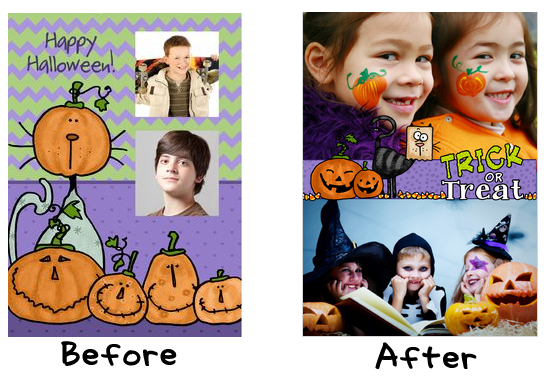
In the Before image, you’ll see the design itself is okay…if it was just a normal Halloween card. As a Halloween Photo Card, it doesn’t really work. Why? Because it looks like exactly what it is: an existing card with a couple of tiny photos shoehorned on it. And it looks unfinished because the photo boxes don’t have a border around them. The emphasis has been placed on the design elements rather than the shopper’s photographs. In the After image, you see the emphasis has been shifted so the photos take center place with design elements interacting slightly with the photos – a very cutting edge composition. Will it be successful? Well, we sold one shortly after the Photo Cards went public, so I’d say “yes!”
Moving on to example number two…
 In the Before image, again the emphasis has been put on the design element – in this case, the skeleton – with the photo area negligible, apparently almost an afterthought. You can see where I was going with the idea, but the execution was lacking. Now look at the “After” image. Although the actual photo area isn’t that much bigger than before, by giving it a somewhat irregular frame that picks up the color on the new front of card text, and allowing the skeleton to interact with the photo, the composition is very much improved. Now the visual joke works so much better!
And the last example…
 The idea of having a giant black, hairy, scary spider menacing the person in the photo is pretty good, however in the “Before” image, it doesn’t have a lot of impact. The photo area is too small, and there’s no border to define the area and give it a crisp edge. In the “After” image, I haven’t changed the photo area’s position, but I’ve enlarged it and made it into a circle, and given it a defining border. Voila! The idea in this new translation suits much better, and I’ve allowed the spider to interact more with the photo to give it even more oomph.
So there you have it – three Before and After greeting card examples of Photo Card design mistakes and how to fix them. I tend to learn best with visual information, so I hope this article will help point you towards making successful designs.
Share this:

Rainbow Connection: Fall Into Autumn

It’s true – artists need to design cards in 3-6 months or more in advance if they want to see sales this year, so I decided I’d offer a couple of Autumn inspired palettes (thanks for the inspiration, Doreen!) The first is a bit more traditional, the colors found in nature as the season turns from summer to fall. The second palette is young and contemporary, bright enough to catch the eye of today’s modern shoppers. They go well together, too. Mix n’ match, and enjoy!
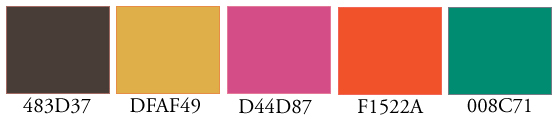
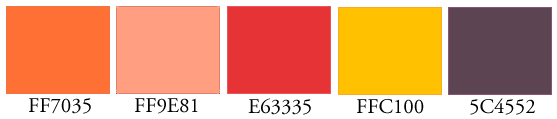
As always, these are RGB colors. I’ve given you the hex numbers to make it easy to use these colors in your favorite graphics editing program. Have fun!


