Blog Carnival III: High Spirited
 We’re feeling like death warmed over here as our Blog Carnival III: High Spirited continues until September 19!
Just make a blog post, Squidoo lens (Hub page, Weebly page, website) about ghosts, spirits, haunted houses, Ouija boards, spirit mediums, or any spooky subject- use your imagination! Believe in ghosts? Don’t believe in ghosts? Just include links to 3 ghostly (or should that be ghastly?) cards at GCU to be eligible to win our prize – a $25 gift certificate to Amazon or Starbucks, OR $25 worth of card credits! And all participants will receive a spook-tacular community star for the occasion.
Ain’t it boo-tee-ful? 🙂
So don’t delay – on September 20, I’ll make the master post of links available to share.
Share this:

Dash of Inspiration – August 29, 2011
A Dash of Inspiration…A Cup of Creativity by Doreen
Paintings Can Be Inspiration

When I have the time, I love to go in search of artists whose work I’ve not encountered before. I find this a wonderful way to be inspired to create something new, try a new technique or even paint a subject I’ve never considered tackling. This week I thought I’d share some links to inspire you, regardless of your medium or level of skill, you most probably will find something in these links that touches your artistic spirit and sparks the flame of creativity.
First here is an amazing collection of 35 paintings created using traditional methods, but with a modern feel to the creative spirit behind the tools.
Here are four extraordinary talents I had the pleasure of stumbling on this past week. All very different in their style, but each offering a collection of art that just amazes me and hopefully you too.
I found this interesting article from Focal Point on their thoughts of Traditional Painting vs. Digital Painting. There is not right or wrong opinion on the subject. I am one who embraces both with equal respect, for I believe it is the artist behind the tools that create great art, not the tools themselves. Lastly, I found this very well done tutorial for those who wish to explore painting using digital tools.
Here’s to a week of creativity!

Image - "Boy Thinker", Terry Staton
Share this:

Critique Clinic – August 26-28, 2011

How does it work? For three days a week (Friday-Sunday midnight), I will open the clinic to any artist who wants an honest peer review and critique of a card which gets plenty of clicks but no sales, so something’s probably not quite right, or you’ve got a new design you want to test drive, or you’re unsure about the marketability of a card. Or perhaps you’re a newbie who isn’t sure if a recently submitted card is up to a marketable standard. Anyone is welcome to participate. In fact, I encourage everyone to at least look at the cards in question and read the critique comments – you may learn something. The purpose of the clinic is to help artists improve the commercial appeal and marketability of their cards.
THE RULES
- ONE card per artist only.
- Card must be for sale at Greeting Card Universe.
- We will take an unlimited number of artists, including those who have submitted recently, HOWEVER I reserve the right to close a clinic for the day if the submissions become overwhelming. If the clinic has been closed, and you submit a card, your comment will be deleted.
- To submit a card for critique, post a link to the card’s details page at GCU in the comments section of this clinic post.
- Any artist is free to comment and/or give a critique of a submitted card. HOWEVER, post-and-run comments like “great card” or “you suck” will not be tolerated, nor will abuse. Criticism should be constructive, not destructive. Play nice or you will be banned.
- I also won’t tolerate temper tantrums if you decide your “artistic integrity” is being stepped on because you asked for a critique, and someone told you the photo you’re using isn’t in focus. If you can’t take honest criticism, don’t submit. Once gets you a warning; twice and you’re banned from submitting in the future.
- Artists who critique may do so by giving their opinion, posting an example of another card, or pointing the submitter to a video, on-line article, or other helpful suggestion.
- Don’t forget that artists who are giving you tips and helpful advice are volunteering their time and trouble. Be nice. A link back to their store on your website or blog is appreciated (but not mandatory).
- You are free not to take any advice offered. There’s no guarantee any card will be a bestseller, so don’t come into the clinic with unrealistic expectations.
- Rules may change as we go along and we see how things turn out, okay?
So without any further ado, I declare this week’s Critique Clinic open!
Share this:

GCU Community Newsletter #15 – August 25, 2011

Everyone’s busy this month – savvy designers are getting ready for the holidays (Thanksgiving, Christmas, Hanukkah, Kwanzaa), summer is winding down to a close, and autumn is around the corner.
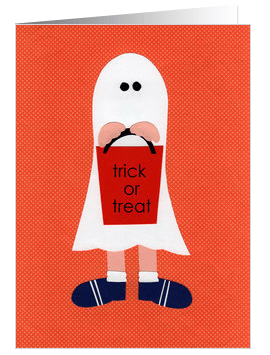
Hidden Gems: Haunted Halloween - artist K.T. Blue Designs
No newsletter last week means we’re got quite a round-up, so let’s get into it!
Doreen Erhardt’s weekly column, A Dash of Inspiration, a Cup of Creativity, gave us some tips and tricks for amazing animal photography, in addition to Photoshop brushes and Action sets handy for making Photo Cards. Our Design Spotlights were on Doreen and her Smug Pug, and Rosanne and her Beautiful Birman.
The conclusion of our Lightning Round: BUTTERFLIES gave us some beautiful blog posts. And finally, we got down to the nitty gritty with a pair of topical Nuts & Bolts articles: advice on using the Artist’s Notes Field for Product Descriptions, and How to Write Product Descriptions that pop.
Until next time, don’t forget to pass the love around!

_________________________

Designer’s Tips for Creating Photo Cards
Since Photo Cards are the hottest topic at GCU right now, with virtually every designer feverishly creating and uploading cards, I thought I’d talk about some of the slightly more technical aspects to Photo Cards that you may not know.
The Bigger It Is, the Better It’s Liked: At a bare minimum, the photo area (this is the transparent spot where the shopper’s photo will go) should take up 1/4 of the card’s surface area. However, market research has shown that consumers prefer the purpose of the card to showcase their photo, not the artist’s work (which should enhance, rather than dominate). The bigger the space you leave for the shopper to fill, the happier they are. If possible, try to use at least 1/3 to 1/2 of the card’s surface for the photo area, if not more.
For the Purpose, Please: One of the worst things you can do is take an existing card design, and try to shoehorn a space out of it to make it a Photo Card. This does not work. In a lot of cases, it looks exactly like what it is: an afterthought. You’ll have much more success designing Photo Cards from the ground up.
Elementary, My Dear Artist: Again, we’re going back to that research thing. Shoppers love Photo Cards where an element of the design will interact with their photo (such as a frame with part of the flower detail coming over the photo). It looks cool, but you need to be careful of a couple of things. First, don’t let the element be too intrusive – that great whacking snowman you designed may look great, but if Frosty’s taking up half the photo area, that’s too much of a good thing. And second, always be aware that in general, when uploading their photo, shoppers will try to put their face in the center of the photo area; if the card is meant to be sent by a family or group, faces will be going across the length (or breadth) of the space, so never position an element that will obscure those smiles.

Hidden Gems: Haunted Halloween - artist Tammy Moody
The Cutting Edge: At the moment, one of the hottest trends is the 100% Photo Card (that’s what I’m calling it)- meaning the shopper’s photo takes up the full 5×7 front of the card, with some kind of design element, such as a customizable text box, small banner, and/or discreet graphic somewhere that won’t interfere with the photo’s subject.
Now you’ve got a few tips to get started, or help you refine your existing plans. Go for it, and happy designing!
_________________________
 BLOG CARNIVAL III: HIGH SPIRITED
Time for a new Blog Carnival, and this time with Halloween in a couple of short months, we’re blogging about ghosts! That’s right, time to tell us about a ghostly encounter you had, your favorite ghost story, a haunted house film you like, a haunted attraction you visited, the history of Ouija boards, seances and mediums, or anything to do with spooky spirits!
Just make a new blog post or Squidoo lens (or Hub page, Weebly page, or a page added to your website, I’m flexible) on the topic of ghosts. Use your imagination! And you must include links to 3 scary cards at GCU to be eligible. Once again, I’m offering a prize worth $25 – Amazon, Starbucks, or card credits, winner’s choice! AND all participants will receive a spook-tacular Community star!
You have until September 19, 2011 to leave a comment here with the URL of your blog post. On September 19, I’ll make a master list of posts, and announce the results of our random drawing for the prize winner.
So get out there, folks, and conjure up a blog post that’s to die for!
_________________________
 The Critique Clinic is open every Friday, Saturday and Sunday to all GCU artists seeking peer review, advice and tips. Any artist may submit or leave a critique. All artists are encouraged to check the comment threads – you’ll learn something that may help you with your own marketability.
There is a GCU artists’ group on Facebook? We encourage you to join, post cards for your fellow artists to admire, share news, and have fun!
The Salon of Art Facebook fan page (by Doreen Erhardt) is a great place to go to find links to all kinds of helpful resources like tutorials, brushes, news about competitions and contests, marketing tips and a lot more. Check it out!

Hidden Gems: Haunted Halloween - artist Richard Toglia
If you have a question about one of your cards being “held” for review, or if your card has been declined due to the new Marketability Standards, write to cardreview@greetingcarduniverse.com and include the PID# of the card in question.
DID YOU KNOW you can “like” this newsletter or any post on the GCU Community blog, or include them in your social bookmarks? Or Google +1 them! Just click the title of the post, which takes you to the permanent link page. At the bottom of the page you’ll see buttons for social sites like Facebook, Reddit, StumbleUpon, etc.
_________________________
The next Newsletter will be published on September 1, 2011
Share this:

Design Spotlight: Rosanne, Red Rose Digital Art

Today, our Design Spotlight is on Rosanne of Red Rose Digital Art – what a beautiful kitty! And thanks, Roseanne, for giving us a fantastic design to admire.
____________________
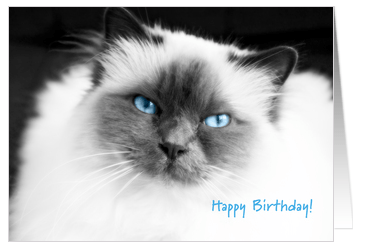
Perfect Birman Cat, Happy Birthday - Red Rose Digital Art
Hi, I am Rosanne Casu from Red Rose Digital Art, and I am one of GCU’s “international” artists. I may not have been quite the first one from Australia, but pretty close!
By profession, I am a molecular biologist but my hobby of photography has evolved in the past few years into an additional, albeit very part-time, profession that is conducted after hours. Photography is a wonderful combination of art and science so, I suppose, my analytical/left brain side loves the techniques and my arty/right brain side just enjoys capturing beauty.
It’s hard for me to choose a favourite card to profile today since so many of them represent mastering a new technique or having the privilege of photographing something that is completely new, at least to me. So, after much internal debate, I decided NOT to choose one of my signature rose cards but one of my older cards, featuring Rani, my cat.
Rani is an extremely regal Blue Birman cat who is possibly one of the worst cat models of all time. Most of the time, she either runs away from me or straight towards me when I point my camera at her. Both techniques are extremely effective at preventing me from capturing a quality image of her. However, there have been a few times when she became very engrossed in supervising me when I was conducting a “photo shoot” of some flowers in my living room. Because of this, I was able to turn the camera on to her and grab some images before she disappeared.
Rani is naturally pale cream with blue-grey points (ears, nose, tail and lower legs except for her little white feet) so, for this image, a black and white conversion worked extremely well. However, she has lovely blue eyes so I left the colour in them, making them the feature of the image. Her expression is also quite wistful and sweet.
I love birthday cards with cat images on them, so I thought that this image would work well in that context. For the “Happy Birthday” on the front, I picked out a blue that was very similar to Rani’s eye colour and also used one of my favourite fonts, Marydale. For the inner verse, I just channelled Rani and you can read the result! I had a lot of fun making this image and the card it evolved into – I hope that you enjoy the result.
Share this:

Lightning Round: BUTTERFLIES
 BUTTERFLIES ARE FREE TO FLY…
Put down your nets and your cameras, our Lightning Round: BUTTERFLIES is done! Here’s the master post of links for you to share. Don’t forget to visit and leave comments, too. Be nice and share the love!
And according to our random drawing, Tracie wins a prize worth $25 – either an Amazon or Starbucks gift certificate, or 25 worth of free GCU card credits. Congratulations!
Now on to the beautiful, colorful, butterfly blogs…
MASTER LIST
A Bit of Fun with Colorful Butterflies
“Ever since I can remember, I’ve been intrigued with the beauty of butterflies…”
Sunshine’s Creative Explorations, Donna Lorello
The Delicate Life of a Butterfly
“So you have a great love for butterflies?”
Sheryl Kasper Card Store, Sheryl Kasper
Beautiful Butterflies
“I have noticed lots of butterflies lately…”
Dragonfire Graphics, Betsy Bush
To a Butterfly
“I’ve watched you now a full half-hour…”
Photography TK Designs, Tracie
Greeting Card Universe & Butterfly Changes
“I started this blog as a way to promote greeting cards…”
Janet Lee Designs, Janet Palaggi
Papillon: The Butterfly Dog
“The big dog in the small body…”
DogBreedz, Peggy Mundell
Monarch Butterflies
“The beauty and wonder of Monarch butterflies inspired me…”
It’s a Beautiful World, Catherine Sherman
Good Luck
“A most unusual thing happened this week when I was gardening…”
Painted Cottage, Judith Cheng
Butterflies
“Imagine, Dare, Do!”
Naquiaya’s Cards, Naquaiya
Butterfly Animal Medicine Transformation Success Story: Carol Moore
“Animal Medicine is a Native American way of using lessons from the animal kingdom…”
Heart to Art, Sri
I Love Butterflies
“I love making butterflies, and including them in my greeting cards…”
I Love Cuttables, Cindy Johns
Share this:

Dash of Inspiration – August 22, 2011
A Dash of Inspiration…A Cup of Creativity by Doreen
Frame It!
Most of us are busy creating new cards or revamping old ones, and I found some great goodies this week to pass along. So keeping it short and sweet this week … Be inspired by these gifts I offer!
First, these free custom FRAME shapes by Shelby Kate Schmitz can be used in Photoshop 7 and up and Photoshop Elements 2 and up. There are a total of 10 Sets equaling hundreds of frame shapes! Shapes are wonderful because you can make them any size/resolution you need and add all types of styles, gradients and personal touches to make them unique to you and your design.
4 Sets of Frame and Border Custom Shapes
6 Sets of Circular Border Shapes for Photoshop and Elements
Next, I offer these wonderful action sets which are nice additions to my artist tool box, so I’m sharing with you:
Doreen Erhardt, Salon of Art
All these great Action sets are offered through FinesseFX and are really nice for creating mattes, edging and a lovely ‘old parchment’ text effect.
Last, for a little icing on the cake this week, here are three nice hand-written fonts you may not have.
Jester – Nice replacement for Comic Sans
Mural Script, A legible casual script
Rogers2 – Big, bold and legible
So, now off you go to create amazing cards!
Share this:

Critique Clinic – August 19-21, 2011
How does it work? For three days a week (Friday-Sunday midnight), I will open the clinic to any artist who wants an honest peer review and critique of a card which gets plenty of clicks but no sales, so something’s probably not quite right, or you’ve got a new design you want to test drive, or you’re unsure about the marketability of a card. Or perhaps you’re a newbie who isn’t sure if a recently submitted card is up to a marketable standard. Anyone is welcome to participate. In fact, I encourage everyone to at least look at the cards in question and read the critique comments – you may learn something. The purpose of the clinic is to help artists improve the commercial appeal and marketability of their cards.
THE RULES
- ONE card per artist only.
- Card must be for sale at Greeting Card Universe.
- We will take an unlimited number of artists, including those who have submitted recently, HOWEVER I reserve the right to close a clinic for the day if the submissions become overwhelming. If the clinic has been closed, and you submit a card, your comment will be deleted.
- To submit a card for critique, post a link to the card’s details page at GCU in the comments section of this clinic post.
- Any artist is free to comment and/or give a critique of a submitted card. HOWEVER, post-and-run comments like “great card” or “you suck” will not be tolerated, nor will abuse. Criticism should be constructive, not destructive. Play nice or you will be banned.
- I also won’t tolerate temper tantrums if you decide your “artistic integrity” is being stepped on because you asked for a critique, and someone told you the photo you’re using isn’t in focus. If you can’t take honest criticism, don’t submit. Once gets you a warning; twice and you’re banned from submitting in the future.
- Artists who critique may do so by giving their opinion, posting an example of another card, or pointing the submitter to a video, on-line article, or other helpful suggestion.
- Don’t forget that artists who are giving you tips and helpful advice are volunteering their time and trouble. Be nice. A link back to their store on your website or blog is appreciated (but not mandatory).
- You are free not to take any advice offered. There’s no guarantee any card will be a bestseller, so don’t come into the clinic with unrealistic expectations.
- Rules may change as we go along and we see how things turn out, okay?
So without any further ado, I declare this week’s Critique Clinic open!
Share this:

Nuts and Bolts: How to Write Product Descriptions

Artist’s Notes:
How to Write Product Descriptions that Pop
As promised, we’re talking using the Artist’s Notes field to include a product description on your cards. If you don’t know why, check out Nuts & Bolts: Artist’s Notes and Product Description. We’ll wait. Okay, ready? Let’s get started.
Today I’m going to explain to you how to write a product description that pops. Yes, there’s a trick to it. That trick is simple, and at the same time, can be a challenge. You don’t need special training to do it, or a degree, or a black belt in promotion, or any ninja stealth marketing skills.
The most important thing to remember is: write about the card as if you were describing it to a blind person.
That’s what it boils down to. Until you get used to the process, I suggest you take a good look at your card, and just jot down words that describe the design. Here’s an example:
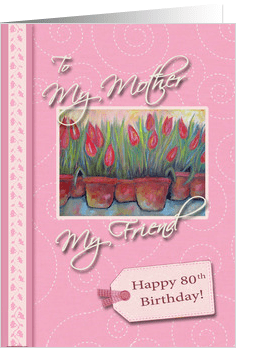
Happy 80th Birthday for Mom - Robin Chaffin
These are the words I’d jot down to describe this card: pink, tulips, tag, gingham, button, swirls, painting, vine. That’s also what I’d use in the keywords, among other things, so I’m killing two birds with one stone.
Now we can turn those random words into a description – for this card, in my Artist’s Notes, I’d say something like: “Celebrate your Mother’s 80th birthday with this pretty pink card with a delicate swirl pattern background, featuring a painting of potted tulips, and a scrapbook effect digital tag with gingham and button accent.”
A couple of things to keep in mind:
1) You have to be careful to avoid deceptive words like gold, glitter, lace, ribbon, etc. as shoppers may believe they’re getting a handmade card, or a card printed with metallic inks, etc. To prevent any misconceptions, use terms like digital, “look” – as in “silver look,” graphic – as in “graphically created glitter,” effect, and so on.
2) Whenever possible, include popular buzzwords in your description. In the example, I wrote “scrapbook effect” for a very good reason – scrapbooking (digital or otherwise) is very hot right now, and I can see that’s the effect Robin was going for in this card design. Just like keywords, it pays to do your research. Not sure how? Check out a previous Nuts & Bolts: Keywords for pointers.
Of course, your space is limited in the Artist’s Notes field, so don’t go completely berserk. If you find it helps, write your description first on a piece of paper or in Word, and tinker around with it until you’re satisfied you’ve ticked all the right boxes.
And here comes a big no-no: Keep in mind this is a product description, not an opportunity to tell shoppers about you, the artist, or give any other irrelevant information. Sure, tell folks where you took that picture of the waterfall. That’s part of the description. But leave out the bit about how you were on a picnic that day, and you got stung by a bee, and took the picture as you were falling into the stream. It’s about the greeting card, not you.
It will take practice, but you’ll get the hang of it. In time, you may even find you’re having fun. Now get out there and start describing!
Share this:

Nuts and Bolts: Artist’s Notes and Product Description

ARTIST’S NOTES:
A Reason You May Be Invisible to Potential Buyers
Let’s talk about the Artist’s Notes field, shall we? This field accompanies every single card you make at Greeting Card Universe, yet many of us (myself included) don’t always take advantage of it. I’ve also seen artists use this field to add some puzzling, irrelevant information to their cards. Few of us use it properly, which is big shame, because the Artist’s Notes field is a lot more important than you think.
Why? Well, there are two reasons. One has to do with shoppers, the other with search engines (that SEO thing, but don’t run away – I swear it isn’t that complicated).
I’ll start with SEO (which stands for Search Engine Optimization). Simply put, search engines use complex algorithms to determine a web page’s place (ranking) when it comes up in search results.
So that part is pretty clear, but what can you do to improve your web page’s ranking, and make it appear higher in the list of results? And why is should you care?
You need to care because each and every one of your cards sits on its own web page. Yes, those pages are hosted on GCU, but there are still individual pages, each of which will be indexed by search engines. For example, when someone does a search on Google for “purple elephant niece’s 14th birthday card,” your lovely lavender elephant 14th birthday for niece greeting card on GCU will come up in the results. Where your card appears in the results – on page one, two, three, or page two million – will likely affect your sales.
Being number one on page one is preferred (much like an Olympic athlete would much rather win gold than bronze, or nothing at all).
How do you improve that ranking? Search engines are constantly tweaking and changing their algorithms so they can offer the most relevant results in a search. Exactly WHAT criteria is used by a search engine is secret and complex. However, I can tell you that while good and relevant keywords remain an important part of allowing your cards to be indexed properly, it’s HOW you use those keywords that will affect you the most.
Search engines love original content. Let me repeat that because it’s important to our discussion – search engines LOVE original content. What that means is, while search engines will definitely use strings of keywords as part of their ranking system, they tend to give preference to sites that use those keywords as part of original content.
Inside Verse: "Hope you gobble till you wobble!" - artist Corrie Kuipers
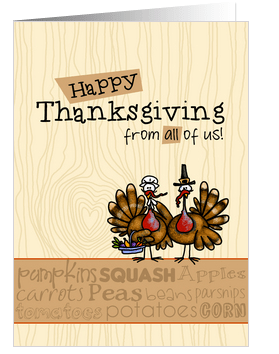
I’ll give you an example. This is a card I recently designed and uploaded (yes, I’m kind of late for this year’s Thanksgiving, but I tend to work a year ahead). It’s a “Happy Thanksgiving from all of us” card.
These are the keywords I used: thanksgiving card from all of us, thanksgiving card from group, turkey, happy thanksgiving, gobble till you wobble, pilgrims, thanksgiving dinner, feast, harvest.
So far, so good. HOWEVER, to take maximum advantage, I now include a brief description in the Artist’s Notes, using as many keywords as possible in a relevant way.
Here’s what it says: “A turkey pilgrim pair stands on top of a “subway art” inspired banner in autumn colors with a Thanksgiving feast mini word cloud on a light wood grain background. A playful and trendy Thanksgiving card that can be sent by a group.”
Notice how I’ve covered my bases in the description?
That will make the search engines happy.
It will make shoppers happy, too. This is the second reason you shoud be using your Artist’s Notes this way. Have you ever seen a catalog that didn’t have product descriptions, just pictures and prices? Of course not! And if you put on your shopper’s hat, you’ll realize that someone shopping for greeting cards really likes to see a nice description of what they’re buying. It just make your design that much more attractive.
Unless you’ve only got a few cards in your store, I’m not advocating you go back and add descriptions like that to all your greeting cards at GCU. Lord knows, I sure can’t. Not enough hours in the day! But since I learned this trick, I will be adding product descriptions to my cards from now on.
Writing good, relevant product descriptions is, I admit, not for everyone. To help you out, tomorrow I’ll be posting another Nuts & Bolts, this one explaining how to write a product description, what to include, and what to avoid.


 GCU Community