Design Spotlight: Priscilla Starling

Our Design Spotlight today is on Priscilla Starling of Periwinkle’s Card Store. Thanks, Priscilla!
_________________________
 Hi, I have been with GCU over three years, now, and love it. I am a photographer and have a vast, varied index of my photography, and use my photographs for my cards, throwing in some Photo Shop effects now & then. I chose this card because it reminds me of the Thanksgiving my husband and I spent with our daughter and other children, grandchildren, sisters & brothers in Ohio two years ago. This card is not a huge seller; I’ve only sold 6 of them since I created it, but the photo is one of my favorites, as it was taken at our daughter’s home in Ohio. We had driven up from Florida to spend the Thanksgivng holiday with her, her children, some of our other children, and a few other relatives. Since we would not be there for Christmas, she set up her house for Thanksgiving and Christmas. It was beautiful, with the Christmas tree, the fireplace, and the stockings. I took many photos and decided to use this one to create some Christmas cards, with atmosphere. It is strictly my photograph with a stock Photo Shop background added.
Share this:

Lightning Round: Kitties – June 26-July 5, 2011

You all are the cat’s pajamas! Our Lightning Round: KITTIES is the most successful yet, and I’m very pleased, happy and downright proud of each and every one of you. 🙂 Welcome to our new bloggers: thanks for playing! I hope to see each of you back for our next challenge.
Speaking of challenges… I’ve finally put the bit between my teeth and made a new post on my blog JUST for this Lightning Round – I even made a video promoting my kitty cards in a fun way!
Here’s the master post of links – all participants, please re-post to your own blogs. Everyone (I mean everyone reading this post, including non-bloggers) – don’t forget to visit and leave a comment on the blogs.
Remember, not only are you spreading the love, you’re getting an opportunity to put a backlink out there to your GCU store, and that’s a very good thing!
The winner of our contest is Diana Delosh – congratulations! 20 free card credits will be coming your way.
Without further ado, I give you our very popular…
LIGHTNING ROUND: KITTIES
Furry Friends
“Animals are such agreeable friends…”
Painted Cottage, Judith Cheng
Cats Are Angels Among Us
“Let’s face it, cat lovers are passionate about their cats…”
Rycky Creations, Robin Chaffin
Jack and Lillie: The Story of Two Rescues
“Jack and Lillie are cats…”
DB Visual Arts, Denise Beverly
Friends with Fur
“I wish I could say I have kitties and cats running all over the place…”
Janet Lee Designs, Janet Palaggi
An Ode to Kitties
“I love cats…”
Diana’s Cards, Diana Delosh
For All Us Cat Lovers
“A life without cats?!? A love story…”
Aura2000, Aura 2000
Everyday Art: Inspirational Kitties and Cats
“The key to finding inspiration in everyday places and things is observing…”
Sun at Night Studios, Sun at Night
Feline Friends
“Cats can be great companions…”
Sunshine’s Creative Explorations, Donna Lorello
Feline Fever
“I fell in love with cats almost twenty years ago…”
It’s a Beautiful World, Catherine Sherman
The Kitty and the Mashed Potatoes
“Sulu was a rescued feral kitten…”
Kilter Cards, A Ley
Luna, a New Family Member
“My daughter and her boyfriend just got a sweet little kitten a couple days ago…”
I Love Cuttables, Cindy Johns
Cats in Love
“Could it be that cats in love express more with their body language than we can imagine?”
Naquiaya’s Cards, Naquaiya
Meow, Meow, Meow
“Being the owner (did I say that?) of five cats…”
Cherie’s Arts ‘N Crafts, Cherie
When the Cat’s Away
“Cats, can anyone truly resist them?”
Salon of Art, Doreen Erhardt
Our Beautiful Gypsy Kitty
“One day probably 20 years ago a gorgeous seven toed calico cat just showed up literally on our doorstep…”
Dragonfire Graphics, Betsy Bush
Here, Kitty! Kitty! Kitty
“DogBreedz isn’t only about Man’s Best Friend…”
DogBreedz, Peggy Mundell
My Rescue Cat Speckles: A Love Story
“On one blazing hot summer night in 2006 in Plano, Texas, a cat wandered outside next to the large patio of my apartment…”
This & That, Rick McBride
CorrieWeb is the Cat’s Meow
“I love kitties!”
CorrieWeb, Corrie Kuipers
I Was Always a Dog Person
“Kitties were an acquired taste for me…”
Cottage Creek Greetings, John H. Johnson
My Cat Loves Birthday Candles
“I live with a cat who is fascinated by fire…”
Blessing Art Cards, Sharon Fernleaf
New ‘Kit’ On the Block
“Introducing Abby, our newest critter kid!”
Cards from the Heart, Lisa Charlton
Share this:

A Dash of Inspiration – July 4, 2011
A Dash of Inspiration…A Cup of Creativity by Doreen
Time Exposure Photography 
Since this posts on the July 4th Holiday, I’m going to keep it simple and give you these 45 Beautiful Examples of time-exposure Photography to enjoy. I’ve also provided a link to some quick tips for taking long exposures if anyone out there has never tried it and feels like playing!
Happy 4th of July!

Image by Joe Penniston, Express Monorail
Share this:

Rainbow Connection: Old Glory

Happy Fourth of July to all my American peeps! I hope you all have a great day of celebration, don’t get sunburned, don’t burn your burgers on the grill, stay safe, and have lots of fun.
Today I bring you just two colors, but they’re important colors – the official red and blue of the American flag (we all know white already, right?) They’re appropriately called Old Glory Red and Old Glory Blue. So if you want to design cards for next year’s Independence Day, you now know the exact colors to use. These are RGB, by the way, which GCU’s printer uses.

Old Glory Red – B22234

Old Glory Blue – 3C36BE
Share this:

Critique Clinic – July 1-July 3, 2011

HOLIDAY WEEKEND SPECIAL – THE CLINIC IS NOW CLOSED!
The clinic will be open until midnight on Sunday, July 3rd. We are open to ALL artists, regardless of whether you’ve recently submitted a card or not, but you are still limited to ONE card per artist. We will take an unlimited number of artists, but I reserve the right to close the clinic for the day if it gets too crazy. The rest of the regular rules apply.
Join us for the discussion!
_________________________
How does it work? Each week on Friday, I will open the clinic to any artist who wants an honest peer review and critique of a card which gets plenty of clicks but no sales, so something’s probably not quite right. Or perhaps you’re a newbie who isn’t sure if a recently submitted card is up to a marketable standard. Anyone is welcome to participate. In fact, I encourage everyone to at least look at the cards in question and read the critique comments – you may learn something. The purpose of the clinic is to help artists improve the commercial appeal and marketability of their cards.
THE RULES
- ONE card per artist only.
- Card must be for sale at Greeting Card Universe.
- Only 5 artists will be accepted per weekly clinic – first come, first served. If you miss out, you’ll have to wait until the next week. International artists, if your time zone doesn’t permit prompt participation, get in touch with me and I’ll try to work something out with you.
- To submit a card for critique, post a link to the card’s details page at GCU in the comments section of this clinic post. Check through the comments before you submit to see how many cards have already been submitted that day. If the number is five, please do not post yours. Any cards posted after the limit is reached will be deleted from the comment thread.
- Any artist is free to comment and/or give a critique of a submitted card. HOWEVER, post-and-run comments like “great card” or “you suck” will not be tolerated, nor will abuse. Criticism should be constructive, not destructive. Play nice or you will be banned.
- I also won’t tolerate temper tantrums if you decide your “artistic integrity” is being stepped on because you asked for a critique, and someone told you the photo you’re using isn’t in focus. If you can’t take honest criticism, don’t submit. Once gets you a warning; twice and you’re banned from submitting in the future.
- Artists who critique may do so by giving their opinion, posting an example of another card, or pointing the submitter to a video, on-line article, or other helpful suggestion.
- Don’t forget that artists who are giving you tips and helpful advice are volunteering their time and trouble. Be nice. A link back to their store on your website or blog is appreciated (but not mandatory).
- You are free not to take any advice offered. There’s no guarantee any card will be a bestseller, so don’t come into the clinic with unrealistic expectations.
- Once you submit a card for the clinic, you may NOT submit again for 4 weeks – fair’s fair.
- Rules may change as we go along and we see how things turn out, okay?
So without any further ado, I declare this week’s Critique Clinic open!
Share this:

Community Shout Out

Hi folks! Today is normally a newsletter day, but since we’ve got a long holiday weekend hovering on the horizon (I can almost smell the smoke from the Fourth of July barbecues already), I’m putting the newsletter on vacation until next week.
In lieu of that, here’s a couple of things I’d like to bring to your attention…
Several GCU artists have started Facebook fan pages to use for promotion, which is great (including me)! If you’re trying to get those vital 25 “likes”, leave a comment on this post and I’ll beat the drum for you. And if you haven’t joined our Facebook roll – for Pete’s sake, give me your link so I can put you on the list.
Our Lightning Round: KITTIES continues until July 5th – write a blog post or Squidoo lens about cats and include links to 3 cards at GCU, and you could win 20 free card credits! Join the furry fun by leaving a comment or sending me your link.
Have you checked the holiday lead-in time over on the right of the page? For the maximum opportunity for exposure, you should be working on Christmas, Hanukkah and Kwanzaa related cards right now. Crank up the air conditioner if you need to get in the mood. 🙂
Don’t forget about Friday’s CRITIQUE CLINIC: if you have a card that’s getting lots of clicks but no sales, or if you aren’t sure a new design has what it takes, submit it for peer review. ATTENTION – it’s a long weekend special! The clinic will run over 3 days (that’s Friday, Saturday and Sunday) – whee!) AND I’m also opening it up to anyone who wants to submit, whether you’ve recently submitted a card or not. ONE card per artist, please. No artist minimum this time; we’ll take everyone who wants to submit HOWEVER I reserve the right to close the clinic if I deem it necessary. I also urge all artists to participate in the discussion.
Photoshop Elements users: I stumbled across a tutorial I thought you might find useful – it’s the Secret to Creating Circular Text. It looks like a fairly easy method for creating a very professional looking effect.
If you missed it, Doreen Erhardt has posted a tip for artists who have a Facebook business page – an app that allows you to set up a cool splash page. Check out her forum post for the details.
Do you photograph people on train tracks? It seems to be a somewhat popular setting for wedding photos, but it may be illegal in your area. Check this forum post for details.
And that’s it for now. Have a great holiday weekend, and stay safe!

Share this:

Nuts and Bolts: The Right Image

The Right Image for the Right Greeting Card
You’re an accomplished photographer. You’ve taken the time to not only learn the skills you need to take great photographs, you’ve studied graphics editing techniques. You’ve taken note of how to create great greeting card images and verses. You know that photograph of a tiger you took at the zoo is a modern classic. It ought to sell like hotcakes, but instead it just sits in your store getting clicks, but no sales.
Why? Has the whole world gone blind?
Nope, you’ve just used the right image for the wrong card.
Let me explain. Certain images are timeless, such as beautiful landscapes, flowers, butterflies, waterfalls, rainbows…you know exactly what I’m talking about. As blank notecards, they’ll sell (although in this digital age, at GCU and other PODs you’ll have a LOT of competition). However, if you’re making cards for a purpose, you have to match the photograph to the occasion. Get it right and you’ll create a greeting card that attracts shoppers and prompts them to buy. Get it wrong, and you’ve wasted all that time and effort.
Sometimes it’s a question of appropriateness. Is a picture of your cat yawning appropriate for a sympathy card? Is a picture of a spider’s web with raindrops on it appropriate for a child’s birthday party invitation? Don’t fall into the trap of thinking that because you took a beautiful picture, it will sell if you slap it on anything and everything. Sure, you’ll quickly fill up your store with cards, but you won’t be filling up your pockets with cash.
Before you decide on the purpose of the card you want to create, sit down and have a really good think about whether the image is appropriate for the category you want to put it in. Is it the right fit? Does it send the right message? Does it match the sentiment you want to express? What does the photograph say to you? Think like a shopper, not an artist.
Let’s take the spider photograph I mentioned. If you try to sell that as a child’s party invitation, you’ll be wasting your time. What use can you make of it? Here’s where the right verse comes into play.
Using the right verse can turn a dud into a winner. You could make the spider card into an encouragement card, for example, by putting “I know you feel you’re trapped in a web right now…” and on the inside, “…but you know I’m there for you when you need me.”
Do you see how that works? Let’s take another example: the tiger I first mentioned. Putting “happy birthday” on it is nice, but that doesn’t really do much, does it? How about, “Happy 2nd Birthday, Tiger!” – with front text like that, you could use it for every age up to about 14 or so + a “Happy Birthday, Husband – You’re a Real Tiger!” or even an additional series of cards for male relatives. That’s a lot of potential sales opportunities!
Creating marketable greeting cards (by that I mean, cards that are commercially appealing, that shoppers will actually put down their hard earned money to buy) is about much more than just taking a photo and sticking it on a 5×7 background. Even if you know all the tricks, you still have to give great weight to how best you can use that photo to your advantage.
Don’t think that any decent photograph can be used for any purpose under the sun. It can’t. If you try, you’re doing yourself a disservice. Match the photograph to the occasion and use front text and verse to tie the two together – use the right image for the right card, and you’ll have the perfect package to entice shoppers to buy, buy, buy!
Don’t believe me? Take a look at Doreen Erhardt’s most recent Dash of Inspiration – Cup of Creativity on Monday. The image is absolutely perfect for a retirement card, and the front text she uses ties things up beautifully. Brava! A big winner in my book, and a fine example of right image – right card.
Share this:

Design Spotlight: Cindy Johns

 The picture on my card is what you might call a visual metaphor. But it needs a little background information for it to make sense.In 1999, I was treated for cancer with high doses of chemotherapy that left me with extremely debilitating memory-loss problems. I later found out that I was afflicted with a disorder referred to as chemo brain or chemo fog, but it threw me for a loop long before I knew what it was. I used to do Internet programming/consulting and I had created a widely used homeschool forum before the cancer. After the chemo, I became distraught by my forgetfulness and inability to focus. The Internet work overwhelmed me and I burned out and had to give it up.
A few years ago I learned the nature of chemo fog, and at that point it became easier to accept that I’d have to adjust to what I could and couldn’t do. Things that required me to remember stuff or demanded my full attention had to fall by the wayside. I ventured into scrapbooking and card-making–using lots of die-cuts (which I love), and after creating hundreds of homemade cards, I considered selling them online. Then, in April of this year, I discovered GCU and immediately got hooked. One of the biggest perks of that discovery is that I’m learning more than I ever could have imagined about digital art, promotional techniques, inside verses/humor & card categories from fellow artists. Alas, I don’t remember nearly as much of it as I’d like, but it’s still fascinating.
When I was invited to submit a card for this Design Spotlight, I was very, VERY honored. In the process of writing this (and re-writing it), I ended up doing some additional research on chemo fog and learned that A.D.D. medication might help with it (fingers crossed–my doctor just recently gave me a prescription). I hope that by talking about my own experience, I can shine some light on chemo fog and maybe help someone else along the way.
Anyhow—getting to my card. It uses a photo that I took outside of my home not long after being diagnosed with cancer, when I was looking for all the rainbows I could find. This one was a lucky shot that seemed ideal for use on a carpooling card. But since I took it so many years ago with a 1.5Megapixel camera it can’t be enlarged without losing quality and resolution. That’s why it’s such a small picture on the card. But it is my favorite because it’s metaphorical for putting the cancer and chemo fog behind me while looking at what lays ahead—the beauty of art, and putting it on cards. Plus, if I could carpool to work with my fellow GCU artists, I would. 🙂
Share this:

Dash of Inspiration – June 27, 2011
A Dash of Inspiration…A Cup of Creativity by Doreen
The Beauty of Silhouette Photography
I think most of us are drawn to the mystery found in a well done silhouette. Perhaps it’s because our own imaginations are allowed to fill in the missing details, so we could never be disappointed. To me, it’s like reading a well written mystery; we are given some basic information about the characters and the scene, but it’s up to our own mind to conjure up the missing pieces and create a complete picture to accompany the story. In art, silhouettes have been around for centuries as a form of portraiture. All of us have seen some famous examples such as; Beethoven’s portrait from the18th century, the Mudflap girl that we still see today on the mudflaps of big rigs and of course the story of evolution from ape to man.
In photography, while a sleek black silhouette combined with the right surroundings can make for a powerful and emotional subject, you can also give the silhouette a bit of depth and realism by letting a touch of light come through as I did with my Retirement Greeting Card. I used a silhouette of the fisherman, but combined it with a grungy, canvas background texture and let that along with the light seep in just enough to give his shirt a bit of texture and to give the dried grasses in the foreground a little glow. This makes the whole scene feel more realistic.
So, for your weekly dose of inspiration, enjoy these 50 Beautiful Examples of Silhouette Photography from our friends at Noupe; and for those of you who would like to learn some tips on How to Shoot Silhouette Photography I’ve provided a link to a great article from Photography 24Seven.
Happy Shooting!

Share this:

Lightning Round: Kitties
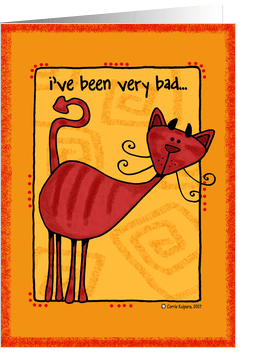 That’s right, you heard me…it’s time to let the cat out of the bag ’cause we’re going to blog about KITTIES!
What’s not to like? They’re furry and cuddly and cute and purr and they do silly things that make us adore them + they can be extremely naughty, putting some excitement in your life. 🙂
So no pussy-footing around – you’ve got until Tuesday, July 5 to write a blog post about kitties and include links to 3 cards at GCU with a cat theme (here’s a headstart). The subject of your post can be anything as long as it’s cat related.
After the 5th, I will post the master list of links for everyone to share. AND there’ll be a drawing for a cool prize: 20 free card credits!
Don’t miss out – artists who’ve tried it agree that sending out your own cards to friends and relatives is an easy way to get new customers and more sales.
Either post your link in the comments of this post or email me your information to be included in our challenge.


 GCU Community