Font Frenzy: Bobber

Bobber is an Art Deco kind of typeface, elegant yet with a touch of fun. There are 2 versions: one is free for commercial use (see the About section on the upper right side of the page) and the pro version costs $5. You can decide if you want the extra features or not. An example is below. Have fun!

Share this:

Dash of Inspiration: September Design Challenge
 Congratulations to our September Winners!
1st Place goes to Barbara Schreiber with PID 1399662

1st Place Winner: Barbara Schreiber
2nd Place goes to Julia Bryant with PID 1398620

2nd Place Winner: Julia Bryant
……………………………………………………………….
Most cultures have rich traditions where costumes play a vital role in their celebrations and/or daily life. These can express identity, marital status, religious beliefs or any number of reasons to include them in celebrations. Often these garments are worn only at festivals or formal events – or – holidays like Halloween! The heritage of various kind of costumes run deep through many generations and cultures which make this a fun and challenging theme for September’s Dash of Inspiration Design Challenge! Ready? Let’s go …
…………………………………………………………………………
September Design Challenge
Theme: Costumes
Requirements:
- The costume(s) you choose to represent in your imagery must be appropriate for the occasion/category choice.
- Additional elements and backgrounds chosen to support your costume in a finished greeting card design, must stay within the theme of the celebration you are representing.
costume = 1. A style of dress, including accessories and hairdos, especially that peculiar to a nation, region, group, or historical period. 2. Dress or garb characteristic of another period, place, person, etc., as worn on the stage or at balls. 3. Fashion of dress appropriate to a particular occasion or season: dancing costume; winter costume.
………………………………………………………………
Entry Deadline: September 28th, 2015
……………………………………………………………….

Doreen Erhardt©2015
How to Enter: Post the PID (card number) and the URL (public storefront link – please WAIT for the card to be available in the public marketplace, please DO NOT post a link to your Manage Cards area) as a post in the challenge blog. We’ll forward your entry to the jury.
……………………………………………………………….
Category: Any Category / Any Occasion where Costume is appropriate
Tips: Halloween, Masquerade, Cultural Holiday Categories
……………………………………………………………….
Rules:
- Submission must meet GCU’s Submission Guidelines and be Approved through the usual Review Cycle – Fast Track your submission with this in the Notes to Reviewer: August Design Challenge Submission here is the link to the blog post: (include THIS blog post URL)
- Only ONE card per artist per challenge.
- Submissions must be NEW, no existing designs.
- Your entry must meet the Challenge Requirements and Theme or it will not be included in the challenge.
- Stock Card Creations entries will not be accepted.
……………………………………………………………………
BLIND Judging: We hope each of you enter every month. Entries are submitted anonymously for judging by the GCU Challenge Jury which means that before and during the challenge, judges do not have any way of knowing what artist is beyond each entry. This eliminates any and all concerns with ‘favoritism’. Results will post on the Community Blog – by October 2nd. The jury will judge the entries on the following criteria:
- How well the card meets the Challenge Requirements and Theme.
- How well the card speaks to the Category the artist chooses for the card submission.
- Creativity, Execution and Marketability.
……………………………………………………………………
Winners: 1st Place:
- The winning designer’s card and store will be featured on the GCU Public Blog – the blog which customers view and follow.
- As well as featured on the GCU Public Facebook Page – nearly 17,000 followers, now THAT’S exposure!
- The winning card will be Design of the Day following the announcement of the winners (within 48-hours).
EXCEPTION: Horizontal (landscape) cards can not be DOD due to GCU Home Page space restrictions. In these cases, GCU will choose a different vertically oriented card from your store to feature as DOD. Thank you for your understanding and apologies for this limitation.
- The winning card will be added to the Greeting Card Universe Design Challenge Winners Pinterest Board – currently over 800 followers.
- The winning card, should the artist choose, may be referenced in a new series by the winning artist and he/she may Fast Track all cards in the new series (being sure to give the Challenge URL and winning card PID in your Notes to Reviewer for each card in this series).
- Winning card will be included in a marketing email to over 100,000 customers!
2nd Place:
- Your submission will be Design of the Day the following week of announcing the Challenge winners (within 7-days).
EXCEPTION: Horizontal (landscape) cards can not be DOD due to GCU Home Page space restrictions. In these cases, GCU will choose a different vertically oriented card from your store to feature as DOD. Thank you for your understanding and apologies for this limitation.
- Your card will be added to the Greeting Card Universe Design Challenge Winners Pinterest Board.
- Winning card will be included in a marketing email to over 100,000 customers!
………………………………………………………………………
Tips:
Check out these tips, tricks, freebies, and tutorials from our own GCU Community Blog which might be helpful in this month’s Challenge.
Dash of Inspiration: Design for All Cultures
Nuts and Bolts: How To Choo-choo-choose the Right Categories
Dash of Inspiration: Don’t be a Copy Cat
…………………………………………………………………………
Share this:

Wanted: New Cards – Get Well, Head Lice

Every week from now on, we’ll be showcasing a GCU category that has few or no cards. We’d like you to create at least one card for this category using the Stock Cards function (Bigstock).
Remember, when you’re submitting your new card, add a little note about the intended category in your Notes to Reviewers – cards submitted for underused categories are much more likely to be approved provided they follow the Submission Guidelines. Be inventive, be clever, be creative. Good luck!
Today’s category with only 5 card is:
Occasions – Get Well/Feel Better – Head Lice

Share this:

Every week we showcase a GCU category that has few or no cards. We’d like you to create at least one card for this category using the Stock Cards function (Bigstock) or your own graphic designs.
Remember, when you’re submitting your new card, add a little note about the intended category in your Notes to Reviewers – cards submitted for underused categories are much more likely to be approved provided they follow the Submission Guidelines. Be inventive, be clever, be creative. Good luck!
Today’s category with only 4 cards is:
Invitations – Birthday Party for Kids Invitations – Pizza Party

Share this:

Nuts and Bolts: Design of the Day

I’ll bet at least some of you are wondering, “How the heck do I win the Design of the Day award?” Well, I figured you might be, here’s the scoop.
The exact process of how a card is chosen by the GCU Team to win the Design of the Day remains a mystery (in much the same way as reviewers’ real identities are protected). However, there are some guidelines.
- For technical reasons, at this time only portrait (5×7) cards are eligible (I totally understand this one – I measured the available space, and a landscape card wouldn’t fit).
- Recently approved cards and new artists get preference.
- Eligible cards are top notch in their design with excellent composition, high marketability, and commercial appeal. Whether photography or illustration based, an eligible card must show a high degree of professionalism in all areas, and both design and verse should be relevant to the chosen category.
- To reflect the fact that Greeting Card Universe’s success is due to its selection of highly unique greeting cards for every imaginable occasion and purposes, cards designed for a specific purpose and containing a relevant inside verse are preferred.
- An effort is made not to choose the same artist twice in the same month.
How do you know if you’ve won the Design of the Day? You’ll receive a notification via your GCU store through the Contact This Artist link (and every one of you should have that module ON in your store for obvious reasons). I saw the other day that Team GCU has also recently started adding a five star review to winning cards, so watch for that as well.
What can you do to promote the Design of the Day? If you’ve won, you’ve got bragging rights, so go for it! Especially spread the word on your social media sites like Facebook and Twitter, and/or on your blog and/or website.
Share this:

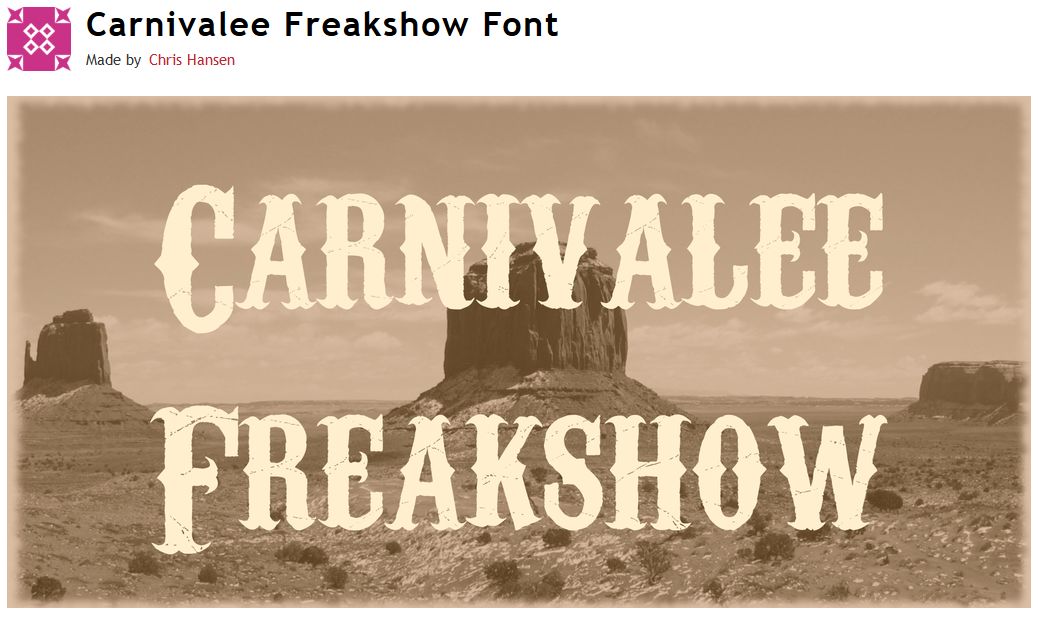
Font Frenzy: Carnivale Freakshow

Vintage/retro being all the rage, it’s handy to have fonts that hail from a time period long past. Carnivale Freakshow is a big, bold font with a real stage presence, suitable to use with old graphics of the vintage variety. Best of all, it’s free for commercial use. See example below. Download to your designer’s toolbox today and have fun!
Share this:

Dash of Inspiration: Get Your Cards Found!
How do you increase your card sales? Here are some areas which have proven successful for me and others on GCU, so if you haven’t taken the time to improve your own cards … you’re missing out!
REWORK your old card fronts! In case you didn’t know or have forgotten, GCU has been going through a process since 2012 to review every card on GCU – in every artist’s store – against the Submission Guidelines. This means that cards by the thousands are either being returned for simple modifications such as; border issues, typography, ellipsis, etc or being declined – when you could have saved them before the reviewers ever found them. I’ve found that when I take the time to improve the design on my old cards, they begin selling nearly immediately.
Here are some helpful posts from the past:
Better Designs = More Approvals = More Sales
10 Reasons Why Your Photos Might Not Meet Submission Guidelines
METADATA is absolutely critical, more today than ever. GCU has stayed on top of all the changes external search engines have made in how they see and rank content. Keywords are of less importance off-site than unique content. If you do not take the time to make the most out of each Card Title, Keywords and Card Description (Artist’s Notes), then your cards are likely not selling very well. In fact, as I understand it, Google won’t even see any card on GCU without a Card Description which reads yellow or green for the Uniqueness Factor. Therefore, once again, the choice is yours. Do the work, reap the benefits.
These posts offer detailed info which might help on this subject:
Uniqueness & Artist’s Notes & SEO
Understanding SEO (Search Engine Optimization)
MARKETING does work if you can find what works for you. Any online presence which you create, whether it’s your GCU store, a blog or a social media account require you to add ‘new content’ at least once a week (more frequently is better). If you abandon these accounts for more than a week at a time, they drop significantly and possibly even to the bottom of search engine findings. AND … there is a difference between new content and spamming – the latter being posting product links every few minutes. Selling online requires momentum – more activity and better content means more sales, more sales means increased momentum – it’s a continuous growth pattern of which you make or break depending on your choices.
We have many great Marketing Posts on the Community Blog which can help you.
Remember, it’s all about what you choose to do. If you choose not to improve your old designs, then you need to be okay with GCU doing it for you – even if that means they decline your cards. If you choose not to improve your metadata, then you need to be fine with minimum sales and be happy for other artists who have done the hard work, rather than think they are getting special treatment.
Get out there and get to work 🙂
…………………………………………………………………
Don’t forget to check out our Dash of Inspiration Design Challenge!
…………………………………………………………………

Doreen Erhardt©
Share this:

Dash of Inspiration: Fonts on Sale!
Just passing along some fun font sales this week – I don’t know about you, but I can never seem to have enough!
Festivo Letters by Ahmet Altun at FontSpring
 Isabella Script (40% Off) by Seniors at Creative Market

Here are a couple of FREE grabs …
Hamster Script (Free Font) by Artimasa Studio

Nickainley Script – Free Font by Seniors Studio
 …………………………………………………………………………….
Remember, you have until Wednesday, August 26th to enter this month’s Dash of Inspiration Design Challenge!
If you haven’t already, check out our August Dash of Inspiration Design Challenge!
…………………………………………………………………………….
So until next week … Learn … Create … Inspire!
Share this:

Dash of Inspiration: Catchlights = Life
If you are a photographer, you should know about catch light or catchlights which is a highlight in your subject’s eye from a light source. These are critical for any living being, in other words, animals too. If you took photography classes you would hear the professor say that catch lights equal life, without them the eyes look dead. There is no personality, no sparkle, nothing to draw the viewer in to face of your subject.
Whether this is something new or you’d like a refresher, these are some great links:
What are Catch Lights? by A Beautiful Mess
Making Eyes Pop and Sparkle and Finding the Light by Paint the Moon
Add Catch Light to Eyes using Photoshop | TrickyPhotoshop
For our visual artists, using traditional mediums, here is a quick video tutorial:
How to Draw a Dog’s Eye With Watercolors : Visual Art Tips

Author: Janae Hardy©
…………………………………………………………………………….
If you haven’t already, check out our August Dash of Inspiration Design Challenge!
Share this:

Wanted: New Cards – Congratulations, Delivering First Sermon
Every week, we showcase a GCU category that has few or no cards. We’d like you to create at least one card for this category using the Stock Cards function (Bigstock) or your own graphic designs.
Remember, when you’re submitting your new card, add a little note about the intended category in your Notes to Reviewers – cards submitted for underused categories are much more likely to be approved provided they follow the Submission Guidelines. Be inventive, be clever, be creative. Good luck!
Today’s category with 0 cards is:
Congratulations – Delivering 1st/First Sermon


