Nuts and Bolts: Changing Front of Card Image

Sometimes an artist wants to refresh and update an older card’s design, address previous flaws, or wishes to change the image on the front of a previously approved card. The Review Team periodically goes through artist’s stores and will delete older cards that no longer fit the Submission Guidelines, so doing some cleaning and revising yourself is always a good idea.
Revising older designs not only breathes new life into your card collection, it can also result in increased sales. By changing the front of card image (as opposed to deleting the card in favor of a new design) you can keep the card’s stats intact.
Here’s a basic primer on how to do it and some rules to follow.
The Rules
You may change a card’s image to:
- Correct spelling/grammar errors
- Improve/clean up a so-so photograph
- Update an older design provided the occasion and/or relationship/occupation/etc. specific purpose of the card remains the same. Artists are unable to alter categories after a card has been submitted, so you can’t change a Birthday card to a Mother’s Day card as that would require a change of category. In that case, create and upload a new card
- Make improvements to layout, color, font choice, etc
- Change the date (for date specific cards in New Year’s Eve or Graduation categories, for example)
How To Change the Front of Card Image
- Log in to GCU
- Upload the new card design you want to use
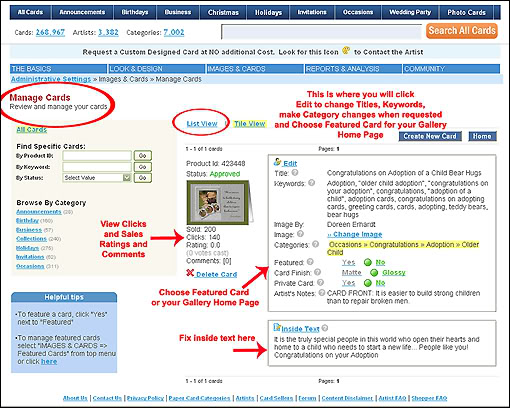
- Go to Manage Store
- Choose Images & Cards > Manage Cards
- Look on the left side of the page. You can search for the card by 1) PID#, 2) Keyword, 3) Status, 4) Card Front
- Once you have completed your search and have the result, click Edit
- Beneath the large image of the card, you’ll see Change Image
- Click the link to choose the updated image you uploaded earlier
- Don’t forget to Save Changes when you’re finished
The GCU Wiki: ” If you are doing this as part of an EDIT and RESUBMIT prior to a card being approved, you will have to find the updated card by doing a search in Manage Cards for EDIT and RESUBMIT cards (Note: Use the menu on the left to select a search by Status). When you do this a RESUBMIT button will accompany the card so that you can resubmit the card for final review.”
Share this:

Wanted: New Cards for July


In the GCU Forum, you’ll find a sub-category titled Wanted: New Cards. Why should you be watching this category like a hawk? Read this Tips and Tricks – Wanted: New Cards article to find out how to beef up your store without breaking a sweat! In a nutshell, you can Fast Track these requests AND use Bigstock photographs, making the process a snap.
Here are some Categories and Sub-Categories that need cards:
Invitations > Cancer Head Shaving Party
Occasion > Congratulations > Cancer Survivor/Treatment > 1st Chemo
Occasions > Get Well/Feel Better > For Secret Pal > Hospital Fairy
Occasions > Congratulations > Anniversary – Organ Transplant > Liver Transplant > 20th Anniversary Liver Transplant
Occasions > Congratulations > Anniversary – Organ Transplant > Liver Transplant > General
There are quite a few organ transplant subcategories here begging for cards
Invitations > Wedding Attendants/Bridal Party Invitations > Be my Gift Bearer?
If you’ve already got a collection of wedding party invitations, add this one
Birthdays > Occupation Specific > Church Secretary
Occasions >> Congratulations >> Vow Renewal >> Year Specific
Make a personalized card too so customers can change the year
Share this:

Dash of Inspiration: The Art of Self-Critique
A Dash of Inspiration, A Cup of Creativity by Doreen
The Art of Self Critique

Many years ago, I was one of the founders of a Photo Club for our community and one of the people who joined was fairly new to the craft. I enjoyed spending on photo shoots and mentoring this student of photography. This past week I had the pleasure of finding him after all these years, through a run-in (not literally) with his brother. I was very pleased to see fifteen-years later, that he has continued to grow and thrive as an artist … and I can’t find words for how proud I am of his artistic accomplishments.
I have always believed that the artist/photographer who can look back at the work they created two years ago (or more) and find at least a few pieces which they find almost embarrassing – is an artist that has continued to grow their skill level, expand their vision and enhance their technique.
The artist who does find fault with old creations has most likely not become stagnant in their craft. Artists, photographers, illustrators and designers all need to continually grow and you can only do that by challenging yourself.
- Choose a subject or theme which is well outside of your comfort zone.
- Learn a new medium or technique which is a challenge to ‘master’.
- Find inspiration that makes you say to yourself “I want to do that” – then go learn how.
- Thicken up your skin and submit your latest ‘masterpiece’ to juried shows and critique sites. Remember GCU Artists have a free critique on this blog every Friday through Sunday.
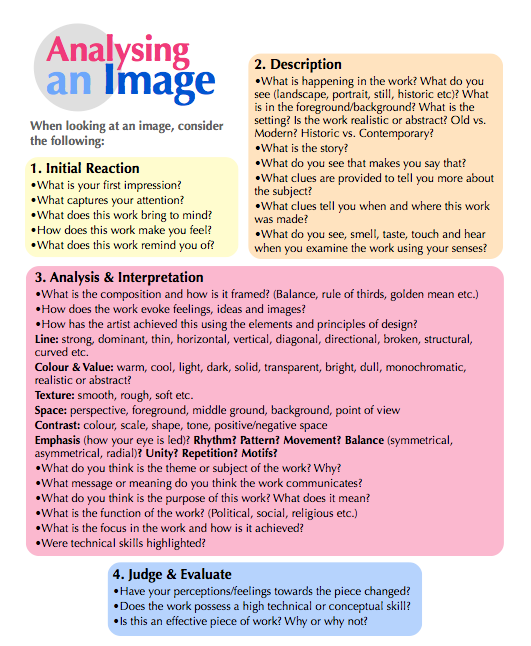
For Photographers:
Jay Ryser could not have stated it better: “One of the great tools for improving your photography, is submitting your photograph for an objective critique. When you first start this process, it’s also a great tool for building frustration tolerance, building humility, and tolerating perceived criticism. Submitting a photograph for critique is not for the thin-skinned, but once you move past the perceived personal attacks, it’s an excellent way to improve your photography.”
This is a short article that if you take the time to read it, as well as the captions under each photo, you will reap the benefits of being able to step ‘inside’ John’s creative process while he sets up to shoot this image.
4 Ways Self-Critique Can Improve Your Photography – By: John Davenport
There’s always room for improvement: self-critique of my popular images – by Ming Thein
Challenge yourself to step outside of your comfort zone and grow in your artistic ability. Here is an interesting challenge for the photographer.
The Photo Critique: Portrait Edition By: Christina N Dickson
For Artists & Illustrators:
Learn to Critique Your Own Artwork by Lori Woodward
HOTS (Higher Order Thinking Skills) in the Art Room by Heather offers these prompts to help get you to be your own best and worst critic.
There are many blogs and sites which offer creative monthly challenges and these, whether you post your results or not, can be very inspiring and push you out of your comfort zone or force you forward when you are in a creative rut – such as this one.
For those who may be curious about my ‘student’ from the past, I proudly share his portfolio – if you stop by, please let him know I sent you.
So until next week … Learn … Create … Inspire!
Share this:

Critique Clinic – July 11-13 2014

How does it work? For three days a week (Friday-Sunday midnight), I will open the clinic to any artist who wants an honest peer review and critique of a card which gets plenty of clicks but no sales, so something’s probably not quite right, or you’ve got a new design you want to test drive, or you’re unsure about the marketability of a card. Or perhaps you’re a newbie who isn’t sure if a card is up to a marketable standard. Anyone is welcome to participate. In fact, I encourage everyone to at least look at the cards in question and read the critique comments – you may learn something. The purpose of the clinic is to help artists improve the commercial appeal and marketability of their cards.
THE RULES
- ONE card per artist only.
- Card must be intended for sale at Greeting Card Universe.
- To submit a card for critique, post a link to the card at GCU in the comments section of this clinic post. Allowances will be made if you’ve had a card declined, or made a new design you’d like advice on before submission. Give us the link where we can see the card, such as your private gallery, Flickr, Tinypic, etc. If you do give a private gallery link, be sure your private module gallery is ON. Please do not post links to your Manage Cards section – do you really want strangers tinkering with your cards? And please don’t ask us to critique a card that’s pending review – we can’t see it until it’s approved.
- Any artist is free to comment and/or give a critique of a submitted card. HOWEVER, post-and-run comments like “great card” or “you suck” will not be tolerated, nor will abuse. Criticism should be constructive, not destructive. Play nice or you will be banned.
- I also won’t tolerate temper tantrums if you decide your “artistic integrity” is being stepped on because you asked for a critique, and someone told you the photo you’re using isn’t in focus. If you can’t take honest criticism, don’t submit. Once gets you a warning; twice and you’re banned from submitting in the future.
- Artists who critique may do so by giving their opinion, posting an example of another card, or pointing the submitter to a video, on-line article, or other helpful suggestion.
- Don’t forget that artists who are giving you tips and helpful advice are volunteering their time and trouble. Be nice. A link back to their store on your website or blog is appreciated (but not mandatory).
- You are free not to take any advice offered. There’s no guarantee any card will be a bestseller, so don’t come into the clinic with unrealistic expectations.
- Rules may change as we go along and we see how things turn out, okay?
So without any further ado, I declare this week’s Critique Clinic open!
Share this:

Inspiration Station: The Natural Look


This week, we’re all about the natural look. Doreen’s given you a holiday heads-up on how natural materials like burlap, sisal, jute, etc. are hot trends for 2014. We’ve given you great free resources to find ways to incorporate these trends in your designs. Now we’re bringing you some inspiration so you can sit down and create new natural looks for your cards.
TIP: Remember, in the product description in your Artist’s Notes, use the right language to make it clear you aren’t selling cards with actual burlap or other genuine materials.

Burlap Cards
The bulk of these are handmade, but you’ll find plenty of inspiration for your designs.
Burlap Cares/Theme
Lots here to check out, many great ideas.
Burlap Cards & Ideas
Some wonderful examples sure to inspire your creativity.
Christmas Burlap Cards
Will get you in the holiday spirit!
Share this:

Font Frenzy: 10 Commercial Use Monogram Fonts

Here’s a list of 10 free commercial use monogram fonts that are not only great for monograms, but most of them are pretty useful to have in your designer’s toolbox. You’ll see examples below. Always check the TOU of each individual font before you download—sometimes font designers change their licensing terms. Have fun!
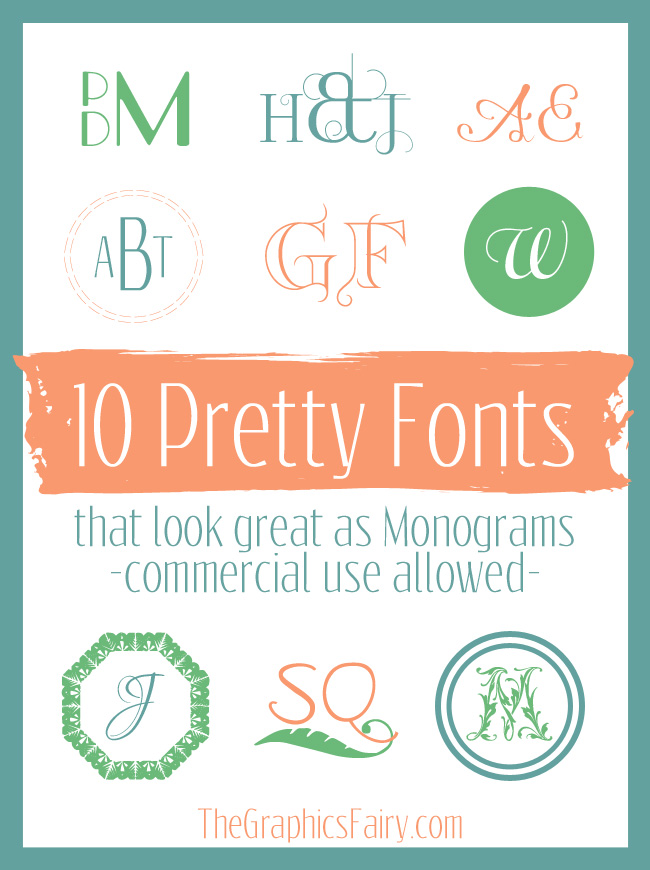
Image courtesy of the Graphics Fairy
Share this:

Tips and Tricks: Natural Textures Freebies

Natural textiles like burlap, canvas, jute, etc. are very “in” right now as designs (particularly for the holidays – see Doreen’s post on 2014 Holiday Trends). Here are some resources where you can find natural textures to incorporate those trendy textiles into your work.
FREEBIE RESOURCES
Free High-Res Canvas Textures + Seamless Patterns by Fuzzimo—okay for commercial use, read the TOU here.
Free High-Res Old Burlap Textures by Sowhaven—okay for commercial use, TOU on the same page as the download.
Free High Resolution Fabric Textures Pack by Premiumpixels—okay for commercial use, read the TOU here.
12 High Resolution Denim Textures also by Premiumpixelsm—see above for TOU.
Free Petit Pique Cotton Teztures Pack by Webexpedition18—TOU on same page as download.
Don’t forget to keep a record of where you downloaded the freebie, the TOU, and be sure to include that information in your Notes to Reviewers to avoid having cards Returned for Edits. Have fun!
Share this:

Dash of Inspiration: 2014 Holiday Trends
A Dash of Inspiration, A Cup of Creativity by Doreen
2014 Holiday Trends
Professional designers – that’s US – create well ahead of all major holidays, and since Christmas shoppers love to get an early start (I’ve already had some nice bulk sales this month), it’s important to remember the old saying “Christmas in July”.
Here are some trends and inspiration to get you motivated to think about holiday designs, even when it’s over 100-degrees outside!
Here are some themes which are trendy for the coming holiday season:
- If you love retro/vintage, the glamor, chic and glitz of the Jazz Age will bring life to the holidays this season.
- Pantone’s Emerald Green is holding strong through 2014 and is expected to dominate the holiday season.
- Woodland creatures will be nipping at the heels of the traditional reindeer this year, so invite them into your designs.
- Natural elements will be popular, materials like jute, shells, sisal and burlap will be featured this year.
- Coming back with a vengeance is The Scandinavian, winter lodge theme. Give longer life to your designs by creating some with a focus on a Nordic Winter which will outlast the holiday-specific season.
- Holiday colors this year will venture even further away from traditional colors by adding bright colors and hues to the palette … try experimenting with varying hues of one color and work some warm colors in your designs.
- Textiles are becoming very trendy, embrace decorative ‘fabrics’ in your holiday card designs in the form of textures and patterns.
- To accompany those bright colors, bold patterns are also in season – with chevron patterns remaining strong, other geometric patterns will also gain prominence.
- Moving from the garden into our holiday designs, this year whimsical creatures such as; gnomes, elves and fairies are going to be popular.
- Certainly still going strong are the urban and industrial looks which focus on simplicity and a minimalistic theme.
For holiday inspiration, you might find these links helpful:
Christmas Decorating Trends for 2014
Holiday Suppliers Offer A Sneak Peek At Christmas 2014 Trends
Free Treats:
If you take the time to look through the pages and pages of backgrounds offered at My Site My Way, you will find many suitable textile, bold patterns and bright color choices for use and modification in your holiday designs.
90 Stars BRK Font – Made by Enigma Fonts – this is a dingbat Star font which could be fun to color with the latest trends.

Share this:

Critique Clinic – July 5-6, 2014
How does it work? For three days a week (Friday-Sunday midnight), I will open the clinic to any artist who wants an honest peer review and critique of a card which gets plenty of clicks but no sales, so something’s probably not quite right, or you’ve got a new design you want to test drive, or you’re unsure about the marketability of a card. Or perhaps you’re a newbie who isn’t sure if a card is up to a marketable standard. Anyone is welcome to participate. In fact, I encourage everyone to at least look at the cards in question and read the critique comments – you may learn something. The purpose of the clinic is to help artists improve the commercial appeal and marketability of their cards.
THE RULES
- ONE card per artist only.
- Card must be intended for sale at Greeting Card Universe.
- To submit a card for critique, post a link to the card at GCU in the comments section of this clinic post. Allowances will be made if you’ve had a card declined, or made a new design you’d like advice on before submission. Give us the link where we can see the card, such as your private gallery, Flickr, Tinypic, etc. If you do give a private gallery link, be sure your private module gallery is ON. Please do not post links to your Manage Cards section – do you really want strangers tinkering with your cards? And please don’t ask us to critique a card that’s pending review – we can’t see it until it’s approved.
- Any artist is free to comment and/or give a critique of a submitted card. HOWEVER, post-and-run comments like “great card” or “you suck” will not be tolerated, nor will abuse. Criticism should be constructive, not destructive. Play nice or you will be banned.
- I also won’t tolerate temper tantrums if you decide your “artistic integrity” is being stepped on because you asked for a critique, and someone told you the photo you’re using isn’t in focus. If you can’t take honest criticism, don’t submit. Once gets you a warning; twice and you’re banned from submitting in the future.
- Artists who critique may do so by giving their opinion, posting an example of another card, or pointing the submitter to a video, on-line article, or other helpful suggestion.
- Don’t forget that artists who are giving you tips and helpful advice are volunteering their time and trouble. Be nice. A link back to their store on your website or blog is appreciated (but not mandatory).
- You are free not to take any advice offered. There’s no guarantee any card will be a bestseller, so don’t come into the clinic with unrealistic expectations.
- Rules may change as we go along and we see how things turn out, okay?
So without any further ado, I declare this week’s Critique Clinic open!
Share this:

Happy Fourth of July!

Wishing our American artists a very happy and safe Fourth of July!
(In honor of the holiday, we’ll post our usual Critique Clinic tomorrow)


