Nuts and Bolts: Writing Funny Greeting Cards


Writing Funny Greeting Cards
Humor is a large category in the greeting card market. The public can’t get enough of funny greeting cards for almost any occasion. If you hit on a great joke, that design will keep selling and will become one of your regular earners.
Unfortunately, writing humor isn’t easy. The art of the joke can’t really be taught, but you can learn techniques which will help you bring the right image and the right text together to create a commercially appealing design that attracts customers.
There are a few subjects of humor that work in greeting cards. It’s pretty common to mix a couple of these subjects together (ie, age and insult).
- Visual: A funny image, usually an illustration, but the right photograph works, too. The subject is usually exaggerated for effect and to maximize humor potential.
- Age: Meaning jokes pertaining to the recipient’s age. For cards targeted toward an older recipient, there is usually an insult element (see below).
- Gender: Meaning jokes pertaining to the recipient’s sex, or humor specific to men or women.
- Insult (Slam): Making fun of or insulting the recipient in some way that isn’t offensive (stay away from racial and ethnic slurs, for example).
- Pun or Word Play: Probably one of the most popular. See the example given at the top of this page to get an idea of word play.
- Adult/Sexy: Naughtiness, tasteful nudity (think fig leaves), mild profanity. Adult humor has no place on cards intended for children. Save that for the 18+ crowd.
Where to begin?
Start by familiarizing yourself with your chosen subject. For example, you’ve got a great close up photograph of a tortoise and you want to develop a humorous card incorporating age. If you’re scouting for ideas, first write down everything you can think about to describe a tortoise. Then think about how getting older feels. What can you find in common? Slow, wrinkled, toothless, hairless. There’s a starting place.
Now ask questions. Turn the concept on its head. Try it from different angles. In the tortoise case, can you think of any benefits to getting older? Here’s an example of a text combining age and gender: “As you get older, you’ll notice you have a lot more money to spend … since you won’t need those hair care products anymore!”
It doesn’t hurt to look at old standby jokes either. You can get great ideas for turning stale cliches into fresh funnies. Just keep in mind the recipient’s age. A child of five years old won’t really appreciate or get a joke that’s too sophisticated.
What you must keep in mind through the development stage is “sendability” which means … will a shopper be enticed to visualize signing their name and sending that card to the recipient? We’ve talked before about how greeting card designs stand in for the sender’s thoughts and feelings.
When you think you’ve got a workable idea, take these next steps:
- Check for spelling and grammar issues.
- Read the card aloud, not only to yourself, but try to get other opinions too. Does the joke flow well? Is the phrasing smooth or awkward?
- If your joke is split between the outside (the set-up) and the inside (the punchline), does the split occur at a natural place? It should never feel forced.
- Is the humorous emphasis in the right place?
Tweaking at this stage will bring long-term benefits since there are few things sadder than a joke falling flat. Once you have your design ready, let it sit a couple of days and return to give it a look with fresh eyes. You want to be certain the joke works the way you want it to.
When you’re creating the card, bear in mind:
- Try to keep your color palette away from very sober colors like dark grays or gray-violets.
- Find a font or fonts that match the mood of the card. For instance, on humorous cards, very formal script fonts are probably not your best choice (unless you’re making a deliberate point).
- Certain categories don’t lend themselves to humor, like sympathy or condolence cards.
- Follow GCU’s Submission Guidelines to lessen the chances of your card being Returned for Edits or Declines due to technical faults.
Now you know where to start in your quest to create funny greeting cards. The article below may help you if you’re looking for more information.
Nuts and Bolts: How to Write Greeting Card Verse
Share this:

Font Frenzy: Storybook Romance On Sale!

Looking for a sweet, girly font with a princess/fairy tale look that isn’t too formal or elaborate? Storybook Romance fits the bill. The caps have a bit more detail, giving you options to create the look you want. It’s new and currently priced at only $5 – a steal! See below for a sample.
We don’t recommend Storybook Romance for large blocks of text, but as an accent font, it’s terrific.

Share this:

Dash of Inspiration: Marketability – No Thank You
A Dash of Inspiration, A Cup of Creativity by Doreen
Marketability: No Thank You

We are nearly finished with the Submission Guidelines series. Next to last up is today’s topic and that’s:
MARKETABILITY: No Thank You
The Submission Guidelines state this: A card design can meet all the requirements and still lack impact, rendering it unmarketable in GCU’s market. The card needs to draw the eye, invoke feelings, and attract an interest in being purchased. Greeting Card Universe reserves the right to say No Thank You to any card, store, or artist which they feel are not a good fit for their market.
GCU, in its efforts to help the artist community, does their best to give the reason(s) behind a declined submission. It’s critical that the artist community understand this level of ‘detailed reasons for decline’ is not the norm. Any artist who submits their work to publishing and/or licensing houses will receive a short rejection notice worded in a manner which ultimately translate into a simple “No Thank You” for their submitted work. In the real art world, most artists receive submission decline notices more often than they receive acceptance. It’s just part of being an artist.
It’s also important to note, that though GCU offers their assistance by giving the specifics of the decline, this also impacts the amount of time a given reviewer spends on a single design; especially when the decline reason is challenged and therefore communication continues with additional time spent not only by the reviewer who made the decline, but additional reviewers for a second and often third opinion. GCU is leaning towards giving a simple “No Thank You” decline in the future to reduce the time spent by reviewers explaining reasoning that a professional artist making submissions of their work, should already know. So keep that in mind.
Remember, GCU has no obligation to accept any cards even if they meet all other guideline criteria. This is their business and a market which they understand better than any of the artists, therefore they know what they want for new submissions. As any business which promotes and sells art of any kind, they know what areas within their market are already saturated with good designs, therefore they look for the unique, the ‘stand out in a crowd’, the designs with ‘wow’ factor, rather than just accepting every design that may meet all other guideline criteria.
In other words, you can submit a ‘fault-free’ design when reviewed against the submission guidelines and still receive a decline of ‘No Thank You’.
Ask yourself these questions about a submission you are about to make which meet all other guidelines.
Will it pass the Marketability criteria for …
Visual Creativity – there is a difference between a simple design and an uncreative design. Simple, clean designs come in variety of styles, yet regardless of content, still be very creative. An uncreative design looks as though there was no thought or imagination involved in creating the card and as if the card was designed in a matter of moments.
Look at this example I threw together which took all of 3-1/2 minutes and resulted in an uncreative simple design. Though the layout, typography and elements all fall within the guidelines, it’s simply boring, uncreative and absolutely can not compete with the 5000+ cards in the Birthday >> Mom category, therefore that translates to zero marketability value.

Here are some simple, yet very creative designs which will hold their own against the competition and are highly marketable.


Creative Message
In most greeting card publishing houses, they license artwork from artists and hire writers to write verse for the artwork they’ve selected. At a place like GCU, the artist has the responsibility to not only create marketable, quality artwork, but also to write a verse to accompany the artwork.
The Greeting Card Association states this:
“The visual design of a greeting card is first to capture a customer’s attention, but the words will make the sale. More than three-fourths of card purchasers base their selection on a card’s text and the special me-to-you connection that those words create.”
“The ideal greeting card is a seamless marriage of art and verse. The successful card designer needs to create an image that’s eye-catching enough to capture the customer’s attention, yet reflects the tone and emotion of the card’s message.”
You see then why a lack of creativity in the verse may also result in a “No Thank You” decline from GCU.
Keep these things in mind:
- Being a greeting card designer means you are most often inspired visually first. When you look at what you are creating visually (especially photographers), the emotion which the image evokes should drive the verse to suit the image and the occasion.
- Don’t use the same boring verse over and over and over again. I’ve seen this done by some GCU artists, nine out of ten complete different Birthday images, yet all say the same thing inside. That’s uncreative and unmarketable.
- Don’t put every occasion Happy Birthday, Missing You, Congratulations, etc. on the same image if the imagery does not evoke those expressions. In other words, don’t overuse the image.
- Don’t use identical verse and cover text, again that’s boring and not marketable.
- Do get creative and match words to imagery and occasion. Learn to play with words and feed off the image and occasion to create a verse to match the mood of the image.
- Don’t just create occasion and relation specific cards which are all blank inside. GCU is a place where most shoppers come to purchase a card for a specific person for a specific occasion. Creating blank cards for ‘general’ categories is often successful such as Holiday cards or Thank You cards with a message only on the front and inside left blank. Or creating cards for the Collections >> Any-Occasion blank card categories are fine too, but if that’s all you create then your sales may be lacking. When a customer looks for a greeting card to wish their Brother Happy Birthday, they are not likely to chose a card that says Happy Birthday Brother on the front and is blank inside over the nearly 3000 other choices at GCU which match the image with a verse to evoke a great message.
Being a greeting card artist means being creative, unique and always trying to create a greeting card that will not only be competitive, but may even stand out in the crowd. Writing verse certainly is not something every artist is capable of doing and that certainly does not mean you aren’t a greeting card artist; but it does mean in order to reach success at GCU, you need to combine your talents with a message using whatever means you have access to. This does not mean copying verses from the internet, in most cases you can’t use these for commercial use and you certainly should not copy other artists. However, you might have a friend or family member who’ve always had a knack with words. Utilize your social network if you need to – put your image for a new card out and ask your contacts to offer their thoughts on what the image says to them. Being a successful greeting card designer means you learn to adapt to the needs of the market.
Here are some examples of matching imagery to verse to occasion for a highly marketable result:


So, remember GCU can just say No and give no other reason. However with all the tips and examples given throughout this blog, the Wiki and the Critique Clinic, you should be able to design cards with solid marketability value every time you make a submission.
Next week we’ll finish this segment with the final section of the Submission Guidelines: MARKETABILITY: Intellectual Property. Till next week, may you be inspired to be creative!
For great resources & tips visit the SalonOfArt
Share this:

Critique Clinic – September 13-15, 2013

How does it work? For three days a week (Friday-Sunday midnight), I will open the clinic to any artist who wants an honest peer review and critique of a card which gets plenty of clicks but no sales, so something’s probably not quite right, or you’ve got a new design you want to test drive, or you’re unsure about the marketability of a card. Or perhaps you’re a newbie who isn’t sure if a card is up to a marketable standard. Anyone is welcome to participate. In fact, I encourage everyone to at least look at the cards in question and read the critique comments – you may learn something. The purpose of the clinic is to help artists improve the commercial appeal and marketability of their cards.
THE RULES
- ONE card per artist only.
- Card must be intended for sale at Greeting Card Universe.
- To submit a card for critique, post a link to the card at GCU in the comments section of this clinic post. Allowances will be made if you’ve had a card declined, or made a new design you’d like advice on before submission. Give us the link where we can see the card, such as your private gallery, Flickr, Tinypic, etc. If you do give a private gallery link, be sure your private module gallery is ON. Please do not post links to your Manage Cards section – do you really want strangers tinkering with your cards? And please don’t ask us to critique a card that’s pending review – we can’t see it until it’s approved.
- Any artist is free to comment and/or give a critique of a submitted card. HOWEVER, post-and-run comments like “great card” or “you suck” will not be tolerated, nor will abuse. Criticism should be constructive, not destructive. Play nice or you will be banned.
- I also won’t tolerate temper tantrums if you decide your “artistic integrity” is being stepped on because you asked for a critique, and someone told you the photo you’re using isn’t in focus. If you can’t take honest criticism, don’t submit. Once gets you a warning; twice and you’re banned from submitting in the future.
- Artists who critique may do so by giving their opinion, posting an example of another card, or pointing the submitter to a video, on-line article, or other helpful suggestion.
- Don’t forget that artists who are giving you tips and helpful advice are volunteering their time and trouble. Be nice. A link back to their store on your website or blog is appreciated (but not mandatory).
- You are free not to take any advice offered. There’s no guarantee any card will be a bestseller, so don’t come into the clinic with unrealistic expectations.
- Rules may change as we go along and we see how things turn out, okay?
So without any further ado, I declare this week’s Critique Clinic open!
Share this:

Tips and Tricks: Creating GCU Links for External Use

There’s been a lot of Forum discussion on the topic recently and Doreen Erhardt has given us a quick reference explaining how to create GCU links from searches and use them on other sites to promote your work. Take it away, Doreen!
_________________________
Creating GCU Links for External Use
Promote your cards, storefront, other cards on GCU and various storefront or site-wide searches using these formulas. Be CAREFUL to not omit or add characters in these parameters, if the link does not work … it’s likely you have some piece of the string incorrect.
Working in your storefront, use this as your guide for unique search URL links:
As an example, I typed into my storefront Search box: Halloween+Cat. Though all the right cards showed up, the URL at the top of the screen looks like this: http://www.greetingcarduniverse.com/community/store.asp
Which of course will not get the customer to my storefront, let alone this specific card search.
So, to the above link when you do the initial storefront search, you add this:
?keyword=halloween%20cats&store_id= your store ID (which should be automatically added after the equal sign for a search within your storefront).
The working URL now looks like this showing my storefront and only Halloween Cats in my store.
www.greetingcarduniverse.com/community/store.asp?keyword=halloween%20cats&store_id=2686
To get a search parameter URL for site-wide to link, use this formula:
As an example, this link will pick up all cards with Red and Anniversary and sort will be newest.
http://www.greetingcarduniverse.com/shopping/cb.asp?search=1&keyword=red%20anniversary&card_sort=new
This link will pick up all cards with Sunflower and Birthday and sort will be most popular.
You get the idea. So to create your own searches simply replace the ‘keywords’ in the above links, separating the keywords with %20 and you’ll have a viable search URL to link to off-site. Notice you can change the ‘sort’ to either newest or popular depending on your needs.
Adding Referral ID to these links:
Now add your Referral ID code to these links to get referral monies from a new customer who follows your link and shops anywhere on GCU using that ‘cookie’.
To add your referral code to the end of a GCU standard URL for a storefront, category, etc.
Add this to end of link for referral code: ?gcu=your referral ID
If link has been derived from a search parameter (like those I show above) use this: &gcu=your referral ID
To obtain your Referral ID, go to Manage Cards >> Community Resources >> Widgets.
Now look at the Get HTML for your widget and notice the Promotional Email Link code, which looks like this: http://www.greetingcarduniverse.com/community/store.asp?store_id=YOURS&gcu=YourReferalIDHere
Replace the ‘your referral ID’ in the two codes above and you just tack that on the end of the appropriate GCU URL.
To see these types of links at work, visit my greeting card page for my own cards and store-wide searches here: http://salonofart.weebly.com/greeting-cards.html
And here where I’ve started an ongoing list of some of my favorite GCU artist’s stores:
http://salonofart.weebly.com/links-to-other-artists.html
Good luck!
Share this:

News: New Cards Misdirected to Category

In case anyone hasn’t heard, there’s a glitch on GCU affecting new cards. When the image of the card is clicked, instead of going to the card’s detail page, the shopper is sent to the category page. GCU is aware of the problem and working to correct it. In most cases, the new card only suffers from a 3-hour delay before correcting. Mindy has come up with a work-around for artists creating custom cards for shoppers – see below for details.
To reiterate:
- The problem affects new cards only
- The misdirection usually lasts about 3 hours before correcting
- GCU is working on a fix
- See below for a work-around
Here’s what Mindy had to say in her Forum post:
“Temporarily you may notice that newly approved cards when clicked on go to the related category page, not the card details page. We are working on rectifying this.
In most situations this is not a problem. However if your shopper is chomping at the bit you can provide them a link directly to your card via this method:
1. enter the pid# in the onsite search (ex: #564967)
2. share the URL of the resulting page with the shopper
(ex: http://www.greetingcarduniverse.com/shopping/cb.asp?keyword=564967)
3. direct the shopper to use the Personalize button or icon (pencil) or Add to Cart button or icon (cart) under the image thumbnail vs clicking on the card image. Alternatively they can use the Quick View and the Personalize or Add to Cart options from there as well.
Again, we are finding this delay is auto-corrected in 3 hours or less.
Thank you for your patience!”
Share this:

Tips and Tricks: Pre-Approval for Card Series with Fast Track

Fast Tracking First Card in Series for Pre-Approval
It’s not news that artists have been given a way to help avoid all the cards in a series being Returned for Edits – you can Fast Track the first card in the series for pre-approval from the Review Team before uploading the rest of the cards.
However, some confusion seems to persist on the why and how, so here’s everything you need to know about this time saving opportunity and how to make the most of it.
Why should I bother getting pre-approval for a card series?
Age specific cards, for example, can run into 100+ in a series. If something’s wrong with one card, the same something’s wrong on every single card. Which means the Reviewer has to return all the cards to you for editing, you have to make the fix on all the cards, and then resubmit all the cards. That’s a lot of work and wasted time! Do yourself a favor – don’t assume everything’s okay with your proposed card design. Even Star Submitters should submit the first card in a series and get pre-approval.
What do I need to do?
Simple! Create the first card in your series. Upload that one card using the Fast Track option. Include a Note to Reviewers stating it is the first card in a proposed series so they’ll know why you’re using the Fast Track option. Now be patient and wait. We know it’s hard, but while you’re waiting, move on to a different card design and get some other work done.
If the first card is Returned for Edits, make the necessary changes and resubmit. Wait until the card has been Approved before you create the rest of the cards in the series.
I’m ready to upload my pre-approved cards … now what?
Make a note of the PID# of the card that was originally pre-approved. Got it? Good. Now as you upload your new cards, add a Note to Reviewers that “PID#XXXXXX, first in series, pre-approved on (date).” This is extremely important.
The same Reviewer who approved the first card probably won’t be the same Reviewer who deals with the rest of the series. Reviewers aren’t robots and they don’t have an automated database giving them all the information they need. Including the PID# of the pre-approved card instantly gives the Reviewer a vital piece of information. If you don’t include this note on your cards, you run the risk of the entire series being Returned for Edits.
Waaah, I did what you said and all my cards were Returned for Edits anyway!
Sometimes, another Reviewer catches an error the first Reviewer missed. It doesn’t happen often. If it does, you have our deepest sympathy. The best advice we can offer is to ensure you are familiar with all of GCU’s submission guidelines, use those guidelines to design your cards, and double-check for grammar and/or spelling mistakes, composition errors, straying over the margin, etc.
We hope we’ve given you enough information to help the review process be a little less painful for those who make series cards. Good luck!
Edited to add note from Mindy: We are seeing a lot of artists taking advantage of this new process with good results (and hopefully less headaches!).
Important to note that ONLY your 1st sample submission should be FastTracked. The balance should be submitted via regular review.
Here’s the forum post on this topic:
https://discourse.greetingcarduniverse.com/t/series-concept-review-fasttrack/34
Don’t be alarmed if your 1st sample submissions is put on hold, as with all cards we may just be taking a little extra time or the courtesy of a second set of eyes to review before you invest a lot of time in the balance of the series.
Share this:

Dash of Inspiration: Marketability – Creative Use Policy
A Dash of Inspiration, A Cup of Creativity by Doreen
Marketability: Creative Use Policy
Let’s keep this series going by heading into the last grouping of the Submission Guidelines; Marketability and next up is Photo Card Area.
MARKETABILITY: Creative Use Policy
The Submission Guidelines state this: Effective immediately all derivative works containing elements and/or photographs that are not the original creations of the submitting artist, or the reviewer feels are not the original creations of the submitting artist, must have a link(s) to the elements/photograph or thorough source description provided in the Notes to Reviewer. This allows for a quicker review process and after all, YOU are the one who obtained the elements and know the copyright holders terms so it is quick and easy for you to provide that information. Reviewers will continue to return card submissions when the ownership is in question and no links or information are provided. These issues pertain to the right to sell the card and therefore its marketability.
Artists who are new to the creative world, often do not understand the true meaning of a Derivative Work. Many places such as; the MorgueFile license the offered content under a Creative Commons license which DOES NOT mean the content has been released into Public Domain; another common mistake.
For example, this is Morgue Files TOU:
“You are allowed to copy, distribute, transmit the work and to adapt the work. Attribution is not required. You are prohibited from using this work in a stand alone manner.”
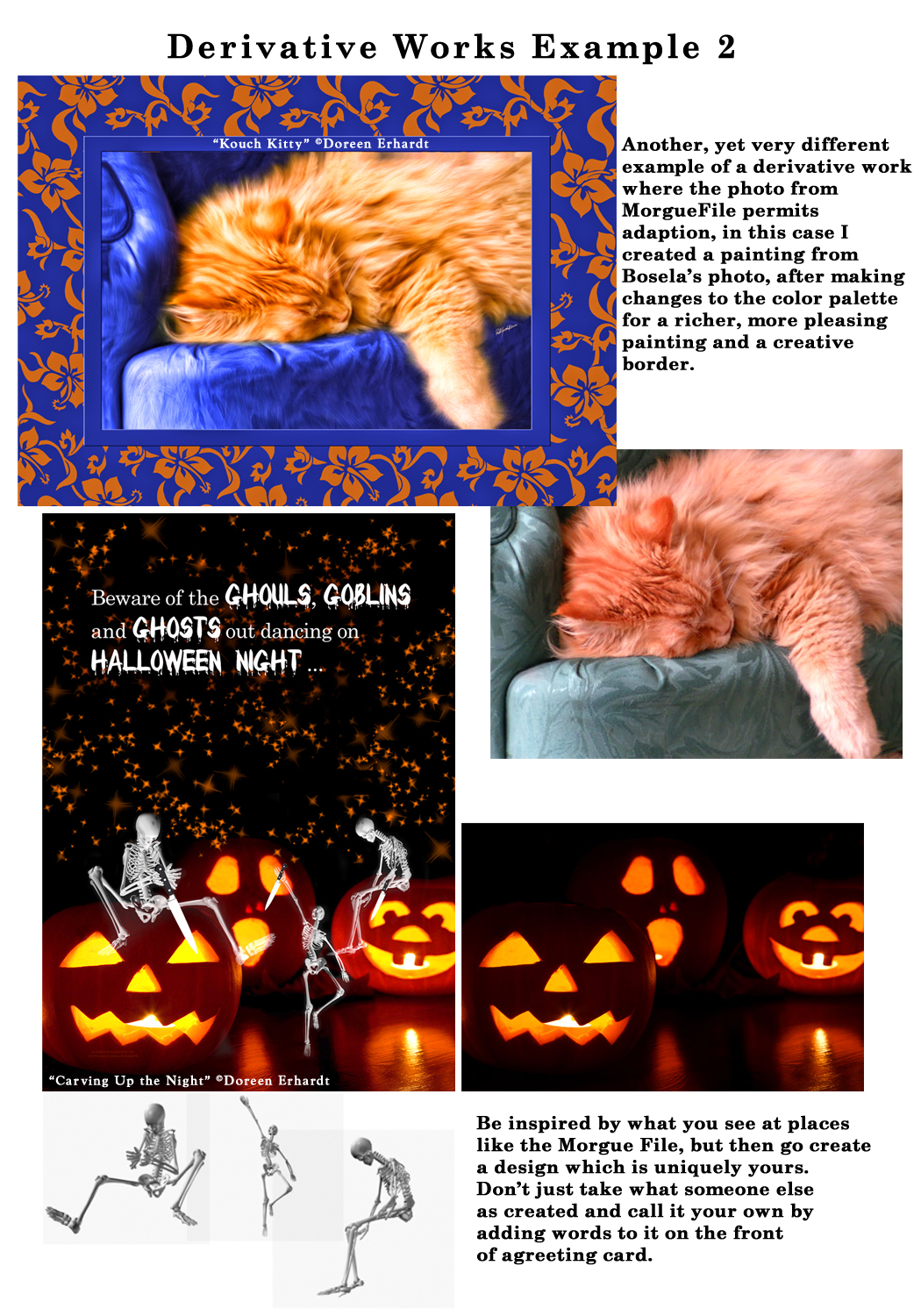
So, this means that by downloading a photograph from MorgueFile, putting it on a card with a border and words IS NOT a derivative work and can be considered copyright infringement by the copyright owner, because you are using the photograph in a stand alone manner, rather than adapting or creating a derivative work.
An example of a derivative work is one that is primarily a new work, but incorporates some previously published material. This previously published material makes the work a derivative work under the copyright law. To be copyrightable, a derivative work must be different enough from the original to be regarded as a “new work” or must contain a substantial amount of new material. Making minor changes or additions of little substance to a preexisting work will not qualify the work as a new version for copyright purposes. The new material must be original, as opposed to an exact copy or minor variation of a work.
Why is this definition important? Because one of the six exclusive rights given to a copyright owner is the right “to prepare derivative works based upon the copyrighted work.” Only copyright owners have the exclusive right to produce derivative works based on their original, copyrighted works. Copyright on original works of authorship is automatic, and registration—while it does carry significant benefits, like the right to sue for infringement—is not required for a work to be protected; protection attaches immediately when the work is completed.
However, a copyright owner can grant permission to someone else to make a derivative work based on his or her original—this is what places like MorgueFile are doing – if permission is granted (in the form of a license or assignment), then creation of the derivative work is not infringement. Derivative work is an artistic work derived from one or more pre-existing original works.
Now let’s view some examples of Derivative Works.
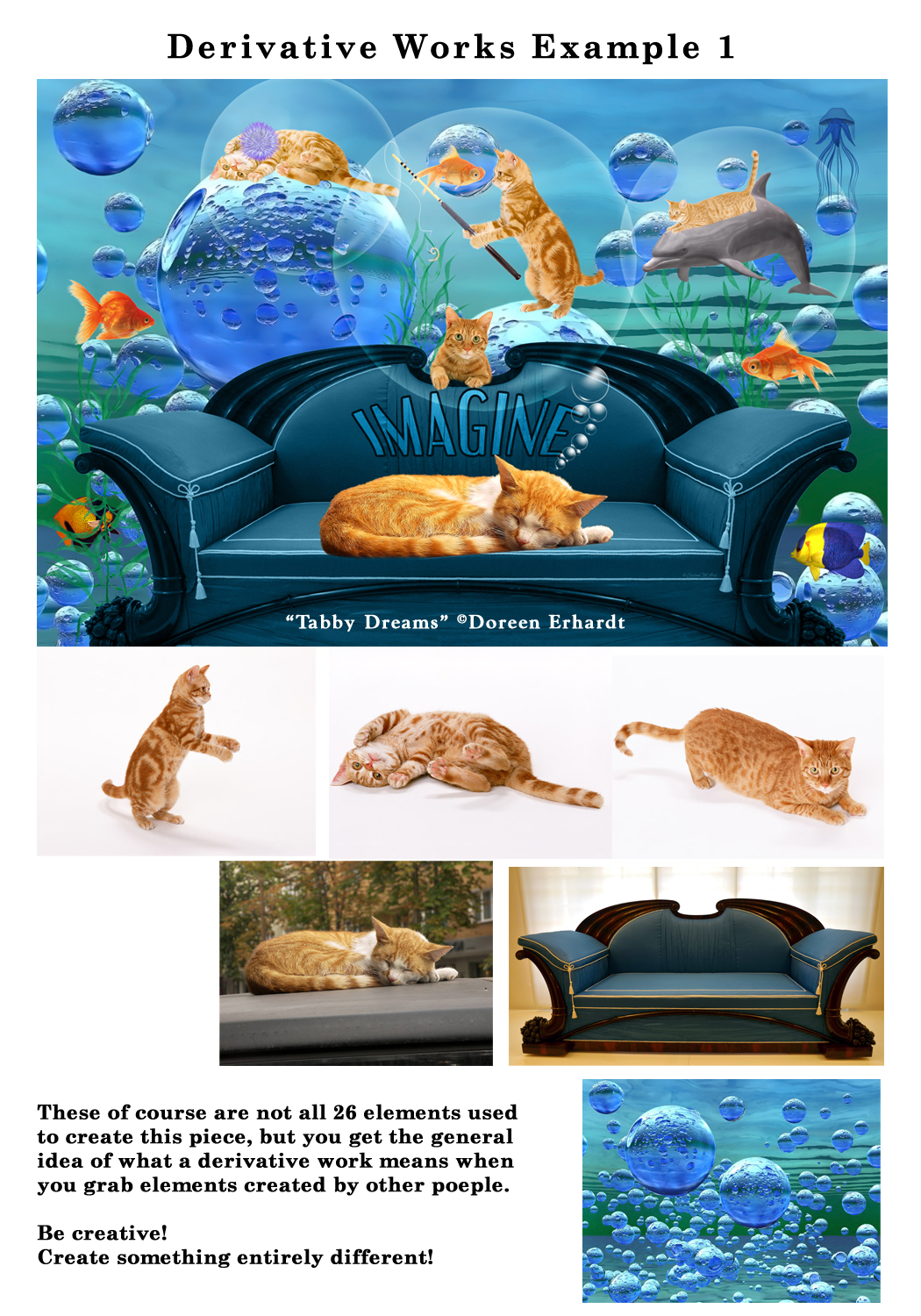
So, my Note to Reviewer looked like this:
This image was created using 26 different bits and pieces.
Small tabby cats from PhotoRack here: http://www.photorack.net/index.php?action=showpic&cat=55&pic=610
TOU: http://photorack.net/terms.php
Cat on the sofa from CepolinaPhotos here: http://www.cepolina.com/cat-feline-red-fur-sleeping.html
TOU: http://www.cepolina.com/freephoto/faq.html
Sofa from Pixabay here: http://pixabay.com/en/lounge-couch-sofa-vienna-austria-111603/
TOU: http://pixabay.com/en/service/terms/#download_terms
Background from MorgueFile here: http://www.morguefile.com/archive/display/600153
TOU listed on same link page.
Underwater elements, plants, dolphin, etc. from OutlawByDesign where I hold a CU Membership. TOU here: http://www.outlawbydesign.com/membershipinfo.html
Remaining elements created by me.
My Artist’s Notes look like this where I offer credit, even to that in public domain:
This zany digital composition has elements of 16 photographs and 10 graphic elements to represent my interpretation of a feline’s dream. Original artwork by Doreen Erhardt©2013 and the St. George Salon of Art, LLC. Elements by PSchubert at Morguefile, Pixabay, Photorack, and Outlawbydesign.
There are many ways to create a derivative work. Use the photograph as a reference for a new painting. Remove elements from a photo and combine with other elements to create a new work. Use as a background to a new piece which combines other elements.
And ALWAYS give credit, it’s the right thing to do. You should credit the source(s) even when the elements you took are in public domain. Wouldn’t you want someone to offer you credit if your photograph was used in a new work? Be professional … read the TOU … follow the TOU … credit the contributor(s).
If there are no TOU, nothing which states under what license/rights you can use the work, or releases it into public domain status … you CAN NOT use it. If you don’t want your work returned or declined under GCU’s Creative Use Policy, then USE your Note to Review field properly, use it thoroughly and treat the contributors out there for designers like us, with the same respect you feel you deserve as an artist.
Here are some great tips:
This post will help you to better understand the various TOU/
This post gives you a better understanding of how to offer credit to contributors:
Next week we’ll continue in the final group of the Submission Guidelines: MARKETABILITY and talk about the No Thank You section. Till next week, I hope I’ve inspired you to learn more!
For great resources & tips visit the SalonOfArt
Share this:

Critique Clinic – September 6-8, 2013
How does it work? For three days a week (Friday-Sunday midnight), I will open the clinic to any artist who wants an honest peer review and critique of a card which gets plenty of clicks but no sales, so something’s probably not quite right, or you’ve got a new design you want to test drive, or you’re unsure about the marketability of a card. Or perhaps you’re a newbie who isn’t sure if a card is up to a marketable standard. Anyone is welcome to participate. In fact, I encourage everyone to at least look at the cards in question and read the critique comments – you may learn something. The purpose of the clinic is to help artists improve the commercial appeal and marketability of their cards.
THE RULES
- ONE card per artist only.
- Card must be intended for sale at Greeting Card Universe.
- To submit a card for critique, post a link to the card at GCU in the comments section of this clinic post. Allowances will be made if you’ve had a card declined, or made a new design you’d like advice on before submission. Give us the link where we can see the card, such as your private gallery, Flickr, Tinypic, etc. If you do give a private gallery link, be sure your private module gallery is ON. Please do not post links to your Manage Cards section – do you really want strangers tinkering with your cards? And please don’t ask us to critique a card that’s pending review – we can’t see it until it’s approved.
- Any artist is free to comment and/or give a critique of a submitted card. HOWEVER, post-and-run comments like “great card” or “you suck” will not be tolerated, nor will abuse. Criticism should be constructive, not destructive. Play nice or you will be banned.
- I also won’t tolerate temper tantrums if you decide your “artistic integrity” is being stepped on because you asked for a critique, and someone told you the photo you’re using isn’t in focus. If you can’t take honest criticism, don’t submit. Once gets you a warning; twice and you’re banned from submitting in the future.
- Artists who critique may do so by giving their opinion, posting an example of another card, or pointing the submitter to a video, on-line article, or other helpful suggestion.
- Don’t forget that artists who are giving you tips and helpful advice are volunteering their time and trouble. Be nice. A link back to their store on your website or blog is appreciated (but not mandatory).
- You are free not to take any advice offered. There’s no guarantee any card will be a bestseller, so don’t come into the clinic with unrealistic expectations.
- Rules may change as we go along and we see how things turn out, okay?
So without any further ado, I declare this week’s Critique Clinic open!
Share this:

Tips and Tricks: Creative Live – Free Workshops
Just letting interested artists know about CreativeLIVE, a site offering workshops and tutorials on diverse subjects like Pinterest, Social Media, Marketing, Photoshop Plug-Ins, etc.
How it works: You can sign up for and watch live courses FREE and interact with instructors in real-time. After the course has aired live, if you want to see it again or if you missed it the first time around, you need to pay for full access, which you can enjoy at any time. However, this access doesn’t come cheap – a quick perusal showed price tags of $99-$149.
But if your schedule is flexible, certainly check out the free live courses since they cost you nothing but time. See the comment on this post for a little more information.
Have fun!


