Design Spotlight: Pattiann Malynn

Today’s Design Spotlight comes from Pattiann Malynn Designs. What a striking kitty!
_________________________
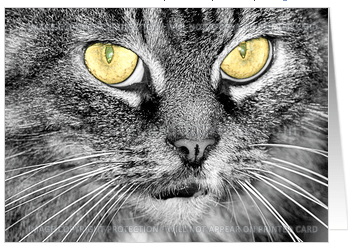 This is by no means my best selling card, but it is among my favorites. This is my neighbor’s cat, who is allowed to roam the neighborhood at will. This cat not only digs in my gardens, but also takes great joy in teasing my Shi Tzu, Kirby, who is probably the same weight as the cat.
When I’m outside with Kirby on the lead, the neighborhood cats, this one included, take great pleasure in walking just beyond the lead, where Kirby can’t reach them. Although, truth be told, I don’t know what Kirby would do with a cat if he caught one — and neither does he! But Kirby thinks he’s a Doberman and has taken on the task of guarding the yard from those mean 🙂 neighborhood cats. Really, all he’s doing is amusing the cats. I can almost hear them snickering their little cat snickers as they walk away, finally bored by Kirby’s predicable reaction. “Stupid dog, he does it every time! Now let’s go see what the Gallagher’s dog is doing.”
To make this image, I layered a black and white layer of the image over a colored version. I then erased the black and white version over the eyes. I really wanted the eyes to pop and I think I succeeded.
Share this:

Artist Interview: Doreen Erhardt

This week, since she’s such a big part of the GCU community, we’re interviewing photographer, artist and designer Doreen Erhardt at Salon of Art Greetings, who has been a member of Greeting Card Universe since April 2009.
_________________________
 Doreen, what drew you to join GCU?
I researched many online card sites and thoroughly investigated selling my designs to Greetings Card Publishers, but when I found GCU, it was the perfect choice for me. No Exclusive Rights, Solid Review Process and excellent Marketing Methods. I’m delighted with my sales at GCU!
Tell us who you are, where you are, and what you do.
I am classified as a Master Photographer, artist and designer living in California’s Sierra Foothills, an hour from Lake Tahoe. Though I am trained in photography, I am self-taught in my digital painting and design efforts. I’m a wife of 30+ years, a mother of furry children and a volunteer for my local Humane Society and the Sacramento Book Review. I left the gallery and art show world in 2006 and happily sell my art and designs online…no inventory, no hassle!
What’s your favorite greeting card on GCU that you’ve created?
Wow, that’s a tough choice, but I really love this pencil drawing I did in Corel Painter called “Smug Pug” and got a good laugh when I used that drawing to create this card, it’s also turned out to be a good seller for me.
Where else can we find you on-line?
PAWSitively PETrageous
Personal Expressions
Business Expressions
Salon of Art Gifts
Fine Art Gallery
Blurb Book Store
Art Portfolio
Facebook
My Point of View Online Newsletter
Blog
Squidoo Lens:
Save the Date
For the Love of Squirrels
The World According to Ossa
Stray Muses…A Language Unspoken
All About Hawkeye
Choosing a Camera
How did you become an artist and photographer?
I have carried a camera in my hands since I was three. I used to shadow my mother using a non-functional twin-lens reflex camera. I would pretend my baby buggies were rocking film developer tanks and develop pictures using photo paper with a leaf on top, which when exposed to the sun made a picture…my mother was a photographer and worked in a professional darkroom. So, it was part of my make up at a very young age. As many kids do, I left it behind until I got married and my husband gave me my 1st 35-mm system in 1980.
What or who inspires you?
Color and light inspire me. Seeing someone else’s creation in a medium or style I’ve never attempted is tremendous inspiration for me.
What tools do you use to create your work?
I shoot with a Canon 7D system. I use Photoshop CS5 in a Windows 7, 64-bit environment. I paint with Corel Painter 11 and a Wacom Pen & Tablet.
What do you do to promote your greeting cards on GCU?
My online newsletter is probably the best promotion for my cards. I use a Facebook Fan Page, I have several Squidoo Lens, a Blog and I have a tremendous amount of GCU cards (not all mine) on my PAWSitively PETrageous website. At the Humane Society events I go to, I take my Pet Sympathy and pet related cards with me.
Is there a tip about GCU or promoting your GCU designs you’d like to share with other artists?
Really match the feeling of the image to the sentiment you attach to it, AND match this image to the appropriate audience. People buy cards to express a feeling. A scenic, for example, will not be appreciated by ages 1 to 16 for example, just like a sad dog image may not be appropriate for Happy Birthday. This is critical, in my opinion, to creating cards that sell.
Name three other GCU artists whose work inspires you or that you admire.
Corrie was the artist that inspired me when I started at GCU and why I stuck with it.
I love Betty Matsumoto-Schuch and the Adventures of Bud and Tony.
Patri Feher is truly inspiring for the photographer side of me.
Is there something you’re really proud of having done?
I volunteered for 6-years at my local Wildlife Rehabilitation Clinic and though being their Director of Public Relations/Ways & Means, and Official Photographer were fulfilling roles, my proudest accomplishment was rescuing, rehabilitating and releasing back to the wild over 85 orphaned Grey Squirrels. I stayed up many nights nursing these babies back to health, sometimes wondering if they would live through the night, and setting them free as healthy, wild animals always made me proud.
_________________________
Thank you, Doreen, for a truly inspiring interview! (and thanks for the mention – we love your work, too) 🙂
Share this:

“Like” GCU Facebook!
Did you know Greeting Card Universe has its own Facebook page?
If you haven’t “liked” it already, cruise over there and hit that thumbs-up button. They’re going to be posting much more frequently from now on, and your card might be chosen next – giving you some lovely free exposure. For example, today I saw a birthday card by Ya-Graphic featured. Isn’t that cool? Yet another way to promote your cards, and you don’t have to do a thing.
Keep up with the action and share the love!
Share this:

Guest Blog Announcement!
 Hey everybody!
GCU Community Super Star Doreen Erhardt has a guest blog posted at Judy Adamson’s Art and Design blog. Go check it out!
Top Ten Tips for Selling Designs Online
Share this:

GCU Community Newsletter – May 12, 2011

____________________________________
Issue #4
DON’T HAVE A COW, MAN
Welcome to the latest edition of the GCU Community Newsletter.
We had a little excitement yesterday when Christie Black discovered a couple of sites selling cards by some

Hidden Gems: Fathers Day - June 19 - artist Mike Shiell
Greeting Card Universe artists. Copyright infringement or something else? Turns out the site’s owner had purchased the cards for resale. Muchos gracias to Shaun for his quick action!
Lesson learned: if you discover a site selling GCU cards, check with Admin before you take further action. A post on the Forum about it will usually get Admin’s attention real quick. GCU has zero tolerance towards theft of its artists’ intellectual properties, and will act on our behalf if necessary.
It’s nice this incident turned out benign. Still, the Internet being what it is, I’m not throwing out my cease and desist letter template anytime soon. Part of the price of putting your art out there on the World Wide Web, I’m afraid.
On to other business!
Last week, our guest blogger Tom Rent shared Part One and Part Two videos about his experience with Facebook ads – must see stuff.
An artist interview with Tanya (Moonie) at Moonlake Designs has us all smiling.
Another guest blogger, Peggy Mundell, shared some fabuloustips about photographing pets.
The talented Doreen Erhardt gave us her Dash of Inspiration – Cup of Creativity column, this time about using text on your greeting cards.
The winner of our first Contest: Maryann Nolan, who won a wonderful art inspiration book, and we’ve started a new Contest to tie into our first Blog Carnival.
The Design Spotlight was on Christie Black.
In Nuts & Bolts: GCU How-To and Tips, we learned about keywords and how picking the right ones can lead to more sales (and some tricks on to find good keywords, too).
Hope you have a lovely weekend and a great week! And don’t forget about our Blog Carnival – you could win a $50 AMAZON GIFT CERTIFICATE! I’ll give you the details later in this issue. Until next time, keep learning, laughing, and sharing the love!

____________________________________
 Finding Your Voice
I’ve said it before, and you’ll probably hear me say it again and again – in the blogging world, content is king. Search engines and visitors LOVE original content.
What does that mean? Simply put, to succeed you should write what you know and be yourself. In other words, once you’ve picked what you want to blog about, next find your unique writing “voice.”
Blogging, especially for newcomers, can be intimidating, but having the freedom to write what you want and share what you know with others is a wonderful experience. Adding the ability to promote your art via GCU card links is icing on the cake.
You don’t need to use twelve dollar words and complicated concepts. You just need the ability to write a clear, understandable sentence. And another, and another, and another… and soon you’ll be blogging with the best of them.
No matter HOW you say it, the point of blogging is to get your message across to readers. If you can do that – and you should be able to – then you’ll quickly find a natural sounding way of expressing yourself, and you’ll enjoy writing posts. That enjoyment will shine through, making people WANT to read your blog.
Here are some tips to finding your writing voice:
Daily Devotion:Reading and writing are important. Read something every day. You could be inspired. Write
Hidden Gems: Fathers Day - June 19 - artist Peggy Ferguson
something every day. Writing is like any other exercise: the more you practice, the better you get at it. Don’t throw out your old writing, either. You never know when you might be moved to polish up an older piece and present it to the world.
Be Yourself: Writing a blog is vastly different than writing a formal business letter. Don’t take refuge in stiff formality. Let your personality shine through.
Quit Wasting Time: Don’t spend so many hours editing and re-editing a blog post that you run out of time to actually write. Off-the-cuff remarks have charm. Don’t focus all your energy on perfection. As long as you avoid grammatical and spelling errors that turn your prose into alphabet soup, you’ll be fine.
Don’t Worry: You don’t need to write about earth-shattering topics of importance. If what you have to say moves you, it will move other people, too. You can reminisce about the past, ruminate about the present, voice an opinion, make a statement, share your knowledge. Anything that sparks your passion!
Spread the Love: Once you get your blog started, have a look around the Internet for blogs with topics similar to your own. Get commenting. Invite people to visit you. You can learn more about that in Newletter #3.
Still need a little help? Check out Seven Tips for Making Your Blog Posts More Readable.
_________________________
 We’re having our very first Blog Carnival! Through May 24, write a blog post (or new Squidoo lens) on the topic: SUMMERTIME, AND THE LIVING IS EASY. Your post could be anything summer related, from childhood or present family memories, to a recipe for a summery lemon cake, to a summer themed painting. Use your imagination! Included in your post must be links to 3 cards at GCU – yours or another artist’s (using the Sell This Card tool earns you commission on new customer sales) that have a summer theme (like a pool party invitation, a beach photograph, a picture of a watermelon slice, a summer holiday like Fourth of July – again, use your imagination). Leave a comment on this blog with the URL of your blog post (or email me directly). On May 24, I’ll post the carnival master list, and I’ll also have a drawing for a $50 AMAZON GIFT CERTIFICATE! And the master list will be shared and posted by all participants, too. How cool is that… or should I say, how hot! 🙂
____________________________________
 Bloggers should have commenting enabled (and Squidoo lenses should

Hidden Gems: Graduation for Nephew - Sandra Rose Designs
have a Guestbook). The best way to interact with visitors (and attract repeat visitors) is through commenting. If you don’t have a way for people to voice their thoughts on your blog, you’re missing out. Not only that, it could make you seem standoffish or uninterested, which is a bad thing.
Need to upload and order a special card in a hurry? During the upload process, check MAKE AVAILABLE IN PRIVATE GALLERY ONLY. Doing this will also enable you to check WAIVE REVIEW. Voila! Instant gratification. Just be sure double-check your spelling and grammar, and don’t forget to enable the Private Gallery module in your storefront.
DID YOU KNOW you can “like” this newsletter or any post on the GCU Community blog, or include them in your social bookmarks? Just click the title of the post, which takes you to the permanent link page. At the bottom of the page you’ll see buttons for social sites like Facebook, Reddit, StumbleUpon, etc. And thanks for sharing!
_________________________

Call For Artists
Judy Adamson is looking for traditionally painted “New Baby” cards from GCU artists to promote on her blog! See her Forum post for all the info.
Tom Rent is seeking illustrators and painters, as well as digital artists, to help him in making a new video about guidelines for preparing art for GCU. He’s got questions, you’ve got answers. See his Forum post for details.
Squid-doo-be-doo-be-doo
Elizabeth has a new lens about Graduation Cards and Gifts
Moonie has a new lens about the Delightful Fairy Folk
GCU Community All-Stars!
While I try to be diligent about handing out our Community Stars, a lot of the time I can’t find an artist’s email address. If you’ve had a card chosen as Design of the Day, please get in touch so I can give you your Star. Equally, if you’ve got a new blog or if you’ve made a blog post featuring GCU cards, you’re eligible for a Star, too. Contact me, please.
Folks, don’t forget to include your email address on your GCU storefront, especially if the Contact This Artist module is at the bottom of the page. Potential customers can’t contact you if they don’t see an email addy (and neither can I).
P.S. Everyone who participates in our brand new Blog Carnival will get a special Star, too!
2011 Reminder Time: Since search engines can take up to 6 months to index new content, you should be working on this year’s cards ahead of time for the following holidays:
- September 5 – Labor Day
- September 11 – Grandparents Day
- September 11 – Patriot Day
- September 29 – Rosh Hashana
- October 8 – Yom Kippur
- October 10 – Columbus Day
Don’t Forget: To change the date on your year specific cards such as Graduation and New Year’s. While GCU tries to contact artists who’ve been a little absent minded, this takes time that could be spent doing other things… like reviewing cards waiting for approval! If you happen to come across another artist’s card, and you notice they haven’t changed the date, give them a friendly heads-up. They’ll appreciate it.
We Need You!: If you’ve got a blog, a website, a Squidoo lens, or a YouTube video promoting your cards at GCU, or a Facebook or a Twitter account that you use, we want to hear from you! To join the roll calls here, leave a comment or send an email to gcucommunity (at) bigdates.com. We update the roll calls daily, so you’ll never be absent for long. Do you have suggestions? Features you’d like to see added? Tips you want to share? Send them in!
____________________________________
The next issue of the GCU Community Newsletter will be Thursday, May 19
Share this:

Need Volunteers!

I need a couple of people willing to check the GCU homepage every day to note the Design of the Day and give me the card link. I’d like to acknowledge the lucky winners. Just send me a note at gcucommunity(at)bigdates.com
Thanks!
Share this:

Nuts and Bolts: Keywords

KEYWORDS ARE THE KEY (TO SUCCESS)
How do people find your greeting cards at Greeting Card Universe? Usually either by doing an on-site search, or using a search engine, which is why your keywords are important.
When a user does a search, they enter words or phrases as their search terms, refining the terms as necessary to refine the results. Here’s an example: a shopper wants to buy a 59th birthday card for their aunt, who is a butterfly collector. They might search for “birthday card for aunt” or “59 birthday card for aunt.” Once they get the results for this search, they may want to refine the results further, such as “butterfly birthday card for 59 year old aunt.”
Are you starting to understand the importance of keywords? If you don’t use the right specific and relevant keywords when submitting your greeting cards to GCU, your cards won’t come up in search results, and you won’t make many sales.
Don’t use fraudulent keywords, though. Not only is it naughty, but I promise you won’t make many sales of misleading cards. GCU reviewers frown on the practice, too. You should be choosing keywords that are relevant to the card.
Do try to find unique keywords to help you stand out from the crowd.
If you’re stuck for keyword ideas, there are other free tools that may help point you in the right direction.
For example, let’s take this card of mine:

The title is very important to search engines, so I’ve titled this card Christmas Tree – Believe – Customizable Photo Card. That should hit some of the right buttons. Next, I need keywords. Obvious choices are snow, Christmas ornament, personalized photo card. Notice I used “customizable” in the title and “personalized” in the keywords? That’s because different people will search for photo cards using different terms. I’m covering my bases.
Now I’ll check to see how I did. Opening a new tab in my browser, I go to Google AdWords: Keyword Tool.
When I plug words and phrases into this tool, it will tell me how many people are searching Google for these terms on a monthly basis, and it may give me ideas on other keywords I can include on my card. For demonstration purposes, I’ll start with just “greeting cards.”
“Christmas photo greeting cards” is on the list of terms people are looking for, so good thing I’ve got that covered in my title. Going further to look at “Christmas cards,” I see “personalized Christmas cards” and “customized Christmas cards” rank high with thousands of monthly searches, so I was right to include both terms in my title and keywords.
I also see “modern Christmas card” and “contemporary Christmas card” are being searched, so I’ll include “modern” and “contemporary” in my keywords, as well as “fashionable” and “trendy.” Not misleading, since the design is everything I say it is. A thesaurus is sometimes an artist’s best friend! To conclude, in my Artist’s Notes section, I’ll write a little blurb and use words like “stylish” and “up to date” to increase the possibility of shoppers finding my card. I could take my searches even further, but for now I’m done.
While valuable, this free service has its limitations. It’s intended to help advertisers placing AdSense ads with Google, but it can be used to assist you in targeting sellers who are looking to buy the kind of greeting card you’re selling.
Another way to get a general idea of keywords other artists are using on cards in the same vein as yours is to enter this into the Google search box:
site:http://www.greetingcarduniverse.com yourkeyword
Your search results will contain every card on GCU containing that keyword. By seeing what terms other artists have used in their keywords, you may get a better sense of what you need to include when uploading your own cards.
Suppose you want to confine your search to just Christmas cards, for example. Your Google search terms will look like this:
site:http://www.greetingcarduniverse.com/Holidays-Christmas yourkeyword
Refine it even further to subcategories:
site:http://www.greetingcarduniverse.com/Holidays-Christmas-Photo+Cards+Your+Picture+Here yourkeyword
And that’s how you do it. You can easily find out the URL you want to search by going to the GCU homepage, scrolling down the list of categories until you find the one you want, then refining your search to the sub-categories until you get where you want to go. Once you have the unique URL showing all cards in that category or sub-category, you’ll be able to search among those cards for specific keywords by using the Google search trick above.
I can’t emphasize this enough: make sure any keywords you choose are relevant to the card. In other words, don’t put “merry Christmas” in your keywords unless that phrase is on the front of your card or in the inside verse. The rule is to use only those keywords that describe your card AS IT ACTUALLY IS, not what you think it’s suitable for.
Yes, I know there are cards out there that break the rules. Please don’t get upset about what other people have done in the past. There was a time in GCU’s early days when cards weren’t reviewed, and some artists overdid things a little in their enthusiasm. Those days are long gone. It doesn’t really matter what somebody did years ago. What counts is what we’re doing today.
As a final note, just remember that if we, as artists, work hard to reduce the number of errors in our cards (including keyword mistakes and oversights), it will reduce the review times for everyone. Wouldn’t that be nice?
Share this:

New Contest: Blog Carnival I

Want to join me on a carnival?
A blog carnival, that is!
What’s that? How does it work? Well, since we have so many great artists with blogs, I thought it would be fun for everyone to participate in an organized “carnival” – meaning, I give you a general topic to blog about, and a deadline to do so. At the end of the deadline, as the host I’ll put up a master post of links to everyone’s blog posts, and all us peeps can go and have a gander, comment, rate, share, etc. In addition, every participant will share the master list on their own blogs, thus spreading the love. Got it?
This is a great opportunity for exposure that shouldn’t be missed!
 The carnival starts tomorrow (May 11) and runs until May 24. Everyone who participates will get a cool GCU Community All-Star, and be entered into a drawing to win a $50 GIFT CERTIFICATE TO AMAZON.COM!
The topic is: SUMMERTIME, AND THE LIVING IS EASY
To participate, write a blog post about summer – it could be anything summer related, from childhood or present family memories, to a recipe for a summery lemon cake, to a summer themed painting. Use your imagination! Included in your post must be links to 3 cards at GCU – yours or another artist’s (using the Sell This Card tool earns you commission on new customer sales) that have a summer theme (like a pool party invitation, a beach photograph, a picture of a watermelon slice, a summer holiday like Fourth of July – again, use your imagination).
Leave a comment on this blog with the URL of your blog post (or email me directly). On May 24, I’ll post the carnival master list. Everyone is encouraged to visit the participating blogs, leave comments, and generally have a good time.
Oh, I’m not forgetting about the Squidoo lensmasters lurking around here… a new Squidoo lens on a summer topic with minimum 3 links to GCU cards (you can include up to 9) will also be considered eligible for the prize.
Now go out and celebrate summer in the best way – and maybe you’ll be the hottest winner in town!
Share this:

Design Spotlight: Christie Black

Today’s Design Spotlight comes from Christie Black at Creations From the Heart, a wonderful humorous illustrator.
_________________________
 This is not my biggest seller, but it is my best seller of cards sold in singles, and this card is “favorited” the most. I chose it because I think it speaks volumes about what I love to do most as an artist…draw animals and play with words! This is one of my earlier cards added to GCU, so I wish I could remember if there was some interesting story behind why I drew it. However, it was probably just drawn on a whim. I really love drawing animals, and adding personality through expressions is always fun for me. My other love is putting a spin on words so I look for any opportunity to do so!
Share this:

We’ve got a winner!

Maryann Nolan has won our first contest – congratulations! And thanks to everyone who participated.
We’ll be announcing a new contest tomorrow. Hang onto your hats, peeps. You could win a $50 gift certificate from Amazon.com, which ain’t exactly chicken feed. 🙂
Stay tuned for the details.
Corrie


 GCU Community