Dash of Inspiration: Tools to Help Choose Color Palettes
A Dash of Inspiration, A Cup of Creativity by Doreen
Tools to Help Choose Color Palettes

A Dash of Inspiration: Tools to Help Choose Color Palettes
Whether choosing colors for a design or for your storefront, here are some cool color wheel tools which will not only help, but may even make the process fun! Great thing is in most cases they give you the hex number so you can plug those numbers into Photoshop, Illustrator, Elements, etc. and have an accurate color match. You can also save the screen shot of the palette you made (as I did in the examples below) and bring those into your image software, then use the color picker to get the hex number.
The Color Wizard
The color wizard lets you submit your own base color, and then returns a coordinating palette for the one you selected. It offers a set of hue, saturation and tint/shade variations of your color, as well as suggests color schemes to you, based on your color’s complementary color, split complementary colors, analogous colors and other variations … read more and play with it here:
http://www.colorsontheweb.com/colorwizard.asp

Adobe Kuler
You will need an Adobe account to use this next one, but it’s a free account with other benefits. Nice for getting shades and complimentary colors to your base color.
https://kuler.adobe.com/create/color-wheel/

PHOTOCOPA by our friends at Colour Lovers
Do you love those color palettes inspired by a photo? Here’s where you can make your own!
http://www.colourlovers.com/photocopa

So, until next week … Learn … Create … Inspire!
Share this:

Critique Clinic – March 21-23, 2014

How does it work? For three days a week (Friday-Sunday midnight), I will open the clinic to any artist who wants an honest peer review and critique of a card which gets plenty of clicks but no sales, so something’s probably not quite right, or you’ve got a new design you want to test drive, or you’re unsure about the marketability of a card. Or perhaps you’re a newbie who isn’t sure if a card is up to a marketable standard. Anyone is welcome to participate. In fact, I encourage everyone to at least look at the cards in question and read the critique comments – you may learn something. The purpose of the clinic is to help artists improve the commercial appeal and marketability of their cards.
THE RULES
- ONE card per artist only.
- Card must be intended for sale at Greeting Card Universe.
- To submit a card for critique, post a link to the card at GCU in the comments section of this clinic post. Allowances will be made if you’ve had a card declined, or made a new design you’d like advice on before submission. Give us the link where we can see the card, such as your private gallery, Flickr, Tinypic, etc. If you do give a private gallery link, be sure your private module gallery is ON. Please do not post links to your Manage Cards section – do you really want strangers tinkering with your cards? And please don’t ask us to critique a card that’s pending review – we can’t see it until it’s approved.
- Any artist is free to comment and/or give a critique of a submitted card. HOWEVER, post-and-run comments like “great card” or “you suck” will not be tolerated, nor will abuse. Criticism should be constructive, not destructive. Play nice or you will be banned.
- I also won’t tolerate temper tantrums if you decide your “artistic integrity” is being stepped on because you asked for a critique, and someone told you the photo you’re using isn’t in focus. If you can’t take honest criticism, don’t submit. Once gets you a warning; twice and you’re banned from submitting in the future.
- Artists who critique may do so by giving their opinion, posting an example of another card, or pointing the submitter to a video, on-line article, or other helpful suggestion.
- Don’t forget that artists who are giving you tips and helpful advice are volunteering their time and trouble. Be nice. A link back to their store on your website or blog is appreciated (but not mandatory).
- You are free not to take any advice offered. There’s no guarantee any card will be a bestseller, so don’t come into the clinic with unrealistic expectations.
- Rules may change as we go along and we see how things turn out, okay?
So without any further ado, I declare this week’s Critique Clinic open!
Share this:


You Can Be a Star … Submitter!
Every card submitted at Greeting Card Universe goes through a review process to ensure the design meets GCU’s submission and marketability standards. Of course, this takes time – up to 6-8 weeks sometimes. It’s hard waiting to learn the fate of new designs. Will the be Accepted? Declined? Returned for Edits? Or will the remain Pending a while?
Is there a way to speed up the waiting time? Yes. If you want your cards approved quickly, you should work toward achieving Star Submitter status.
What’s a Star Submitter? An artist who achieves this status may Fast Track all cards, gaining expedited reviews.
Who Chooses Star Submitters? The Review Team nominates artists whom they believe fit the criteria below.
How Do I Become a Star Submitter? An artist must show – consistently – that their card designs meet marketability standards and conform to GCU’s submission guidelines, contain no spelling or grammatical errors and avoid mistakes such as design elements over the margin and trim lines, use correct and relevant keywords and categories, create good titles, and basically do everything right from the get-go. To become a Star Submitter, learn the rules. Study the GCU Wiki. Understand the guidelines and standards. Make certain your images and verse fit the occasion.
What Do I Get As a Star Submitter? Expedited reviews. All cards are Fast Tracked, so you don’t have to wait weeks for your new cards to be approved.
Who Can Become a Star Submitter? Anyone! If you apply yourself – that’s the key. Star Submitter status is a reward for artists who have invested their time into mastering the “art” of GCU.
How Do I know When I’ve Become a Star Submitter? When you’re in the process of uploading your card, you’ll see text already in the Note to Reviewer field that says: “I am a Star Submitter so please expedite the review of this card.” Don’t delete the note!
Star Submitters must still follow all Submission Guidelines. They must also continue to include links to website/TOU of any 3rd party elements in their designs.
So if you want faster review times, reduce the errors in your card designs, don’t make silly spelling mistakes, stay in the margins, and learn (and apply) the Submission Guidelines. And perhaps one day, you can be a Star Submitter too!
Share this:

Nuts and Bolts: Back of Card Credits

Put Your “Pro” Face On: Back of Card Credits
It’s time to talk about the Back of Card Credits (BOC). That’s the information printed on the back of every one of your Greeting Card Universe cards – your logo + your store’s URL.
I don’t know about you, but when I pull a greeting card out of the rack at a grocery store, I look at the card’s front, inside, and the back as well. So do shoppers. The BOC is the second face of your store, something that represents you as an artist, a greeting card designer and a business person whenever a shopper buys your card and sends it to someone.
Just as you want your storefront to be professional looking, you want your BOC to be as professional as possible. It’s your brand, it helps sell you to customers, and it says a lot about you as a business. A logo can make or break a business, which is why companies pay thousands of dollars to design firms to come up with consumer-attracting logos.
You only have one chance to make a good first impression. When the recipient of a card flips it over to look at the back and find out where it came from, no matter how nice your front of card design is, a BOC that looks amateurish, ugly, sloppy, or just plain bad will not draw shoppers to visit your store.
And in case you weren’t aware, in the beginning GCU actually had cards returned by shoppers because the BOCs weren’t well done – hence the option for shoppers to choose a “simplified” BOC instead – meaning store URL only, no logo.
So what goes into making a good logo? Think about the company logos you see every day, the logos of companies you trust to give you a great product experience in exchange for your money.
The basic rules of logo design are:
Follow the Fundamentals – The logo must follow the basic principles of design – form, clarity, consistency, space and color. This means your logo must have aesthetic appeal, the same as the greeting cards you design, and be designed to attract shoppers of all types. No personal photos. The logo should not appear distorted or squished. Every element of your logo, including any fonts you use, must be visible and above all, recognizable or readable at a small size. For GCU, a 200×200 pixel square is the ideal size for BOC.
Form Follows Function – Keep it simple. You logo must be instantly recognizable and usable in any context, at any size, on any background (from plain to patterned, any color) – whether on the back of a greeting card, in a store banner, on a T-shirt, on a matchbook cover or a bumper sticker. The fussier and more intricate your design, the further you’re getting away from a functional logo. Do not under any circumstances use shadow, 3D effects, texture effects, embossing, beveling, glare, or gradients. Simple is best.
For Consistency: Use your logo on every product you produce, on every on-line store you maintain, on your business cards, brochures, and everywhere else. Branding is important to create consumer awareness. The more shoppers see you out there, the more they’ll want to find out more about you.
Find Your Face – Choose an image for your logo that represents something about you as an artist, or some aspect of your business. For example, my CorrieWeb logo is an illustration – the Earth encircled by different animals because a lot of my art has animals in it, and our tag line is “The Wonderful World of Corrie Kuipers.” Your logo should be unique, and have a classic, timeless quality that will not become dated in two years. And don’t be a copycat. It’s a fact that copycat logos will fail. Don’t believe me? Just ask Pepsi. Their old logo was very similar to the one used by Coca-Cola. It wasn’t until Pepsi completely redesigned their logo to be unique that they saw a big increase in sales.
Bottom line: if your logo doesn’t have the professional look, how can shoppers take you seriously?
Share this:

Tips and Tricks: Basic Marketing


One aspect of making money from designing and selling your greeting cards is marketing. Don’t run away. Come back. This isn’t a scary topic, nor is it a dirty one. If you’re aiming to be a professional artist or photographer and/or greeting card designer, you will have to market yourself and your products.
In our digital age, on-line marketing has become paramount. Here are some basic tips to help you on the way to marketing your designs, bringing them to the attention of the buying public, and making more sales.
All of these basic marketing methods are geared toward improving your card’s rank in search engines and thus, it’s visibility. The quicker your card is picked up in searches, the quicker you’ll start selling.
Artist’s Notes: The first step is creating a product description in the Artist’s Notes field. This article on How to Write Product Descriptions and this article on Using the Artist’s Notes for Product Descriptions will help you if you’ve never done it before or need to brush up on your writing skills. Do you have to do this? You should. If not, your designs are pretty invisible to search engines and therefore, to shoppers.
Facebook: If you don’t have a Facebook fan page specifically for your art or photography, make one. If you don’t know how, here are some instructions on creating a FB fan page. Once you’ve done that, you can start posting links to new card designs. Get “likes” by asking friends and family, and by posting a request to other artists on the GCU Forum’s Artist Chatter topic board. You can try the Facebook Fan Page thread. Keep in mind, the more “likes” you get on a fan page, the more Facebook will include your posts in your fans feeds. When posting, keep it interesting, not just a sales pitch. Use a conversational voice like you would in your personal FB. Whatever you do, don’t spam. Limit yourself to no more than one or two posts per day maximum. You should be posting at least once a week.
Twitter: There’s nothing wrong with having a separate Twitter account solely for your art or photography projects and products if that’s what you choose to do. Some people like to separate business and personal. Other’s don’t. That’s up to you. You’ll need to use a service like Bitly to shorten URLs in your tweets. Rather than make tweets like “buy my cards pleeeeeeeze kthxby” try to make a little post either about the design, about how you felt when you made it, something relevant to the design – in other words, try to make your tweets interesting rather than just a sales pitch. And again, do not spam. There’s no quicker way to lose followers. Limit yourself to 1 or 2 tweets per day maximum, but make sure you tweet every day. Silence is a mood killer on Twitter.
Pinterest: Some people love it, some people hate it, but Pinterest is one of the biggest growing marketing tools out there. It’s true – the original link to the card you pin is only on your pin, BUT if someone else repins, a link pointing back to you and the original pin travels with it, so anyone can and will use that link to find the original pin and get the URL, ho worries. If you don’t want to get involved in Pinterest, that’s your choice. For those who do, creating boards and pinning your card designs is easy, fun, and yes, it does eventually help with sales by making your designs more visible.
Blogs: There are two ways of putting yourself out in the blogosphere – write your own blog or do guest posts on other people’s blogs. If you want to try your hand at blogging, our advice is not to just blog about your greeting cards. You won’t get much attention that way. Instead, write posts on topics you’re passionate about and include your greeting card designs as part of those posts. To make guest posts on other blogs, you’ll need to search out blogs relevant to your niche, start leaving good comments on their posts, and then ask the owner if you can do a guest post. Any artist can do a Design Spotlight or guest post on this Community blog at any time, even if you’ve done it in the past but want to highlight a new design – just drop me a note. You can also participate in Design Contests on this blog (I usually run a contest once a month). These are great opportunities for you to get a little promotion of new and old designs.
Web Pages: Lots of services out there like Squidoo, Weebly, Wix, etc., allow you to create specialty web pages on just about any topic. Create these individual web pages on topics relevant to your interests and/or niche card designs. Several GCU artists have had great success with this kind of promotion.
Forums: Suppose you like to hang out in a form for lovers of chihuahuas. You create some chihuahua based greeting card designs. What’s stopping you from promoting your new relevant designs to an audience tailor made for them? Some forums require you to ask before putting up commercial links – and if you aren’t sure, ask anyway as it’s only polite. Don’t just jump into a brand new forum where nobody knows you and start flogging your cards. You’ll be quickly banned. Instead, develop a relationship with people who share your passions. Then you’ll have that established relationship to help you when it’s time to do a little self promotion.
Comments: A lot of blogs and web pages offer guest books or comment boxes to their visitors. Find blogs or pages relevant to your passions and/or hobbies, or relevant to your card designs in some way. Leave comments on current posts. Make them good comments that are meaningful, not spam. Include your store URL as part of your signature, or links to promotional web pages of interest, which beings us to …
Signatures: Including your store URL or links to your promotional web pages, Facebook, Twitter, etc. in signatures you use for e-mail, Forum comments, blog comments, etc. is a very easy promotion method that helps spread the word about you and your products every time you participate in Internet activities.
Be Trendy: Keep an eye out for developing trends you can take advantage of with new card designs. Whether it’s this year’s most fashionable wedding schemes or popular fads in design, by incorporating trends into your cards AND bringing attention of that fact through your Artist’s Notes and other promotions, you stand a good chance of getting bumped up by search engines a lot faster. Search engines will give more weight to pages that speak to popular trends.
Bottom Line: Don’t go into this expecting instant results. You need to build yourself up with consistent effort. The work you do today will pay off a month, six months, or a year or two from now. But if you don’t start now, you won’t be able to enjoy the benefits later. Make your promotions relevant to the holiday, season, or niche that’s coming up.
Good luck!
Share this:

Dash of Inspiration: Don’t be a Copy Cat
A Dash of Inspiration, A Cup of Creativity by Doreen
Don’t Be a Copy Cat
Today’s subject was requested by the Review Team. Let’s face it, as a greeting card designer, a prerequisite would be CREATIVITY.
Definition: cre·a·tiv·i·ty (krē-āˈtivitē) – noun – The use of the imagination or original ideas, esp. in the production of an artistic work.
Synonyms: inventiveness, imagination, innovation, originality, individuality, artistry, inspiration, vision
In fact, GCU enforces their policy which states: “Creative Works Misuse Policy is enforced in order to prevent the misuse of the original creative works, image/art and verse, of artists. All GCUniverse artists have agreed to and accepted in our Terms & Conditions that they have or own the rights to use and sell all images/art and verse they submit. Artists also agree to this each time a card is created … GCUniverse will not tolerate the copying of another artist’s creative work – no copy cats, poachers, no “borrowing”, no stealing. If it’s not your idea, artwork or unique verse – Don’t use it!”
So, what does this mean?
1) Be inspired by another artist’s design, don’t copy it. Your creation should have your own unique style, which when complete, no longer resembles the design that inspired you. Inspiration should be a wave that washes over you to create something new and entirely different.
2) Do not use verses, poems, song lyrics, and quotes you find on the internet and claim them as your own. Either be inspired by them to write your own or don’t use them. If you choose to use them anyway, then GIVE CREDIT, both where the words are placed and in your Artist Notes – regardless of whether it’s Public Domain or not … if you didn’t write, it’s NOT YOURS.
3) Though images in Public Domain can be used on greeting cards, how uncreative to simply plop a public domain image/photograph on a card, add Get Well Soon on the card front and call it yours to make money on. Even if you use a public domain image and do not create a derivative work, you should not claim it as your own; which is what you are doing when you say Image by XYZ© or Image by XYZ.
4) If you use elements in your design, whether free or purchased, in public domain or as a creative use policy – you should offer credit in your Artist Notes. I realize some artists/photographers do not require attribution – however as an artist, isn’t it a bit unethical to not attribute those who so generously created elements for you to use?
5) Let’s not forget, that even Bible verses fall into Public Domain and copyright protected versions. Use the King James version as it is in the public domain.
Tips
- ALWAYS keep track of the URL links to the elements/imagery you use in your card design and put those links in your Notes to Reviewer. As an example, here are my Notes to Reviewer for the card shown in this article:
Notes to Reviewer: Mountain scene can be found here: http://www.adigitaldreamer.com/gallery/displayimage.php?album=2&pid=175#top_display_media – Raccoon is from: http://commons.wikimedia.org/wiki/File:Raccoon_Cute_Pose.jpg and Hawk from here: http://commons.wikimedia.org/wiki/File:Circus_hudsonius_juvenile_flight_Hudson_Bay.jpg
- Protect yourself by always offering credit in your Artist Notes. As an example, here are my Artist Notes for the card shown in this article:
Beautiful lake view with mountains and woodland creatures in this digital photographic Announcement. Original design by Doreen Erhardt ©2013. Elements courtesy of A Digital Dreamer, Harlequeen & George Gentry of the U.S. Fish & Wildlife Service at WikiCommons.
- ANYTIME you use a verse, poem, quote or song lyrics and you feel you have the right to use it – a) give proper credit AND b) give a link to where you found it in your Notes to Reviewer.
- If you want to use song lyrics or a poem, do your own research – if it’s not in Public Domain, GCU will not allow you to use it.
- If you were inspired by another design, give the link to the original design to the Review Team in your Notes to them so you can get a 2nd opinion on whether your design is unique enough to not be considered a copy.
- Learn what constitutes a Derivative Work. Recoloring, adding a border/words, are both considered using in a Stand Alone manner.
- Just because something is in the Public Domain today, does not mean that status can’t change. It’s not unheard of for artists to remove their work from Public Domain if they feel it’s being abused, or for the family after a contributors death to decide they no longer want to give that persons work away as Public Domain. You can protect yourself by always giving credit in your Artist Notes, and when attribution is required add credit to the image itself – prove that you are not taking credit for that which is not yours.
Remember, GCU has the right to not only decline cards for Creative Use Policy, but to close stores when the artist continues to abuse this policy. So be inspired, but be the creator of something new and different. Use the many elements/images offered to creatives by creatives, but create new derivative works of art which you can claim as your own. And, if you didn’t take the photograph, write the verse, author the quote, illustrate the artwork, then it’s not yours to claim.
Here are some previous posts which offer some further details on this and related subjects:
Give Credit Where Credit is Due
Submission Guidelines – Examples Creative Use Policy
Understanding TOU (Terms of Use)
So, until next week … Learn … Create … Inspire!

card by Doreen Erhardt – example of offering credit in the Artist Notes for images used in a derivative piece.
Share this:

Critique Clinic – March 14-16, 2014
How does it work? For three days a week (Friday-Sunday midnight), I will open the clinic to any artist who wants an honest peer review and critique of a card which gets plenty of clicks but no sales, so something’s probably not quite right, or you’ve got a new design you want to test drive, or you’re unsure about the marketability of a card. Or perhaps you’re a newbie who isn’t sure if a card is up to a marketable standard. Anyone is welcome to participate. In fact, I encourage everyone to at least look at the cards in question and read the critique comments – you may learn something. The purpose of the clinic is to help artists improve the commercial appeal and marketability of their cards.
THE RULES
- ONE card per artist only.
- Card must be intended for sale at Greeting Card Universe.
- To submit a card for critique, post a link to the card at GCU in the comments section of this clinic post. Allowances will be made if you’ve had a card declined, or made a new design you’d like advice on before submission. Give us the link where we can see the card, such as your private gallery, Flickr, Tinypic, etc. If you do give a private gallery link, be sure your private module gallery is ON. Please do not post links to your Manage Cards section – do you really want strangers tinkering with your cards? And please don’t ask us to critique a card that’s pending review – we can’t see it until it’s approved.
- Any artist is free to comment and/or give a critique of a submitted card. HOWEVER, post-and-run comments like “great card” or “you suck” will not be tolerated, nor will abuse. Criticism should be constructive, not destructive. Play nice or you will be banned.
- I also won’t tolerate temper tantrums if you decide your “artistic integrity” is being stepped on because you asked for a critique, and someone told you the photo you’re using isn’t in focus. If you can’t take honest criticism, don’t submit. Once gets you a warning; twice and you’re banned from submitting in the future.
- Artists who critique may do so by giving their opinion, posting an example of another card, or pointing the submitter to a video, on-line article, or other helpful suggestion.
- Don’t forget that artists who are giving you tips and helpful advice are volunteering their time and trouble. Be nice. A link back to their store on your website or blog is appreciated (but not mandatory).
- You are free not to take any advice offered. There’s no guarantee any card will be a bestseller, so don’t come into the clinic with unrealistic expectations.
- Rules may change as we go along and we see how things turn out, okay?
So without any further ado, I declare this week’s Critique Clinic open!
Share this:

Nuts and Bolts: Blast From the Past – Bigstock Guidelines

BIGSTOCK GUIDELINES
As you know, Greeting Card Universe, in partnership with Bigstock, has offered artists a new opportunity to use stock pictures for greeting cards. If Approved, these cards are automatically entered into a special category, Collections > Off the Cuff Greetings. Your design may be permitted in other categories, too – see below.
Shoppers are already finding and purchasing those cards already made by artists during the open beta process, so well done, participants!
We’ve been previously restricted to just 10 cards per artist. Today, GCU is announcing that the limit is being lifted. Artists are now free to make as many cards as they like. Before you jump on the bandwagon, here are the GUIDELINES you must keep in mind per Mindy.
BTW, if you need to report a bug, please don’t do so here. Instead, make a post in the GCU Forum where it’s more likely to be seen by someone who can help.
Ideal and Encouraged Cards to Create
- Choose categories with few to zero cards that serve niche occasions.
- Card design MUST add value and be different than cards in the same category, not more of the same. Be clever, be creative, be original.
- Card design must be as good, if not better than, existing cards.
- Research existing cards in your chosen category before making your design. Don’t offer “more of the same.” Bigstock has millions of images. Go beyond page one. Think outside the box. Dig deep and search creatively.
- Also research the stock cards already created to take note of stock images that have already been used in the same way/occasion. If the image has been used, ensure your design is significantly different and ideally, for another occasion. See this example of three cards using the same image, each a little different than the others, and each for a different occasion.
- Some stock images may not be suitable without extra manipulation. If your chosen image doesn’t work, move on and find another image.
- All the usual Submission Guidelines apply. In addition, GCU can Decline cards for any reason.
- To speed up Review times, make good use of the Notes to Reviewers field. For example, make a note of the intended category, full bleed intent, created for a Wanted Cards post on the Forum, etc.
- Images cannot be Returned for Edits. If Declined by a Reviewer, you will need to recreate the card – making the necessary edits – and resubmit.
- Most stock card creations will not be in their functional categories, but rely on their metadata (descriptive title, keywords, Artist’s Notes) for shoppers to find them in a search. Exercise care.
- If you continue to have cards Declined due to repeated errors, GCU can revoke your use of the service. If repeated submissions are Declined based on lack of marketability, GCU can revoke your usage of the service.
Of Further Note
Bigstock is perfect for quick submissions for Wanted & Custom Requested cards.
Bigstock images may be taken down if necessary. Content contributors on Bigstock can choose to not participate in their Partner Program. GCU cards created using a stock image that has been removed from the service will be Declined and the artist will be notified of this action. Thank you for your understanding.
Cards can be declined for any reason – including no reason at all. The FAQs share: “Overall GCU Reserves the right to remove or decline any submissions for any reason: A card design can meet all the requirements and still lack impact, rendering it unmarketable in GCU’s market. The card needs to draw the eye, invoke feelings, and attract an interest in being purchased. Greeting Card Universe reserves the right to say No Thank You to any card, store, or artist which they feel are not a good fit for their market.”
Share this:


Did you know that search engines are much more likely to index your card quickly if you include a card description?
Some artists use the Artist’s Notes section for a generic message, such as informing customers they’re willing to customize colors, etc. Or thanking shoppers for choosing their cards. While this is nice, you’re doing yourself a disservice by not including a detailed product description.
True, shoppers use GCU’s on-site search for cards. However, we still get plenty of sales from off-site searches, and you can bet that part of our success (and the fact that we’ve sold new designs literally within a couple of days of being uploaded) is that we’ve been adding product descriptions to our cards for over a year. It works.
I know that not everybody is comfortable with writing product descriptions, so I’ll teach you a very easy method. Don’t worry about keywords or buzzwords or anything like that right now. Just take a look at this card:
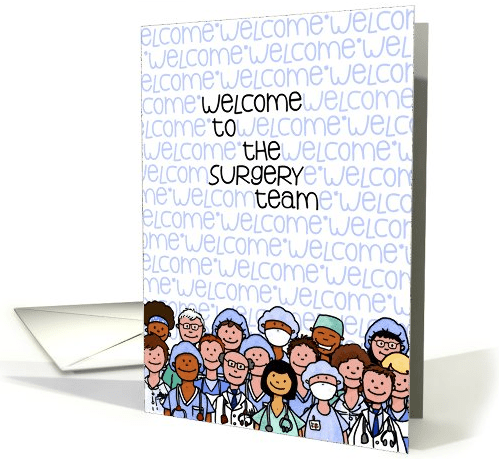
First, use your eyes. What do you see? Illustrated nurses and doctors… welcome to the surgery team…
Good. Now what’s the card for? What’s it’s purpose? To welcome new members to a surgical unit.
Who will likely buy this card? A hospital or clinic.
Let’s put our information together in a sentence.
“An illustration of male and female doctors and nurses with the phrase ‘Welcome to the Surgery Team.'”
That’s the basic description. It’s adequate, but how much better will it be if you add a little more detail? Remember those questions we asked up there? Now we add that information.
“An illustration of male and female doctors and nurses with the phrase ‘Welcome to the Surgery Team.’ Perfect for hospital or clinic to make a new member of the surgical team feel welcome.”
Now what about keywords and buzzwords?
Keywords describe what the card depicts and it’s purpose. I think we’ve hit the mark there. Buzzwords are like tinsel on a Christmas tree – embellishments meant to draw attention. Buzzwords might include words like trendy, modern, fashionable, contemporary, cute, sweet, scrapbook-style, hand drawn, etc.
For this particular card, I don’t really need any buzzwords.
See how simple it is to create a product description?
Let’s try another card, this time by another artist:
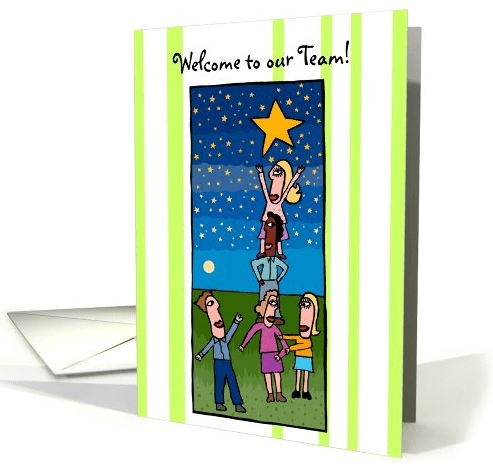
What do you see? Remember what we learned above, just ask yourself the right questions.
“A group of hand drawn men and women reaching for the stars in a night scene on a green striped background.”
There’s the basic information. Let’s add a bit to that, and don’t forget an important buzzword:
“A multicultural group of men and women reaching for the stars in a night scene on a green striped background. Perfect card to welcome a new employee or new hire to your team.”
How easy was that! Anybody can do it. And if you’re really stuck, feel free to submit a card to the Critique Clinic, right here every Friday, Saturday, and Sunday. Just ask, and we’ll help you craft a description that’s sure to draw attention to your creation and help you make sales.
Remember, artists who describe their products get more love from search engines than artists who don’t. Can you afford to do without? I can’t, and I think artists looking for sales can’t, either.
Share this:

Dash of Inspiration: Keep You in Stitches
A Dash of Inspiration, A Cup of Creativity by Doreen
Keep You in Stitches
Stitches can be useful when making greeting cards for babies and kids, as well as for some of the textile hobby categories at GCU. Of course, stitching might also come in handy for some Halloween ghoul imagery and even some get well cards. I thought I’d pass on these great goodies I added to my design toolbox this week.
As always, be sure to read TOU …
Stitch Brush for Photoshop by Boying at MyPhotoshopBrushes.com
Sewing stitches for PSP – by Gothika-Brush.deviantART – There are 10 brushes in all, made with PSP 8
Text in Stitches Photoshop Tutorial
Illustrator Tutorial: How To Make A Stitch Effect by Terry Mahy
For some fun Halloween or Get Well cards
Stitches and Sutures Brushes by Obsidian Dawn
And … just because you enjoyed them, here are a couple more Dingbat fonts for you.
Sports 1 font — by Ouripedes Gallene
Gardening With Sue font by LeChefRene
So, until next week … Learn … Create … Inspire!

card by Rose Byrd


